How long does a taper fade last? Fresh, tidy and grown-out stages
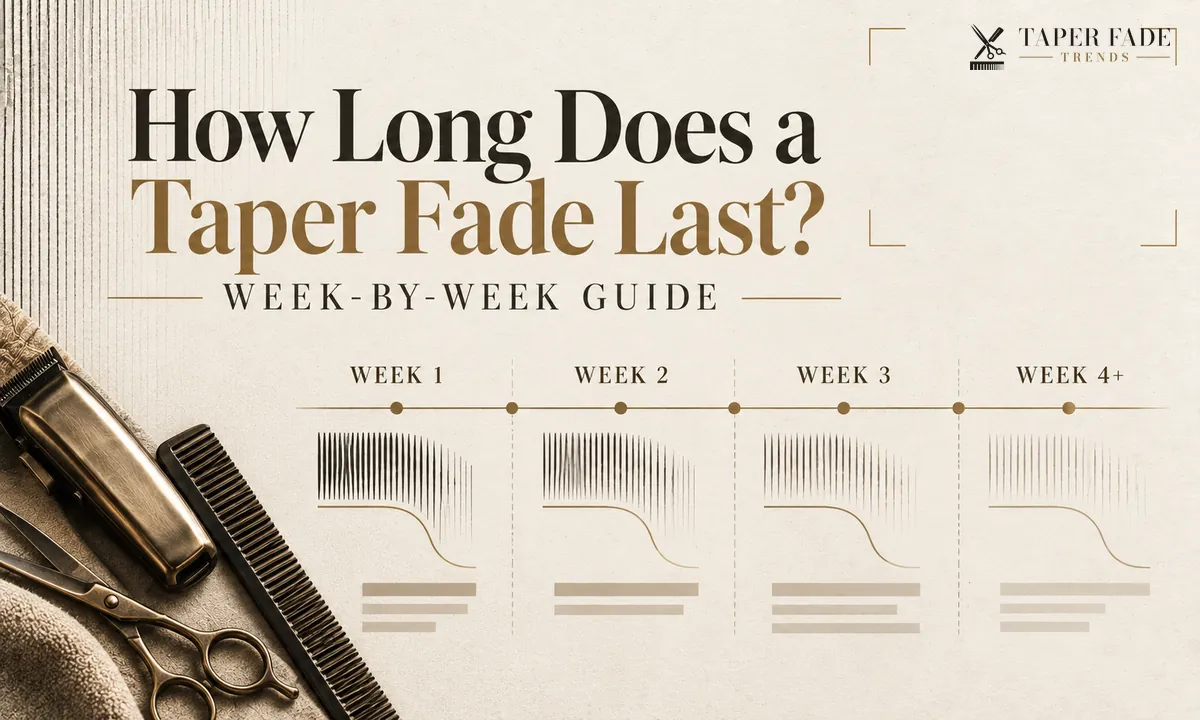
A taper fade usually looks sharpest for one to two weeks and stays tidy for about two to four, but there is no single expiry date. How long a taper fade lasts depends on your shortest finish, how much contrast it has, how fast your hair grows and how crisp you want the edge.
| Question | Working answer |
|---|---|
| Sharpest (fresh) | Often 1 to 2 weeks |
| Still tidy | Often 2 to 4 weeks |
| Grown out | Often weeks 4 to 6; sooner for skin-close or high tapers |
| Check first | The sideburn and temple, then the nape |
| Touch-up when | Only the taper zones or neckline have softened |
| Full haircut when | The top, bulk or overall shape also needs reshaping |
| Shows regrowth sooner | A skin-close finish, high contrast, a strict edge standard |
| Evidence | Published barber and grooming guides, rechecked October 12, 2026; no first-party grow-out record yet |
These ranges describe how a cut looks, not how fast hair grows.
How long a taper fade stays fresh
A taper fade usually stays fresh, meaning the edge and shortest finish still look close to the day of the cut, for about one to two weeks. That is a synthesis of published barber and grooming guides, not a biological deadline, and a shadow finish hides early regrowth better than a skin finish does.
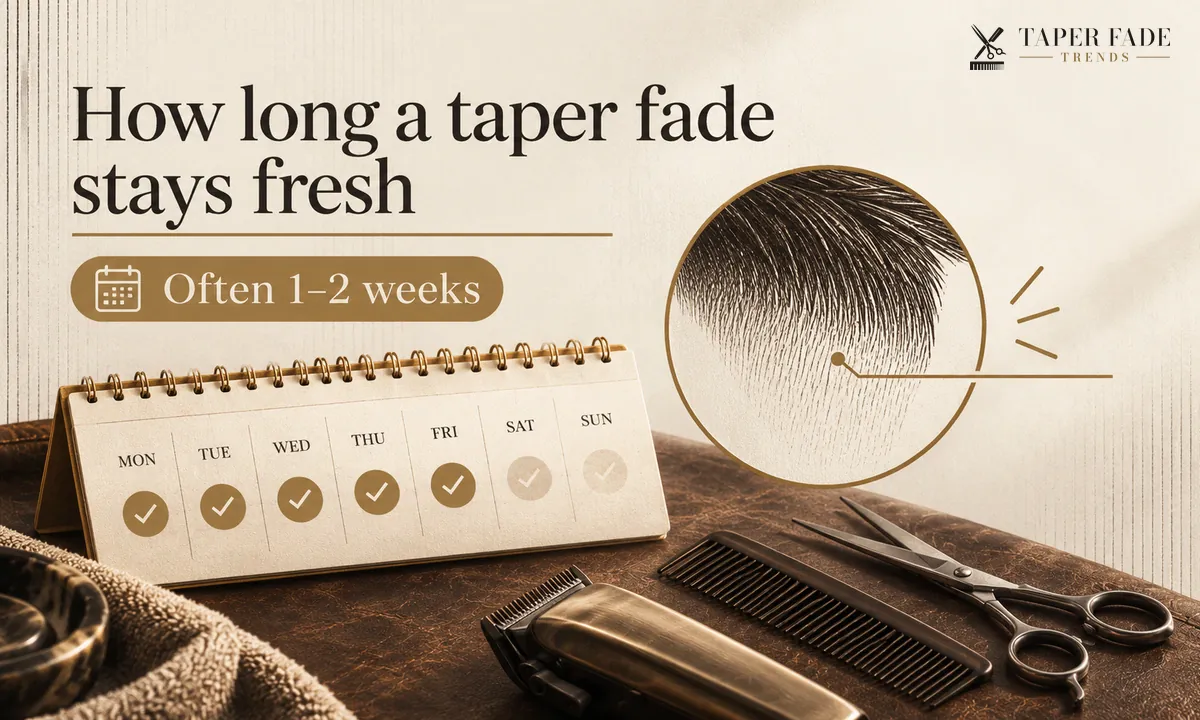
taperfade.co.uk puts peak sharpness at one to two weeks. Former barber Nick Hall, writing for Man of Many, says a taper fade looks its sharpest for the first two weeks, and Haircutopia describes week one as still very close to the original shape.
A taper fade shortens the hair in two zones, the sideburns and temples and the nape, while the rest of the sides keep more length. Height, side coverage, shortest finish and top are separate choices, laid out in what a taper fade is. Shortest finish means what is left at the lowest point: visible hair, a shadow of stubble, or bare skin.
Freshness depends mostly on that finish and on contrast, meaning how sharply the short zone stands out from the hair around it. Your own edge standard matters too. Someone who wants a crisp outline will call a cut grown out days before someone who likes a softer edge.
Fresh, tidy and grown-out: three taper fade stages
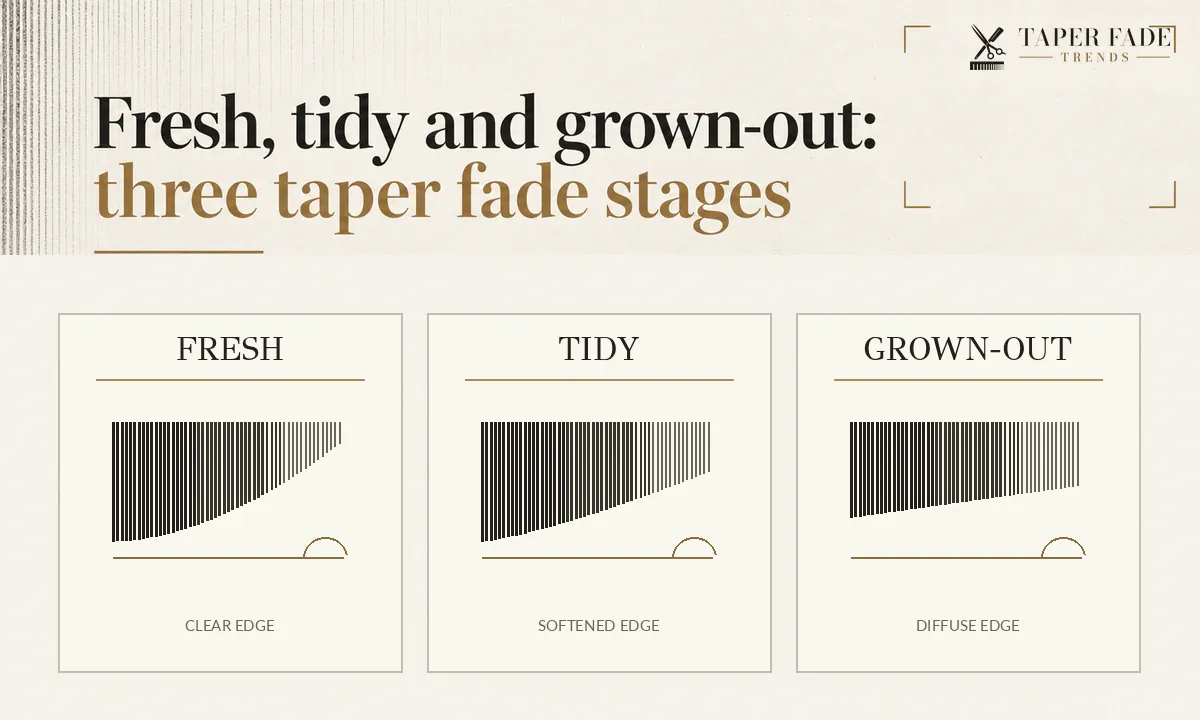
Fresh, tidy and grown-out are working stages this guide uses so the timing question has a usable answer. Fresh means close to the Day 0 reference. Tidy means softened but still intentional. Grown-out means the taper no longer reads as deliberate and the overall shape has slipped, which is when a full haircut helps.
| Stage | What you see | Typical window in guides | Usual service |
|---|---|---|---|
| Fresh | Edge and shortest finish close to your Day 0 photos | Often 1 to 2 weeks | None needed |
| Tidy | Edge softened; the taper still reads as intentional | Often 2 to 4 weeks | Touch-up if you want it crisp again |
| Grown-out | Taper has blended into the sides; top or bulk has lost shape | Often weeks 4 to 6 | Full haircut |
Where published timelines disagree
The guides agree on the order of the stages and disagree on the dates. Joni’s Cuts, a Colorado barbershop, gives a taper fade about three weeks of sharpness, while Barbertainer, a London shop, folds sharp and tidy into one two-to-four-week window.
| Source | Sharpest | Touch-up or tidy limit | Full haircut |
|---|---|---|---|
| taperfade.co.uk | 1 to 2 weeks | Acceptable to about 3 weeks; touch-up every 2 to 3 | Every 3 to 4 weeks |
| Man of Many (Nick Hall) | First 2 weeks | Clean-up every 2 to 3 weeks for mid and high tapers | Not stated |
| Haircutopia | Week 1 close to original | Cleanup around week 3; touch-up by week 4 | Weeks 5 to 6 |
| Treatwell | Not stated | Every 2 to 3 weeks; low tapers 3 to 4 | Not stated |
| Barbertainer | 2 to 4 weeks, one window | Refresh a sharp skin transition after about 2 weeks | Not stated |
| Joni’s Cuts | Days 1 to 21 | Blurs from about day 21; book every 3 to 4 weeks | Grown out at 5 to 6 weeks |
The spread follows the finish. Shorter, higher-contrast tapers sit at the early end of every range, and low, softer tapers sit at the late end. Treat the ranges as a trial window and let your own cut set the date.
What changes week by week in a taper fade
In week one a taper fade looks close to the original; around week two the shortest zones show regrowth; by weeks three and four the edge has softened and a touch-up usually restores it; after that the whole haircut may need reshaping. This timeline is drawn from published guides, not from a timed record of one cut.
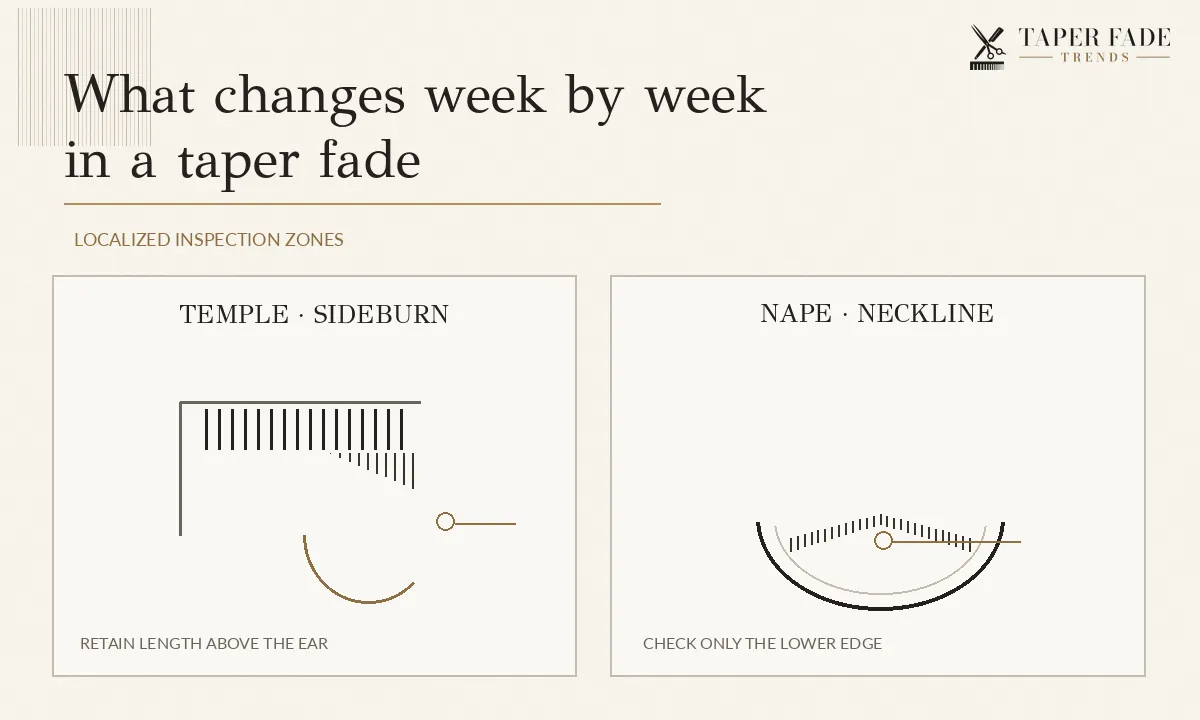
Use the inspection zones below as a checklist, and compare each with the same zone in your own Day 0 photos.
Day 0 to 7: your taper fade reference
After one week, many taper fades still read close to the original shape, though a skin-close finish can already show a little stubble. Judge the sideburn and nape against photos taken on the day of the cut rather than against the calendar, because small changes are easier to see side by side.
Take those photos the day of the cut: front, left profile, right profile and back, at the same distance, in the same light, against the same background. Write down the placement you asked for, the side coverage, the shortest finish, the top length and the date. If you trim anything between check-ins, note it, because a trim resets the comparison.
A photo can’t show the guard, blade or lever setting. Ask the barber what they used and write it down instead of guessing from the picture. How to ask for a taper fade has a short record template for this.
Around week 2: the edge starts to soften
Around two weeks, many taper fades leave their sharpest stage but still look tidy. Look for a softer outline at the sideburn and nape and a taper that stands out less from the sides. If the placement and overall shape still hold, the cut is tidy, and a touch-up is optional.
Haircutopia notes that a skin taper usually shows this growth more clearly than one left slightly darker at the bottom. If you want the edge crisp at all times, this is the earliest point most guides suggest a cleanup.
Weeks 3 to 4: judge the taper, not the calendar
By weeks three and four, the useful question is whether the taper is still tidy. Haircutopia calls week three a common point for a taper cleanup, and taperfade.co.uk puts its touch-up window at two to three weeks. Run three checks before you book, and let the result decide.
- The taper still starts where you asked, at both the sideburn and the nape.
- The edge is softer but still reads as a deliberate line.
- The top and sides still hold the shape they had on Day 0.
Pass all three and the cut is tidy, whatever the date. Fail only the first two and a touch-up fixes it. Fail the third and read on.
After week 4: judge the whole haircut
After about four weeks, several barber and grooming guides place many tapers near a rebooking point, but the haircut should make the call. If the top, sides and neckline have all lost the intended shape, a full haircut does more than an edge-only cleanup. If only the taper has softened, a touch-up still works.
Haircutopia puts weeks five and six in full-haircut territory, and Joni’s Cuts treats a taper as grown out at five to six weeks.
What makes taper fade regrowth show sooner
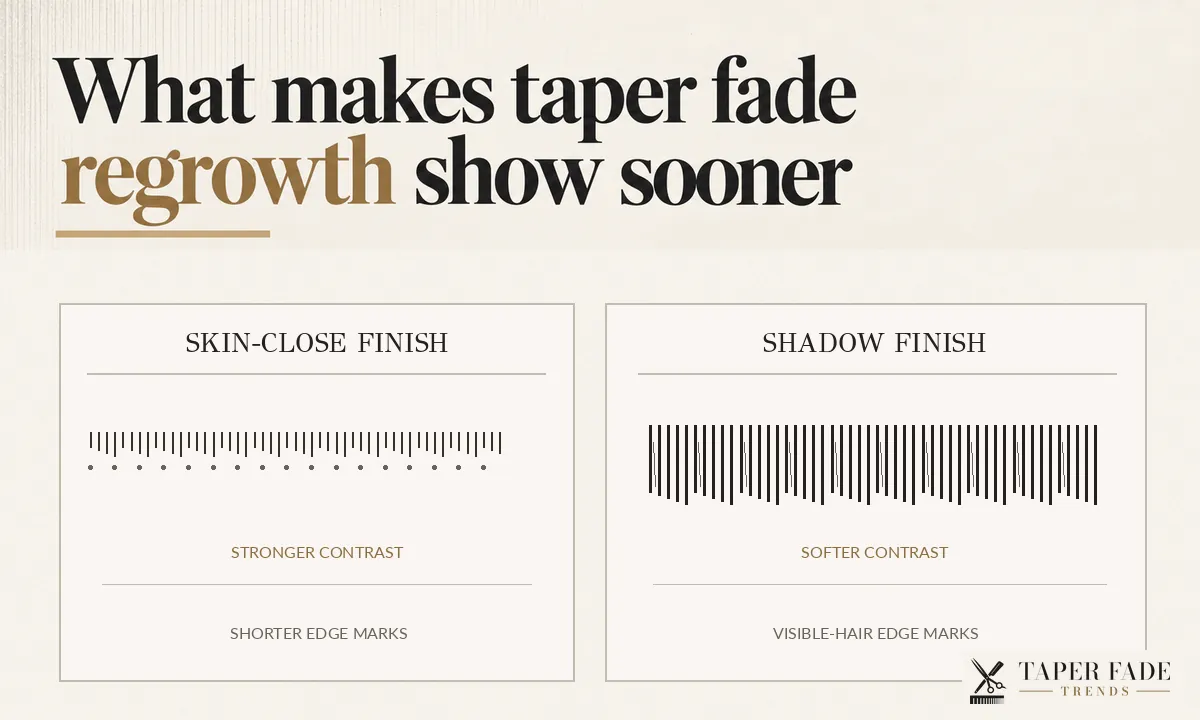
Regrowth shows sooner when the shortest finish is very short, when the taper contrasts strongly with the hair around it, and when you want a crisp outline. A higher taper puts more short hair on show, so guides give it a shorter window, but none of these choices changes how fast hair grows.
| Setting | What it controls | Effect on visible regrowth | Pick it if |
|---|---|---|---|
| Skin-close finish | Bare or nearly bare skin at the lowest point | Shows first, because stubble stands out against skin | You want maximum crispness and accept more visits |
| Shadow or visible-hair finish | Short hair left at the lowest point | Shows later, because there is less contrast to lose | You want a softer edge and longer gaps |
| Higher taper | How far up the short zone reaches | More short area on show, so softening is easier to spot | You want a bolder shape |
| Lower taper | Short work kept near the hairline | Less short area on show; guides give it the longest window | You want the longest gap between visits |
taperfade.co.uk, Treatwell and Haircutopia all give low tapers the longest window and high tapers the shortest. Haircutopia adds the useful caveat: a mid or high taper that stops at a shadow can stay blended longer than one taken to skin. Height and finish are separate settings, so a high taper is not automatically a skin taper. For a height example, see the high taper fade guide.
Does a skin taper grow out faster than a shadow taper?
A skin-close finish makes early regrowth easier to see because new stubble shows against bare skin. A shadow or visible-hair finish starts with less contrast, so the same two or three weeks look less dramatic. That is a difference in how the cut looks, not proof that hair grows faster after a skin taper.
Texture changes how regrowth looks too. Haircutopia and Treatwell note that curly hair can hide some early growth and needs extra length to allow for shrinkage, straight hair at the sides can start to stick out, and fine hair can show scalp through a very short finish. This guide makes no claim that any hair type grows faster.
Touch-up or full haircut?
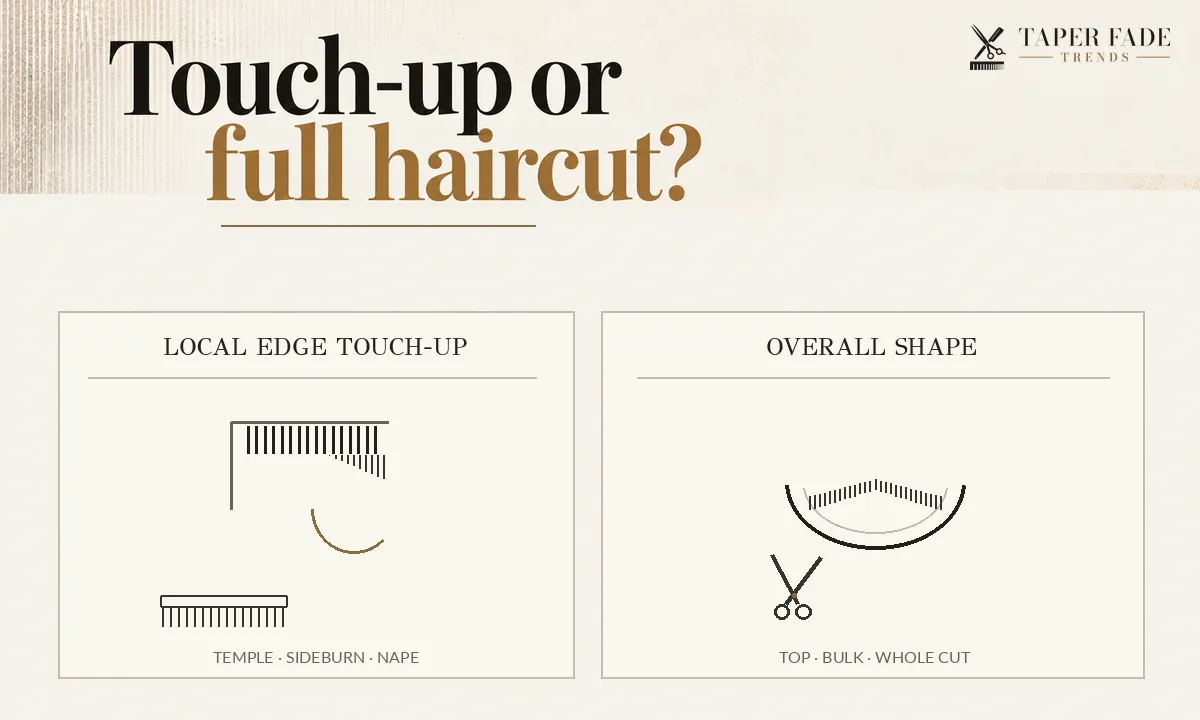
Choose a touch-up when the top and sides still work and only the taper zones or neckline have softened. Choose a full haircut when the bulk, top length or overall shape also needs reshaping. Either way, ask the barber to keep the taper at its original height, because repeated cleanups can creep it upward.
| A touch-up is enough when | A full haircut is the better choice when |
|---|---|
| The top still looks right | The top is too long or heavy to style |
| The sides hold their shape | The sides have gone bulky or stick out |
| Only the sideburns, temples or neckline look soft | The taper has grown into the sides |
| You want the same cut refreshed | You want to change the style |
Haircutopia warns that taking a little more above the existing line at every cleanup gradually raises the taper, until a low taper starts to look like a standard fade. Say the height out loud each time.
A touch-up request can be this short: “A touch-up today, not a full cut. Keep the taper at the same height as this photo, keep the shortest finish where it was, refresh the sideburns and neckline, and leave the top and the bulk alone.”
Bring your Day 0 side and back photos so the barber can match height and finish. Describe the result and let the barber choose the guard, blade and lever. For wording that covers a full cut, use the five-part brief in how to ask for a taper fade.
Plan appointments around your own baseline
Set your rebooking interval from your own cut, not from a population average. Start with two to four weeks as a trial window, photograph the same four views at each check-in, and note when the taper stops looking fresh and when it stops looking tidy. After two cycles, book around the point you observed.

- Take a Day 0 set on the day of the cut, using the four views and setup above.
- Check in weekly with the same four views and note which stage you judge it to be in.
- Mark the day it stops looking fresh to you and the day it stops looking tidy.
- Repeat for a second cut.
- Book at your tidy limit, or at your fresh limit if you want the edge crisp.
Haircutopia makes the same point: after two or three cycles, most people know when their taper starts to bother them. This is a tracking method, not a test, and it measures your standard as much as your hair.
Need the cut at its sharpest for a wedding or an interview? Haircutopia suggests booking one to three days before, which leaves time to wash and style it once yourself.
How often should you book a taper fade?
Most published guides land on every two to three weeks for a crisp taper fade and three to four weeks for a relaxed one, with skin and high tapers at the short end. Use that as the trial window above, then book around the fresh-to-tidy point your own two cycles show.
How to budget for taper fade upkeep
Budget from your own barber’s prices and your own interval. Divide 52 by your interval in weeks to get visits per year, then multiply by the price. A three-week interval works out to about 17 visits a year. Price touch-ups and full haircuts separately if your barber charges differently.
| Worksheet line | Your figure |
|---|---|
| Interval in weeks | |
| Visits per year (52 ÷ interval) | |
| Touch-up price | |
| Full-haircut price | |
| Touch-up visits per year | |
| Full-haircut visits per year | |
| Yearly total (each visit count × its price, added) |
If cost is the constraint, ask whether your shop offers a lower-priced cleanup between full appointments, as Haircutopia suggests. A shadow finish and a lower taper also stretch the interval.
Keep the look between visits
Between visits, style the top and keep the edges clean, but leave the blend to the barber. Haircutopia and Treatwell both draw the same line: tidying stray hair below the neckline is the most they suggest doing at home, because re-fading the taper yourself tends to leave lines, patches or a higher taper.

The top sets how the cut looks from the front, so a well-styled top keeps a softening taper looking deliberate for longer. This guide names no products; ask your barber what suits your hair. At each weekly check, look at the neckline as well as the sideburns, since it is the other edge that shows growth first.
Limits and what a photo cannot tell you
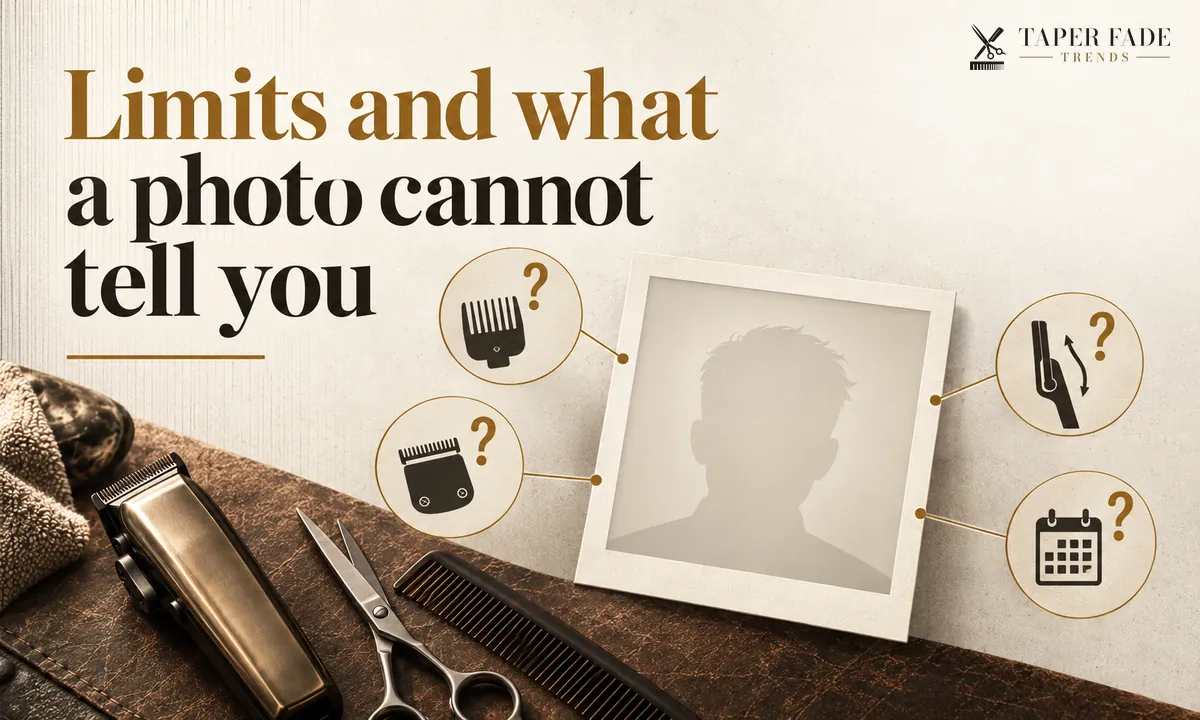
This guide gives working ranges, not a guarantee. A photo cannot show the guard, blade or lever used, how long ago the cut was done, or how fast your hair grows, and this page gives no growth rate by hair type and no national price, because no measured source supports either.
A taper fade suits someone willing to check the edge every week or two and describe the placement they want. If you want an outline that holds for six weeks without attention, a longer, softer cut is the more honest choice. Still deciding between the two cuts? Taper vs fade compares them.
How this guide was researched
Taper Fade Trends Editorial prepared this guide to help readers decide when a taper fade still looks fresh, when a touch-up is enough and when the whole haircut needs reshaping. We compared published timelines from barbershops, a former barber and grooming publishers, kept their disagreements visible, and rechecked every cited page on October 12, 2026.

Fresh, tidy and grown-out are working stages defined here, not industry terms. No first-party grow-out record appears on this page. The figures are illustrations, and no result on this page is observed. When a dated, consented Day 0, 7, 14 and 28 record of one cut is available, it will be added with its starting specification. No barber has reviewed this version yet; when one does, their name, role and review date will go here.
Found an error? Contact us or read the editorial policy for how corrections are made and dated.
Sources cited in this guide:
- How Long Does a Taper Fade Last?, taperfade.co.uk, Prince Nawaz, January 22, 2026. Fresh window, one-week check, touch-up and full-haircut intervals.
- Taper Fade Maintenance Schedule, Haircutopia, Vanessa Harper, August 17, 2026. Week-by-week changes, touch-up or full haircut, taper height creep, event timing.
- 7 Best Taper Fade Haircuts for Men, Man of Many, Nick Hall, updated June 1, 2026. Sharpest first two weeks, clean-up interval.
- Taper fade: your essential guide, Treatwell, May 19, 2026. Intervals by taper height, texture notes, home tidying limit.
- How Long Does a Taper Fade Last? The Hard Truth, Barbertainer, June 9, 2025. Two-to-four-week window.
- How to Maintain Your Fade, Joni’s Cuts, April 1, 2026. Stage timing and booking interval for a taper.
- Acne keloidalis nuchae: Causes, American Academy of Dermatology. Nape irritation note.
- Taper fade visual guide, Taper Fade Trends. Placement and shortest-finish terms.
Next: re-specify your next cut
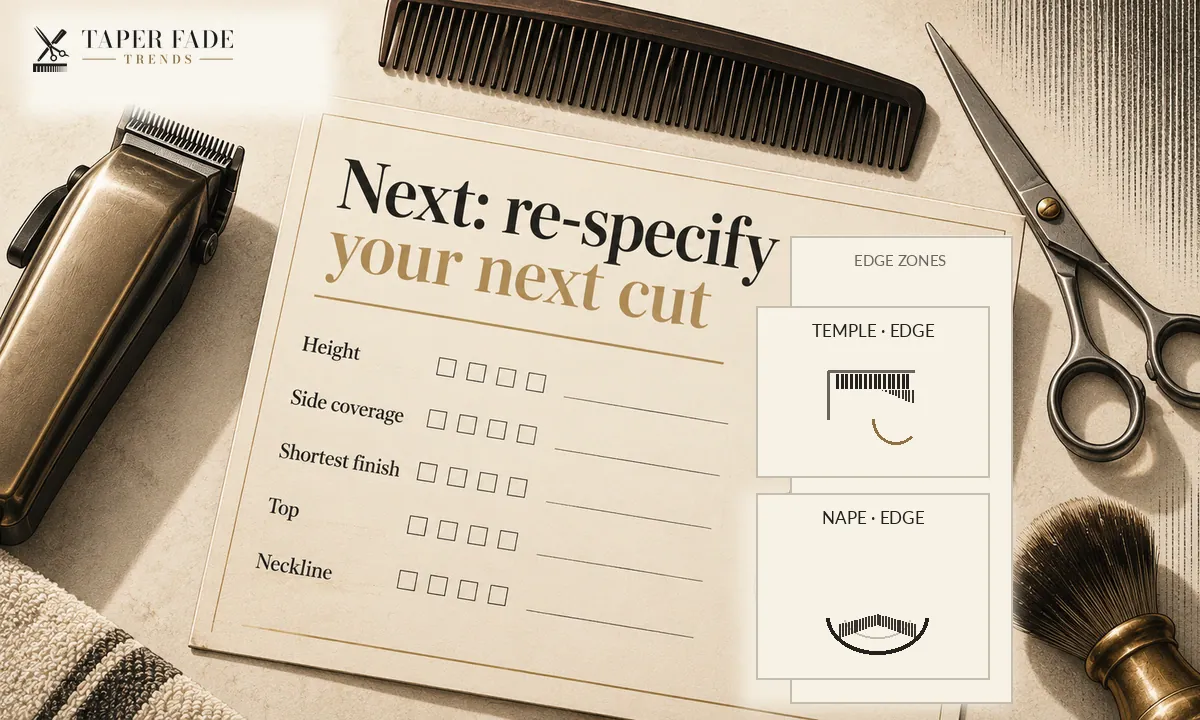
Take a Day 0 set on the day of your next cut and note when it stops looking fresh to you. When you rebook, use the main taper fade guide to re-specify height, coverage and shortest finish.
Keep reading
All guides
How to maintain a taper fade between haircuts
How to maintain a taper fade between haircuts: what is safe at home, where to stop before the blend, and when to book a cleanup or a full cut.

Taper fade: a visual guide to heights, finishes and top styles
Where a taper fade sits from the front, side and back, how low, mid and high differ, and how to ask for side coverage and a finish with or without skin.

Taper vs fade: what changes in area, finish and side weight
Taper vs fade compared by coverage, height, shortest finish and side weight, with a back-view check and word-for-word barber scripts for either cut.

High taper fade: placement, finish and barber brief
Where a high taper fade sits, how much side weight stays, skin vs shadow finishes, what the back should look like, and exactly what to tell your barber.
How to ask for a taper fade: a five-part barber brief
How to ask for a taper fade: say where it may reach, how short the base goes, how much side weight stays and what to do on top, then check the plan first.
More in barber brief and upkeep
Barber brief and upkeep: all 4- How to ask for a taper fade: a five-part barber brief9 min
- Haircut numbers: clipper guard sizes in millimeters and inches10 min
- How to maintain a taper fade between haircuts11 min
- How long does a taper fade last? Fresh, tidy and grown-out stagesYou are here