Taper fade: a visual guide to heights, finishes and top styles
A taper fade shortens the hair closest to the skin in two places, the sideburns and temples and the nape, while the rest of the sides and back keep more length than a full fade. You choose its height, side coverage, shortest finish and top separately, then confirm all four with side and back references before the clippers start.
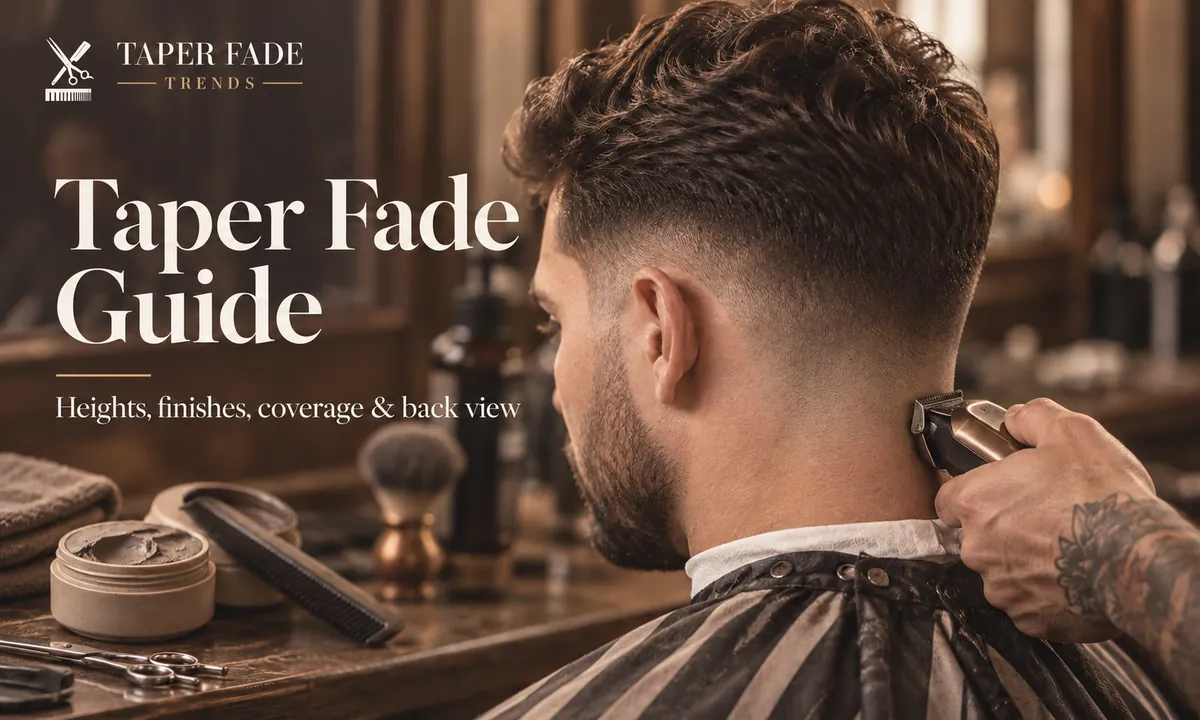
What is a taper fade?
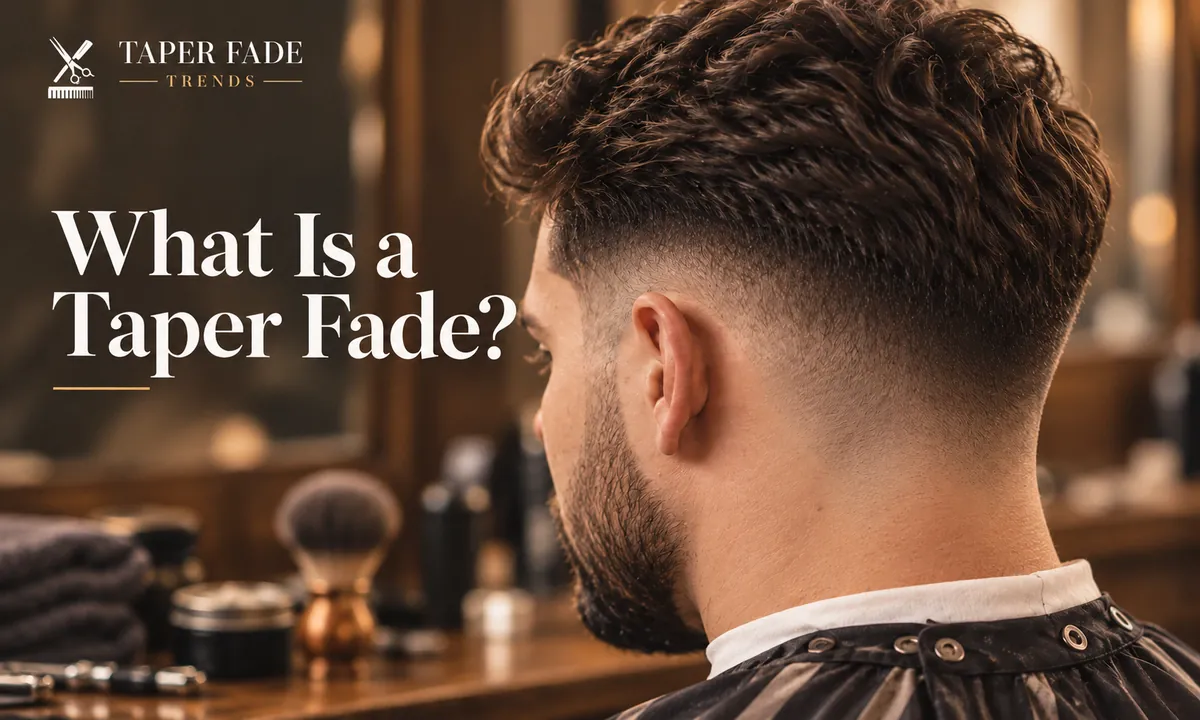
A taper fade is a haircut that blends very short hair at the sideburns, temples and nape into fuller sides, a fuller back and whatever top you choose. The term describes the edges of the cut, not the top. Barbers don’t agree on whether it must end in bare skin, so the shortest finish is something you name.
| What you decide | What it means |
|---|---|
| Location | The sideburns and temples, plus the nape: the two zones cut shortest |
| Height | Low, mid or high: how far up the short blend reaches |
| Side coverage | How much of the side and back is taken short, from a narrow edge to a wider wraparound |
| Shortest finish | Visible hair, a shadow of stubble, or bare skin at the lowest point |
| Top | Crop, fringe, quiff, curls, afro, braids, locs or a longer swept top |
| Reference views | Front, left profile, right profile and back |
Nearly every source describes the shape the same way. They disagree about how short the bottom goes.
- CADMEN Academy, a barber school, defines a taper fade as blending down to skin or near-skin at the neckline and temples.
- FashionBeans also describes the cut running right down to a skin fade.
- Treatwell says the opposite: the hair is closely clipped but not fully shaved, and that is what separates it from a skin fade.
- Former barber Nick Hall, writing for Man of Many, lands in between: a taper fade doesn’t necessarily go all the way to skin.
Shops use all of these meanings, so treat the finish as its own request.
Where the taper sits: front, side and back
A taper fade changes two edge zones: the sideburn and temple area, which you see in profile, and the nape, which you only see from behind. Most of the side panel between them stays fuller. One side photo can’t show how far up the back blend climbs, so a rear reference matters as much as a profile.
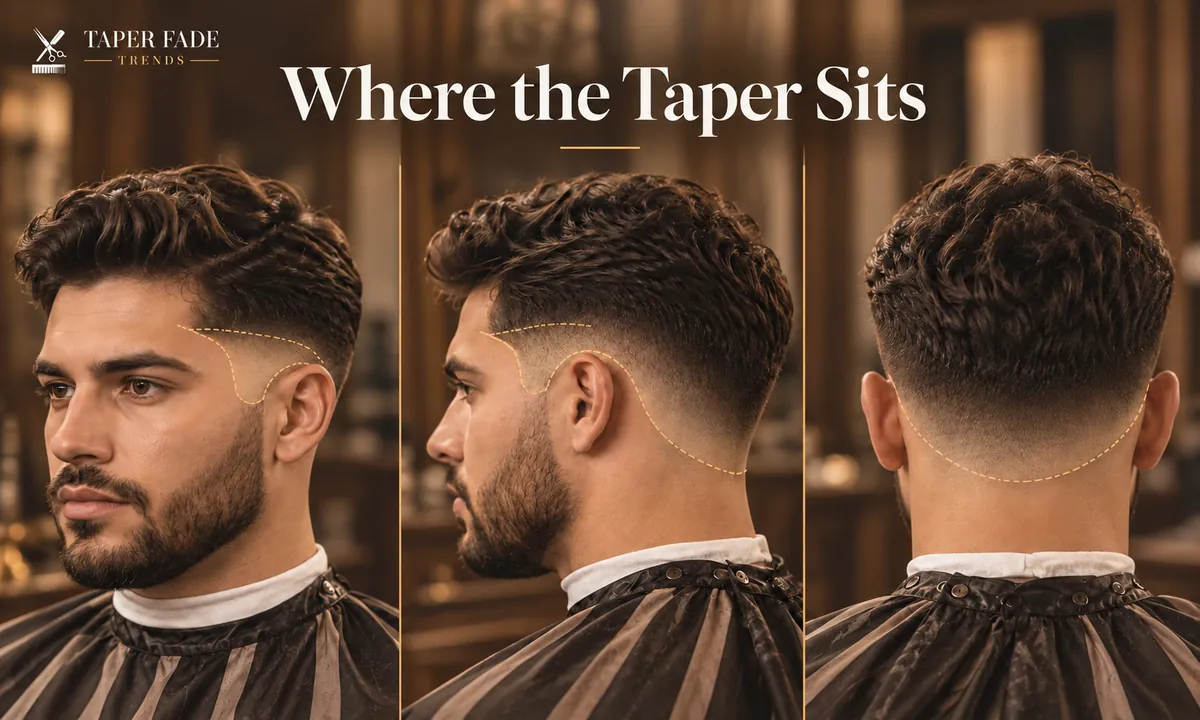
What a side view shows
In profile, look at two things: how high the short blend rises above the ear, and how much side hair is left above it. Hall calls that boundary the blend point and says moving it changes the whole feel of the cut. It is also the easiest thing to point to in a photo, so point to it instead of describing it.
What the back view shows
The nape is where the back blend meets your natural neckline, and you can’t see it without a hand mirror. Hall tells readers to bring a back shot as well as a profile, because a good taper fade and a regrettable one usually differ around the ears and neckline. His rule of thumb: the back matches the sides, so a low taper at the sideburns gets a low taper at the nape, unless you deliberately want the back left long.
Choose height, coverage, finish and top separately
A taper fade request comes down to four choices:
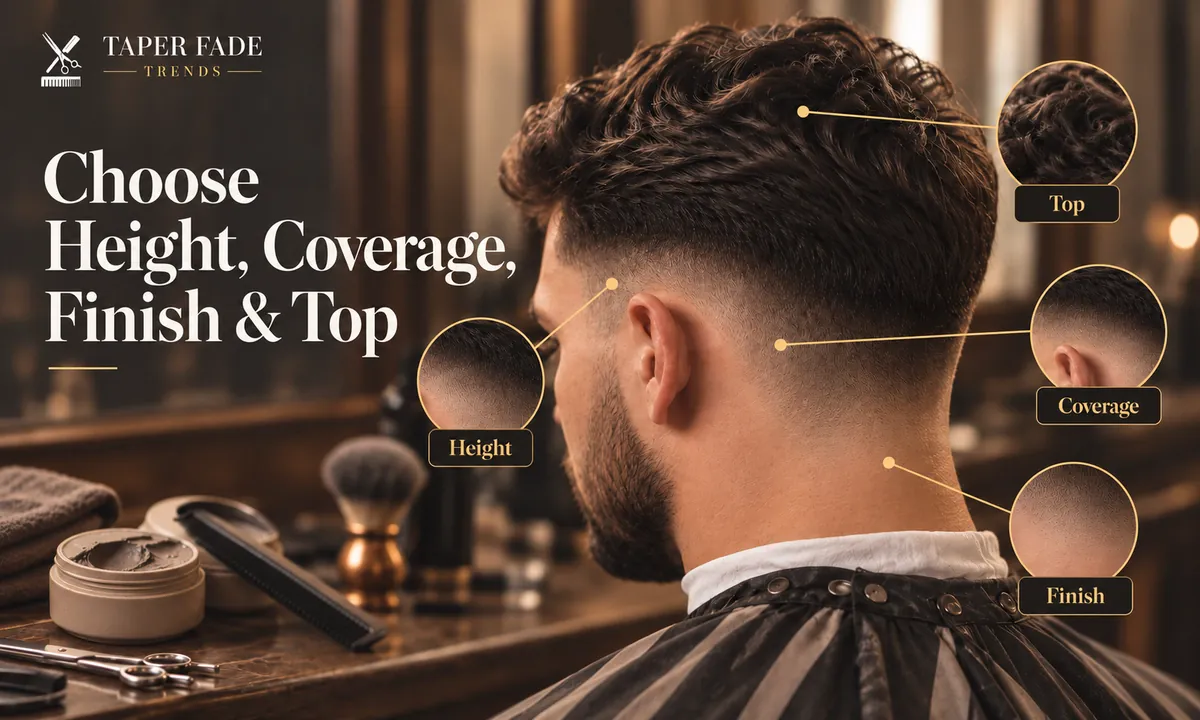
- How high the short blend rises.
- How much of the side and back it covers.
- What’s left at the lowest point.
- How the top is cut.
None of them decides another. A low taper can still end in bare skin, and a high one can stop at visible hair.
Side coverage is the one people forget. Two cuts can start at the same point above the ear, but one keeps the short work to a thin edge while the other wraps it wider around the head and removes more side weight. GQ Middle East’s guide makes the same split for finish: know your fade height, and separately know whether you want skin or a shadow.
| Shortest finish | What’s left at the lowest point | Words you may hear |
|---|---|---|
| Visible hair | A short but clearly visible length, usually cut with a guard | “No skin,” “leave some hair” |
| Close stubble | A faint layer of stubble over the scalp | “Shadow” |
| Bare skin | Scalp showing at the bottom of the blend | “Skin,” “down to skin” |
Low, mid and high taper fades at a glance
Low, mid and high describe where the short blend reaches relative to your ear and temple, not a guard number or a measurement. A low taper fade stays near the ear and neckline, a mid taper fade rises toward the temple, and a high taper fade climbs highest and takes off the most side weight.
Sources don’t even agree on the landmarks. Treatwell puts a mid taper at temple level, CADMEN says it starts at about the temples, and Hall describes one starting roughly an inch above the ears. None of them ties a height to a guard number. Point to the spot on the diagram, or on your own head, rather than trusting the word. Each height has its own guide: low taper fade, mid taper fade and high taper fade.
Can a taper fade stop above skin?
Yes. You can ask for a taper fade that leaves visible hair or a shadow of stubble at its lowest point. Whether the name alone implies bare skin depends on the shop, so say “no skin,” “shadow” or “down to skin” before the barber sets the bottom guideline.
Shortest finish means the actual hair or scalp left at the lowest point. “Skin” means bare scalp, not just a very short guard. A skin fade names the finish; it says nothing about how high the blend goes. Some shops treat the difference as a separate service. The Spot Barbershop in Miami cuts its taper fade with a half guard or longer and charges less for it than for its skin fade, because skin needs blade work.
Once placement and finish are settled, the top and the amount of side weight decide how the cut looks on you.
Examples by hair texture and top style
A taper fade works under a crop, fringe, quiff, curls, an afro, braids, locs or a longer swept top, because the short work stays at the edges. Your growth direction, density and styling routine decide the top, not a face-shape rule. A photo of different hair shows the taper’s shape but can’t promise your result.
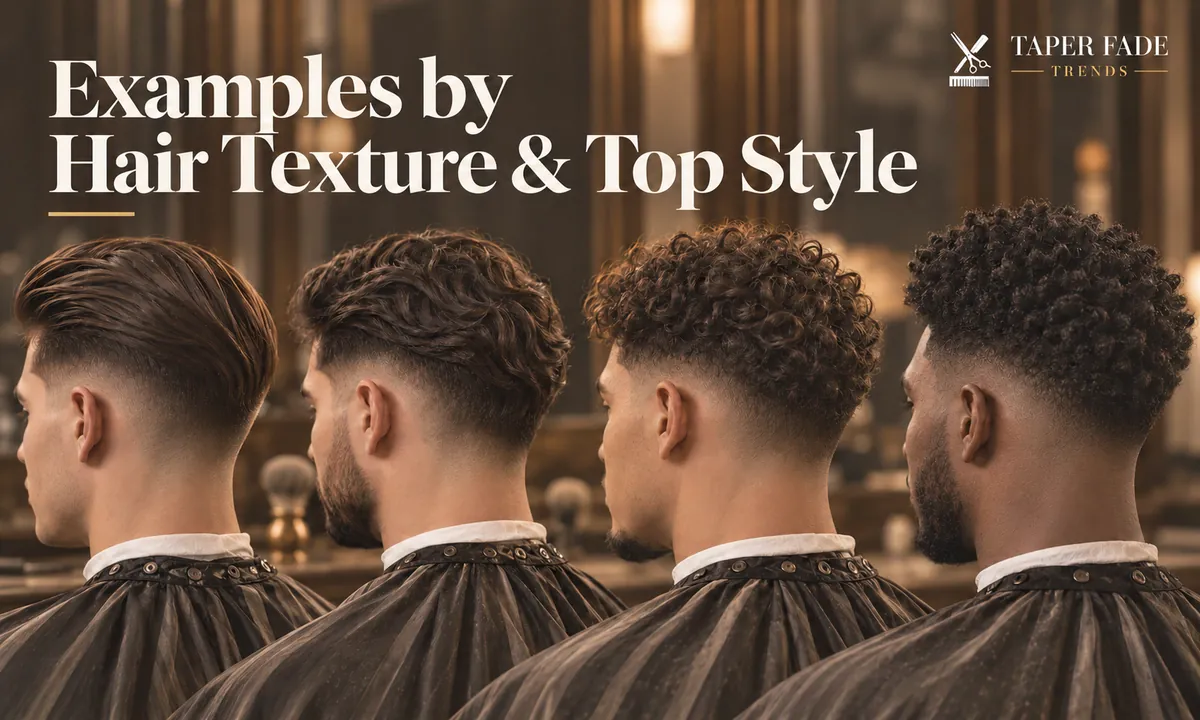
Texture changes how the same cut reads.
- Straight hair gives the most predictable result.
- Fine straight hair shows every uneven pass, and scalp can show through a very short side, so a longer, more gradual blend helps.
- Curly and coily hair shrinks after it’s cut, sometimes a lot, which is why Treatwell advises slightly longer guard sizes for curly hair.
- Growth direction decides which way a fringe or quiff wants to fall, so mention any cowlick instead of expecting the barber to read it from a photo.
| Top | Works best with | Upkeep note |
|---|---|---|
| Crop or fringe | Straight to wavy hair | A comb and a little matte paste usually cover it |
| Quiff or pompadour | Enough length and density on top to hold lift | Product and a blow-dry most mornings |
| Curls | Any taper height; curl pattern is separate from the finish | Leave extra length on top for shrinkage |
| Afro | Tight curls and coils | Pick a barber with real Afro-hair experience; the top shape is its own trim |
| Braids or locs | Any length on top | The taper runs on its own touch-up schedule, separate from the braids or locs |
| Longer swept top | Straight or wavy hair with length to sweep | A lower, narrower taper keeps more side length to blend into |
For curls under a high taper specifically, see high taper fade on curly hair.
How to choose yours without losing side fullness
To keep your sides full, ask for the closest work only at the sideburns and nape, with narrow side coverage and a lower height. Name the highest point you’ll accept and the shortest finish together. If your sides are already clipped short, fullness comes back through grow-out, not the next cut.
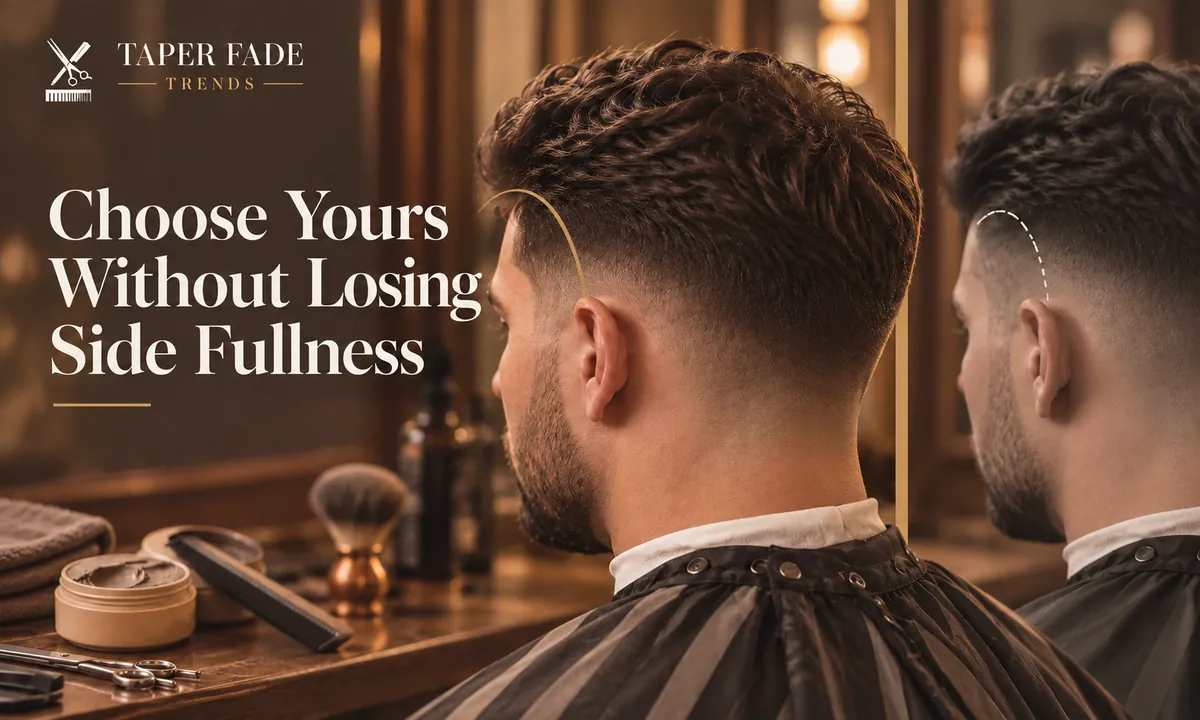
| If you want… | Ask for… |
|---|---|
| Full sides | Narrow coverage, a low height, and visible hair or a shadow at the finish |
| More contrast | Wider coverage, a mid or high height, and a closer finish |
| No bare skin at all | The finish named directly, whatever the height, before the clippers start |
| Less daily styling | Narrow coverage with a shorter top, such as a crop |
If you’re unsure, start low. Hall’s point is simple: a barber can always take a taper higher on the next pass, but can’t put hair back. Before any cutting, repeat the height, coverage and finish back in your own words. Saying “no skin” early is a finish request, and a good barber will hear it that way.
Taper fade versus classic taper and full fade
All three use the same tools. What differs is how much of the side and back gets shortened and how low the shortest point goes.
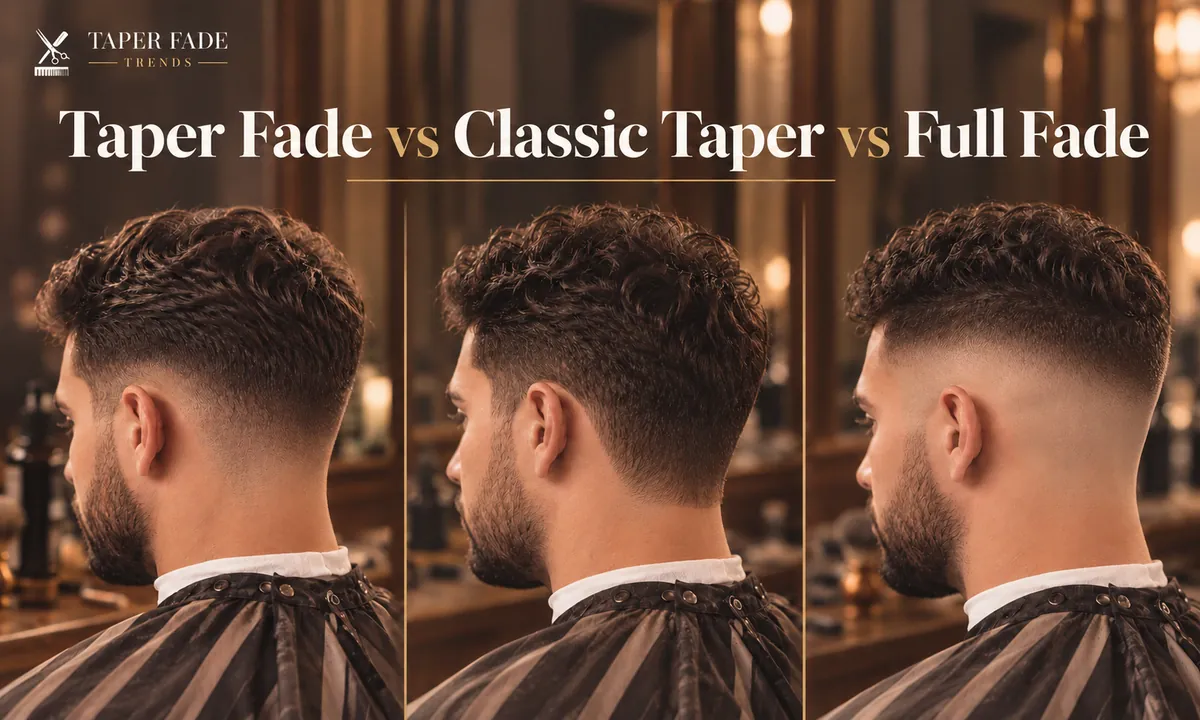
- A classic taper cleans the edges gradually and keeps visible length.
- A taper fade concentrates very short work at the sideburns and nape.
- A full fade takes the sides and back short all the way around.
| Area shortened | Typical shortest point | Side weight kept | |
|---|---|---|---|
| Classic taper | The perimeter, gradually | Visible hair ending in a defined line | Most |
| Taper fade | Sideburns, temples and nape | Hair, shadow or skin, by request | More than a full fade |
| Full fade | The sides and back all the way around | Usually skin | Least |
The labels blur at the edges. A taper fade with wide coverage can look close to a full fade, and some barbers call any clean perimeter a taper. When the words overlap, the photo decides. The full comparison is in taper vs fade.
What to tell your barber
Tell the barber the height, where the shortest area should and shouldn’t reach, whether it ends in hair, a shadow or skin, and how much length stays on top. Show a side and a back reference, then ask them to repeat those four choices back before they start.
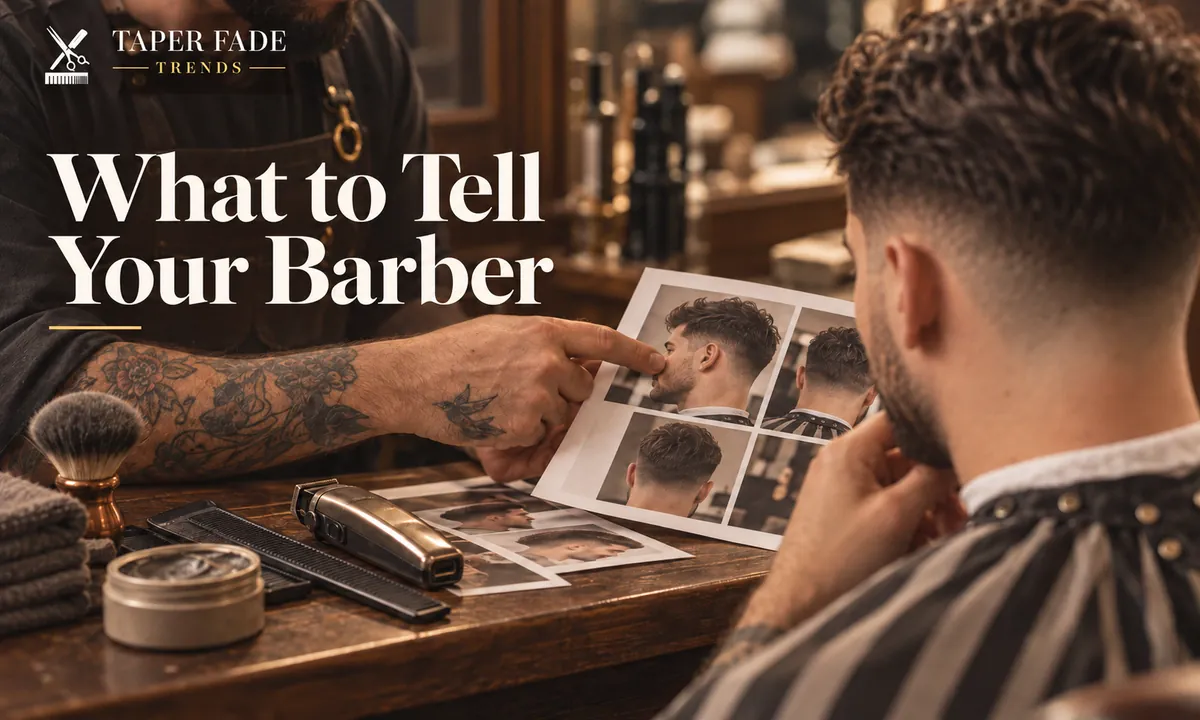
Bring four references if you can: front, left profile, right profile and back.
Guard numbers come up once those choices are set, and they aren’t universal. On Wahl’s guide-comb chart, a #1 is 1/8 inch and a #2 is 1/4 inch. That’s one manufacturer’s marking. Wahl also notes that its clippers’ taper lever moves the cut closer or longer between guard sizes, so the same number can land at different lengths.
Wahl guide comb; other brands and lever settings vary
Wahl guide comb; other brands and lever settings vary
For wording that fits different shops, see how to ask for a taper fade. For the full guard chart, see haircut numbers.
What to check in the mirror
Before you leave, check both sideburns, the area behind each ear and the neckline in good light, with a hand mirror for the back. Confirm the agreed height, how full the sides still look, and whether the lowest point reads as hair, shadow or skin. If one side looks different, try another angle before assuming a mistake, then ask.
A reference gets you the same cut once. Keeping it looking that way depends on how close the finish was.
Styling and upkeep depend on the finish
Daily styling time depends on the top: a short crop needs little more than a comb, while a quiff needs product and a blow-dry. How soon the taper itself needs a cleanup depends on how close the finish is, how fast your hair grows and how crisp you want the edge.
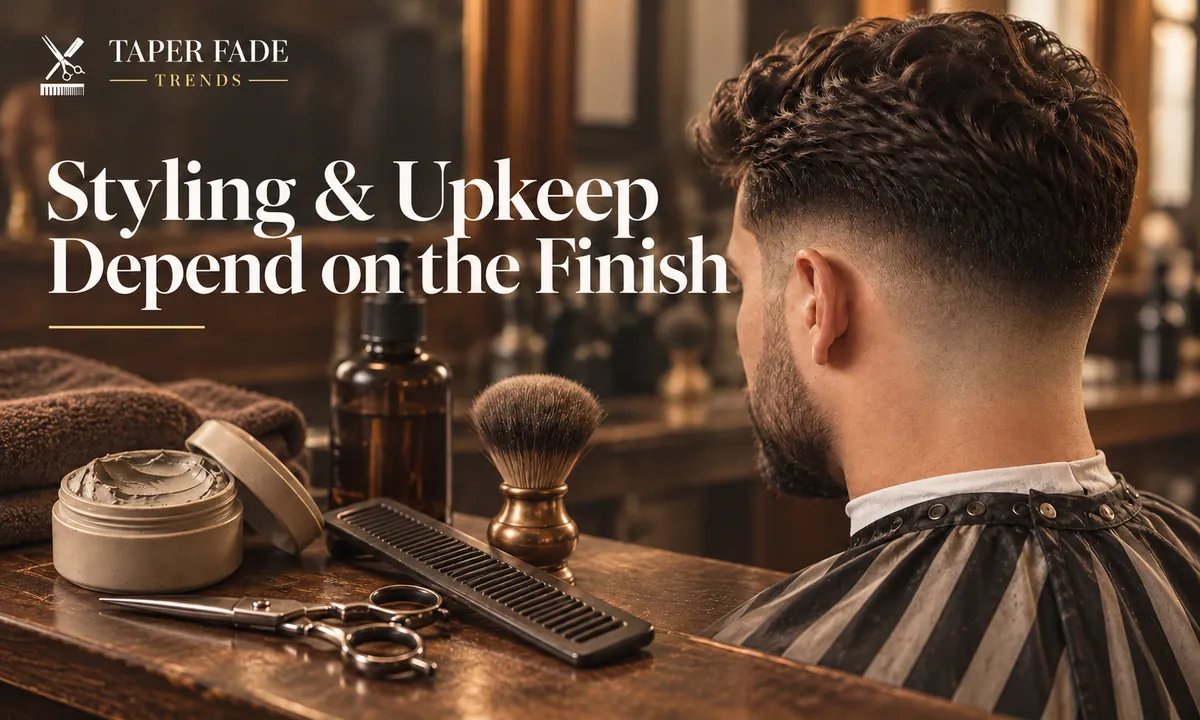
Published intervals cluster between two and four weeks.
- CADMEN gives two to four weeks.
- Treatwell and Hall both suggest two to three.
- CADMEN adds that a high skin finish can show regrowth within 10 to 14 days, while a lower, longer finish stays clean for three to four weeks.
Treat these as rules of thumb from people who cut hair, not a timetable. A shadow or visible-hair finish blurs more slowly than skin. Hall also argues that a tapered neckline grows out more naturally than a squared-off one. For care between visits, see how to maintain a taper fade.
A skin finish also brings a skin question. The American Academy of Dermatology explains that when a razor cuts coarse, curly hair very short, the hair can curve back into the skin and cause razor bumps. Its guidance is written for the beard and includes avoiding a very close shave.
Separately, the AAD says bumps on the back of the neck or scalp that look like acne or razor bumps may be acne keloidalis nuchae. The condition is most common in Black men and can scar without treatment. The AAD advises seeing a board-certified dermatologist when you notice these bumps. This is general information, not a diagnosis.
What photos and terminology cannot tell you
A reference photo shows placement and roughly how close the finish is. It can’t show density, growth direction, how long ago the cut was done, the guard or lever setting used, or what lighting and filters did to the edge.
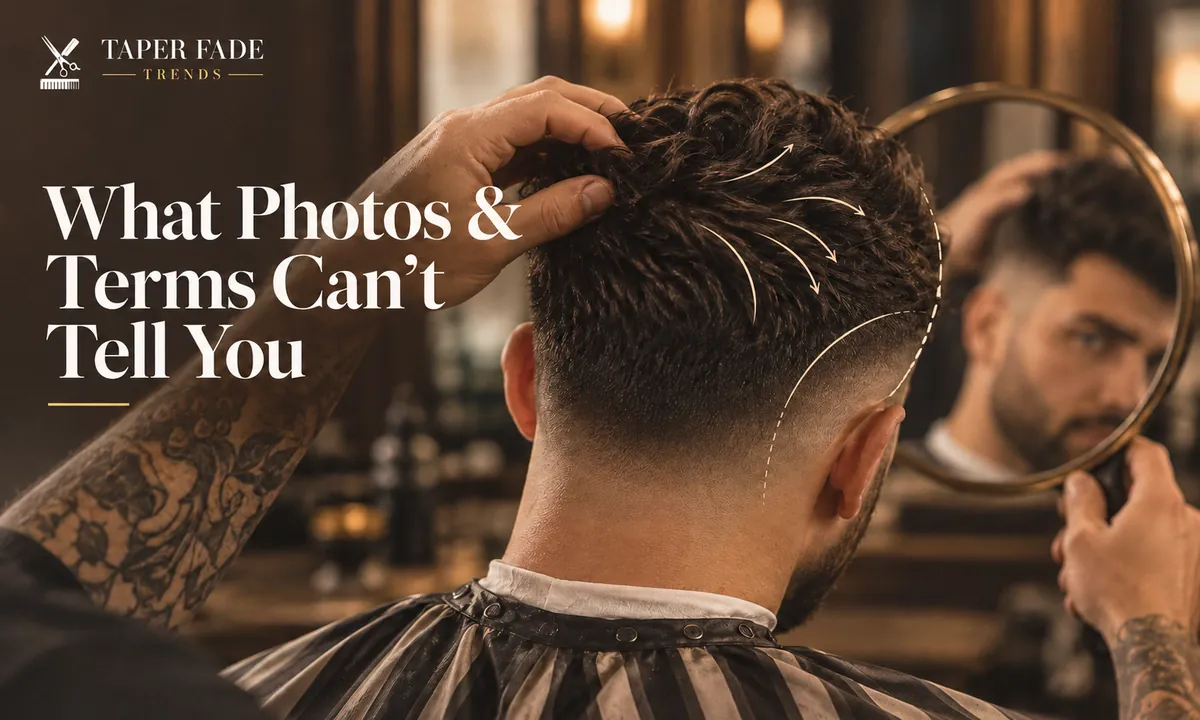
| What a photo hides | Why it matters |
|---|---|
| Density | The same guard reads fuller on thick hair and thinner on fine hair |
| Growth direction | It decides where a fringe or quiff sits |
| Days since the cut | Day one looks sharper than day ten |
| Guard, lever or blade | None of these can be read from a picture |
| Curl shrinkage | Dry curls sit much shorter than their stretched length |
| Lighting, filters and angle | They can sharpen or soften how an edge looks |
The word has the same limit. Two shops can mean different heights and finishes by “taper fade,” so your four choices and a shared photo do more work than the name.
How this guide was checked
Taper Fade Trends built this guide by comparing explanations from four kinds of source: a barber school, a former barber, a working barbershop and grooming publishers. We kept height, side coverage and shortest finish as separate choices, and checked each guard length against the manufacturer that publishes it. Where sources disagree, the page says so instead of picking a winner.
The accompanying images are AI-generated editorial visualizations or project-supplied reference imagery, not documented before-and-after results or verified client case studies. No barber has reviewed this version yet; when one does, their name, role and review date will be added here.
Sources: CADMEN Academy, Man of Many (Nick Hall), Treatwell, FashionBeans, GQ Middle East, The Spot Barbershop, Wahl USA and the American Academy of Dermatology, each linked where it is cited above.
Published and last checked September 25, 2026. Found an error? Our editorial policy explains how corrections are made and dated, or you can contact us.
Find the next guide for your taper
Write down your four choices (height, coverage, shortest finish and top) and save a side and a back reference on your phone. Then open the guide for the height you picked: low taper fade, mid taper fade or high taper fade. If you want the short work to curve around the ear instead, the burst fade guide covers that shape. Confirm the shortest finish at the chair before anything else.
Keep reading
All guides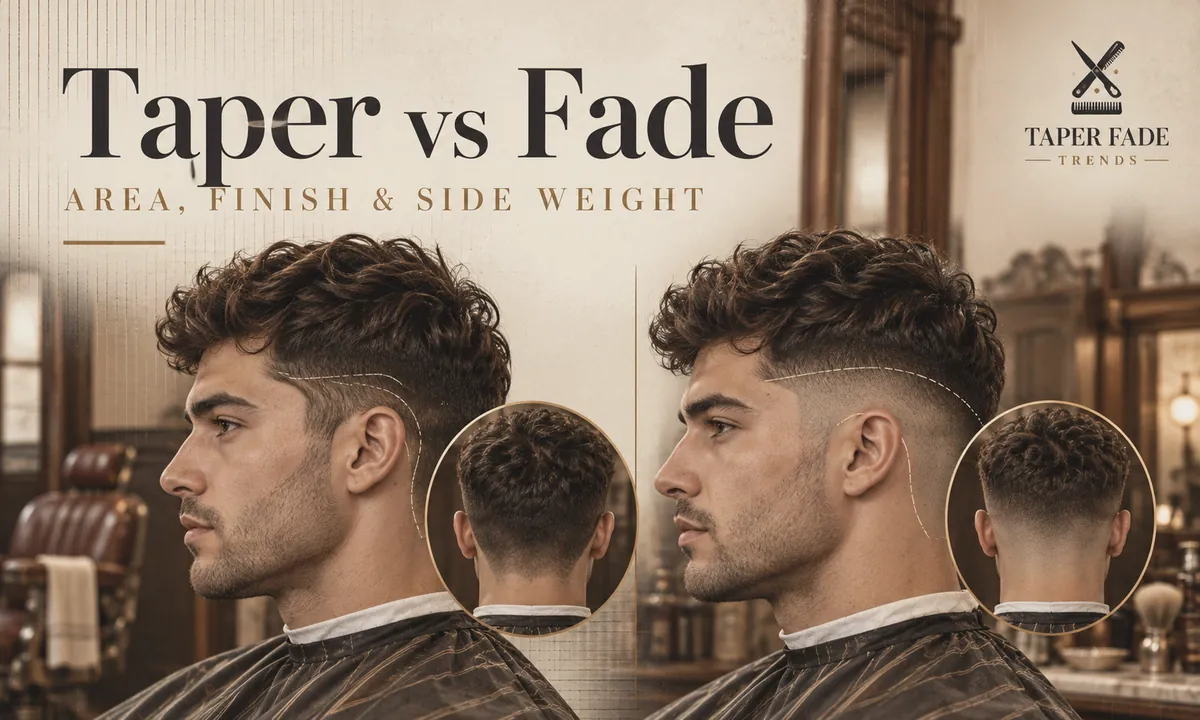
Taper vs fade: what changes in area, finish and side weight
Taper vs fade compared by coverage, height, shortest finish and side weight, with a back-view check and word-for-word barber scripts for either cut.
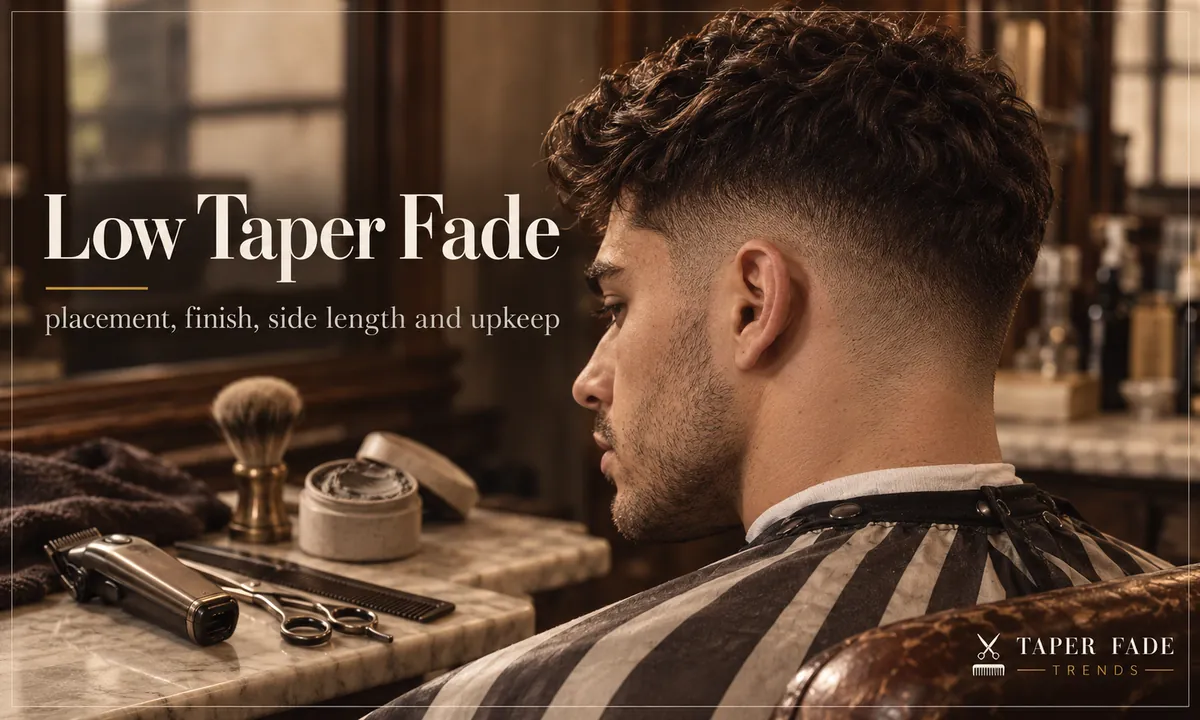
Low taper fade: placement, finish, side length and upkeep
A low taper fade shortens the sideburns and nape and keeps the sides full. See the four choices to make, whether it can go to skin, and what to say.
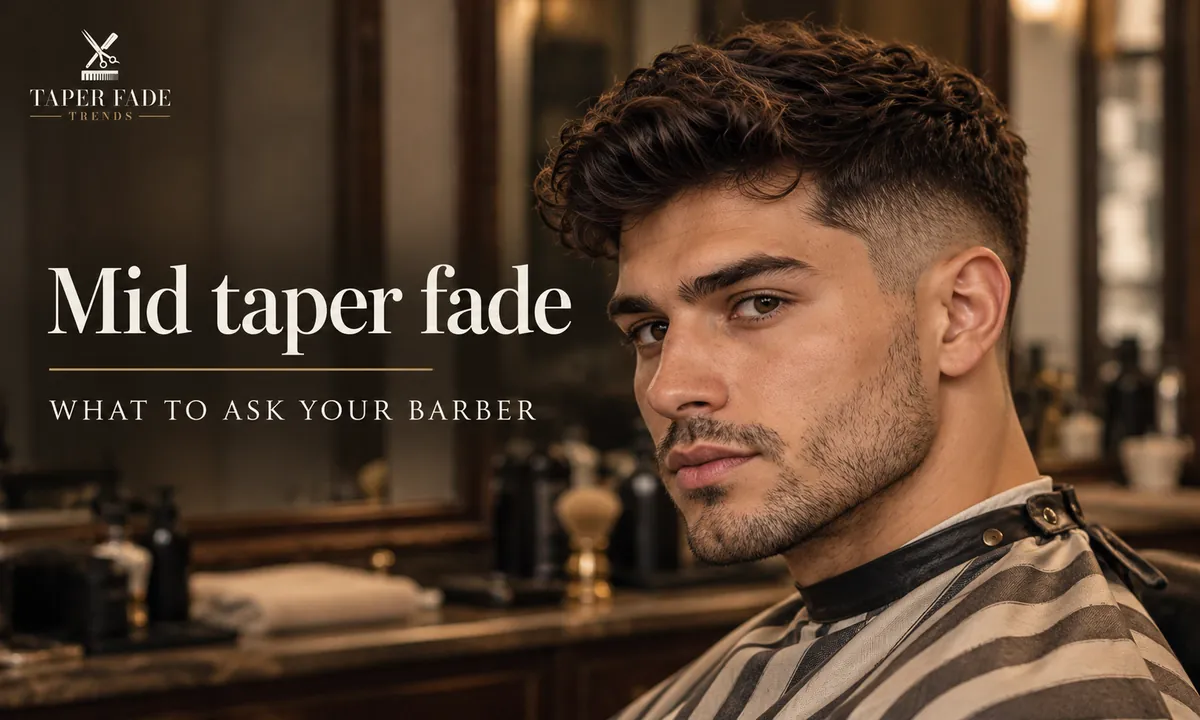
Mid taper fade: what it is and what to ask your barber
What a mid taper fade is, how it differs from a full mid fade, why skin is optional, and the four specs to give your barber before the cut starts.
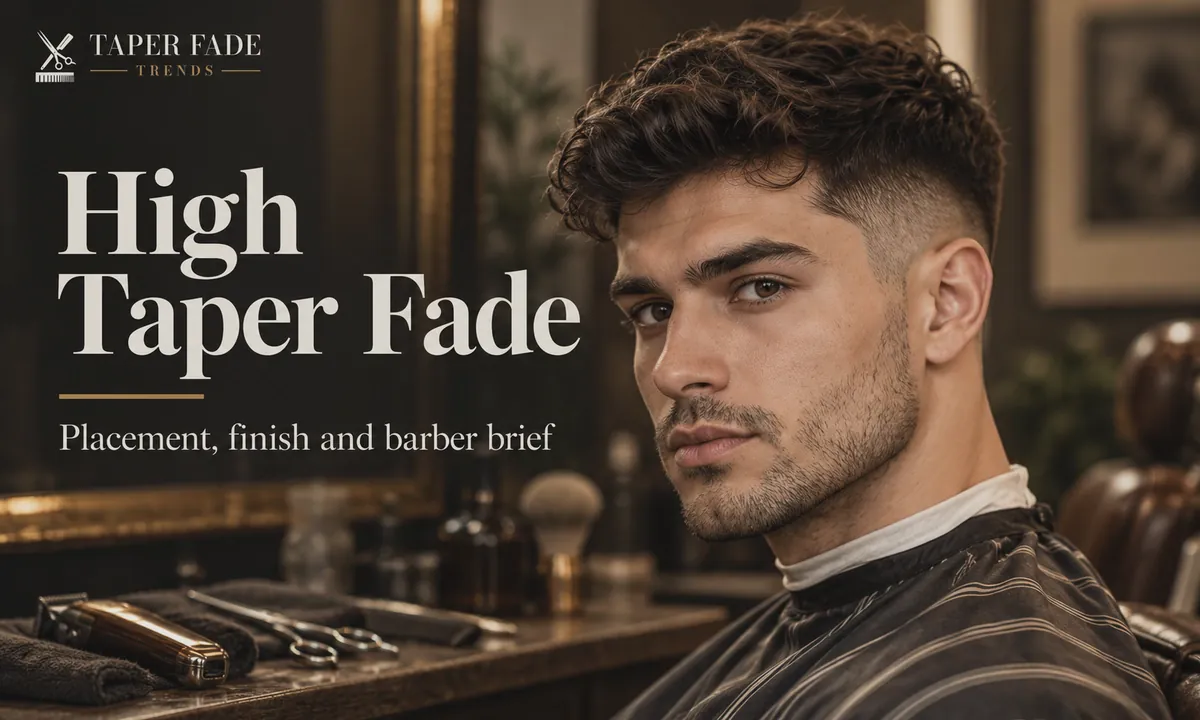
High taper fade: placement, finish and barber brief
Where a high taper fade sits, how much side weight stays, skin vs shadow finishes, what the back should look like, and exactly what to tell your barber.
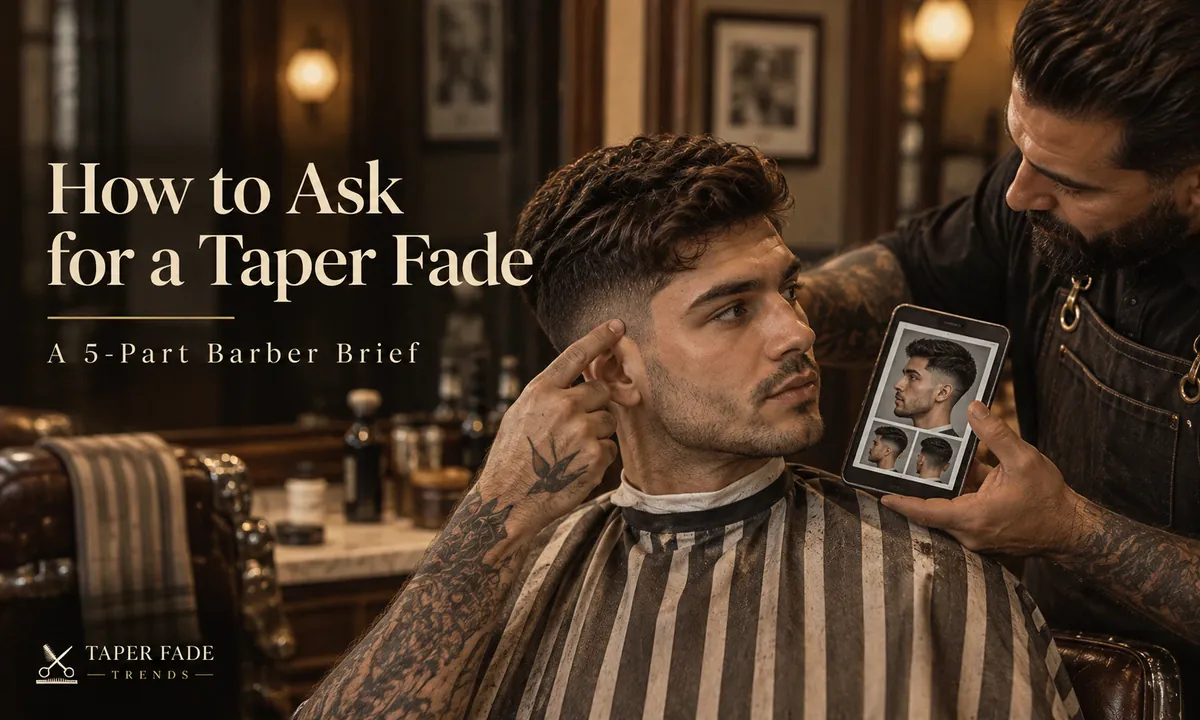
How to ask for a taper fade: a five-part barber brief
How to ask for a taper fade: say where it may reach, how short the base goes, how much side weight stays and what to do on top, then check the plan first.
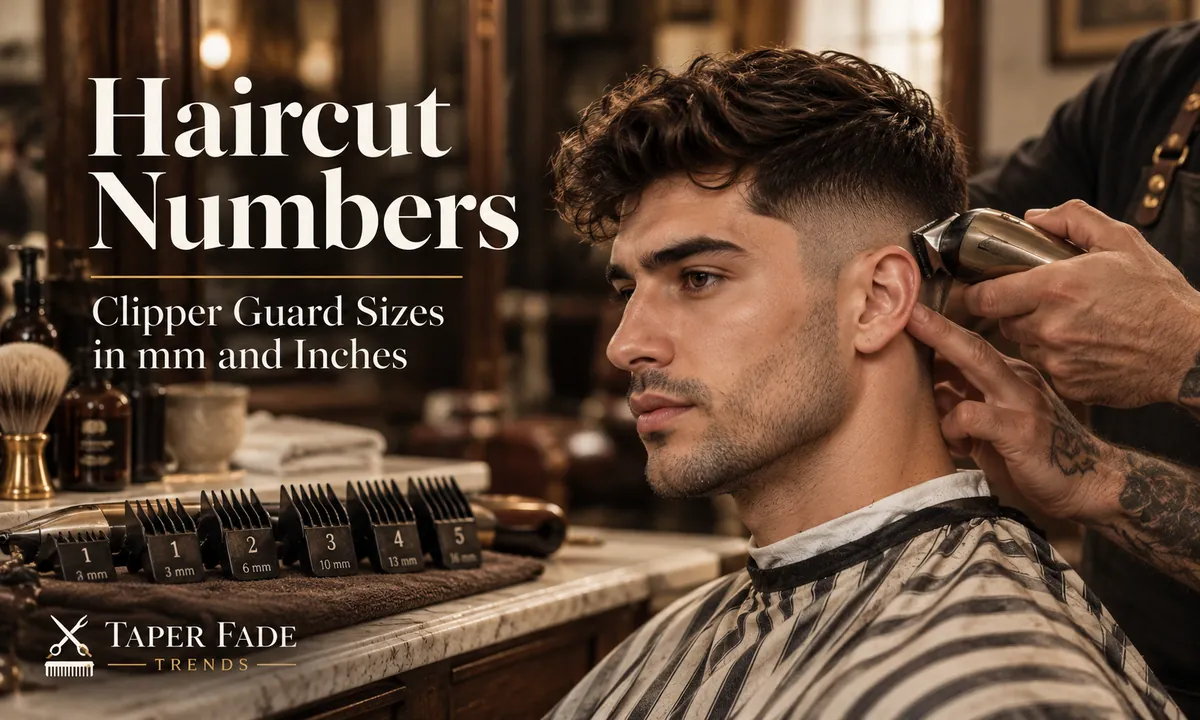
Haircut numbers: clipper guard sizes in millimeters and inches
Haircut numbers in mm and inches, checked against Wahl, Andis and Oster specs, plus why #0 isn’t always no guard and what to tell your barber.
How to maintain a taper fade between haircuts
How to maintain a taper fade between haircuts: what is safe at home, where to stop before the blend, and when to book a cleanup or a full cut.
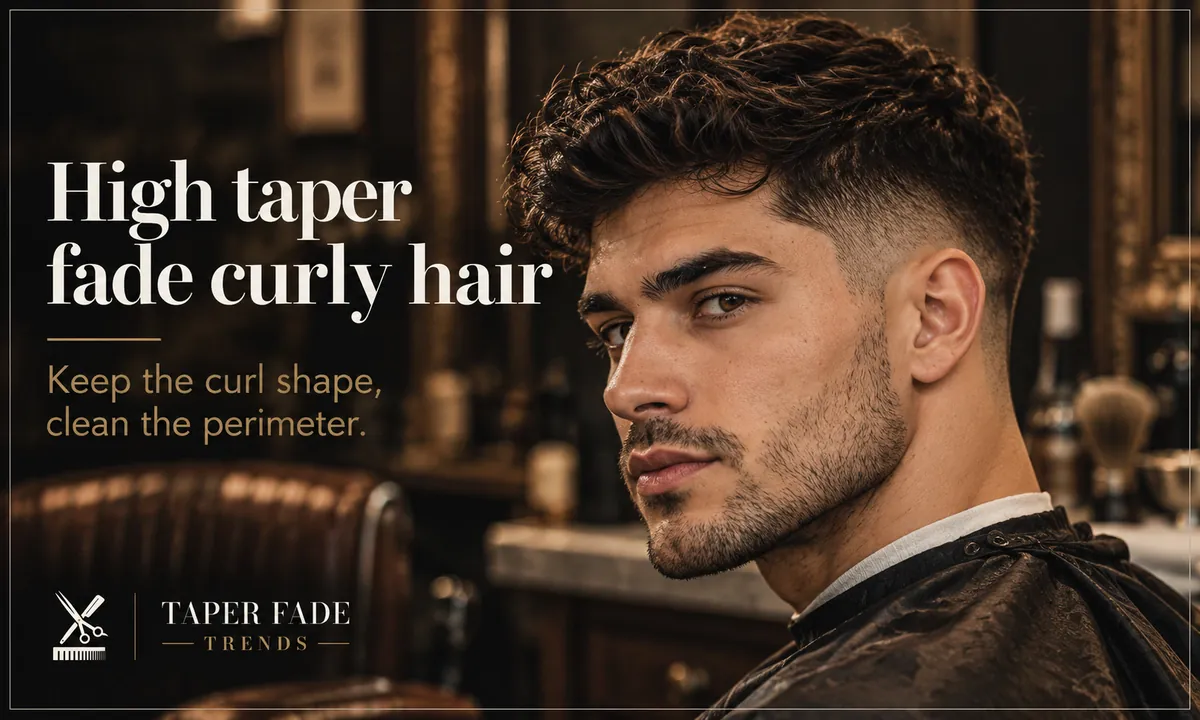
High taper fade curly hair: keep the curl shape, clean the perimeter
How a high taper fade works on curly hair: what side weight to keep, why curls are judged dry, how to measure shrinkage and what to tell your barber.
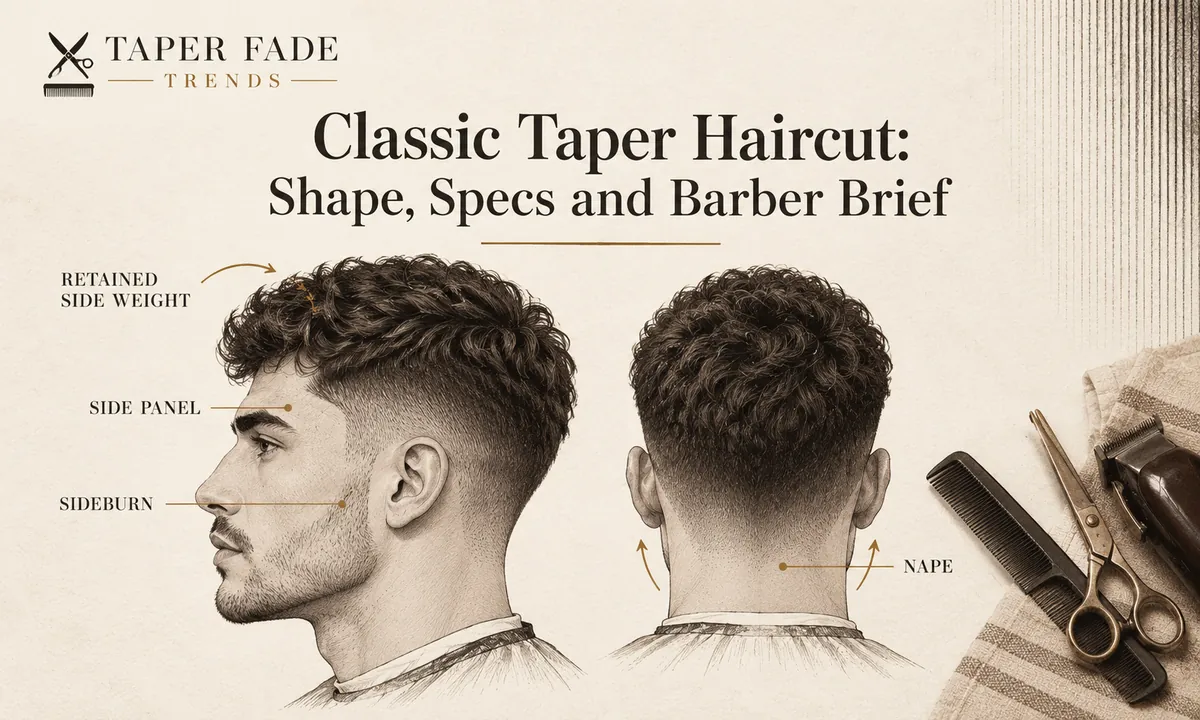
Classic taper haircut: shape, specs and barber brief
A classic taper haircut keeps side weight while the sideburns and nape go shorter. See the specs to choose, the skin question and what to tell your barber.
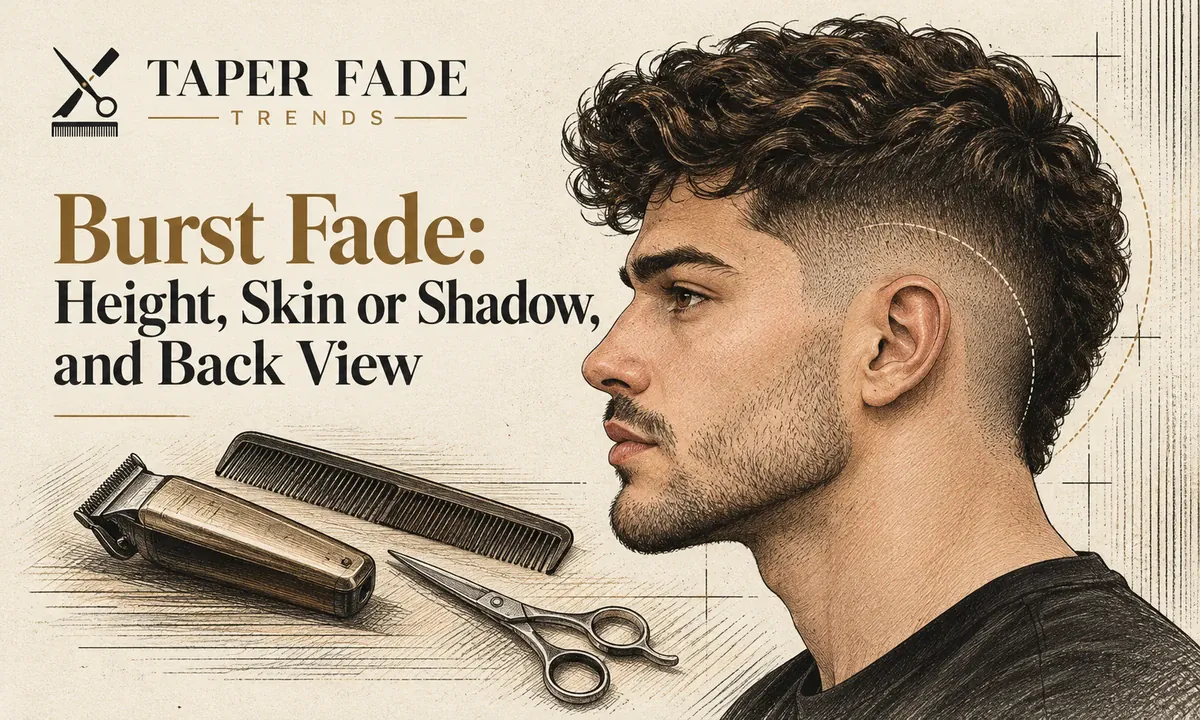
Burst fade: arc height, shortest finish and back view
A burst fade curves around the ear. It doesn’t have to reach skin, and the back is a separate choice. See the three controls and what to tell your barber.
More in taper fade basics
Taper fade basics: all 6- Taper fade: a visual guide to heights, finishes and top stylesYou are here
- Classic taper haircut: shape, specs and barber brief16 min
- Blowout taper: choose lift, silhouette and taper height13 min
- Taper vs fade: what changes in area, finish and side weight10 min
- Haircut numbers: clipper guard sizes in millimeters and inches10 min
- Burst fade vs taper: compare the ear arc and nape10 min