How to maintain a taper fade between haircuts
To maintain a taper fade, keep the shape you already have instead of rebuilding the blend at home. Style the top the way you wear it, check the sideburns, temples and nape, trim only obvious strays outside an edge you can clearly see, and book a barber when the blend, height or overall shape needs cutting.
| Item | Working rule |
|---|---|
| Goal | Preserve the taper’s placement, shortest finish and overall shape between full haircuts |
| Zones to check | Sideburns and temples; nape and neckline |
| Safe at home | Washing, styling, combing, and trimming obvious strays outside an edge you can clearly trace |
| Stop line | The point where your next pass would enter the blend |
| Book a taper cleanup | The top and sides still work; only the taper zones have lost definition |
| Book a full haircut | The top needs length off, the sides are bulky, or the shape no longer holds |
| Your placement | Record yours: low, mid or high |
| Your shortest finish | Record yours: skin, shadow or visible hair |
| Guard, blade and lever | Unknown unless your barber tells you; a photo can’t show them |
| Evidence | Compiled from published barber and grooming sources, checked October 2026; no original photo record or barber review yet |
Fill in the two “Record yours” rows from your last full haircut. Every check below compares the mirror against them.
What taper fade maintenance actually means
Taper fade maintenance is care and limited cleanup that preserves an existing taper’s placement, finish and overall shape between full haircuts. In practice that means styling the top normally, checking the sideburns, temples and nape, and trimming only clear strays outside the established edge. Rebuilding the blend is a barber’s job unless you can genuinely cut one.
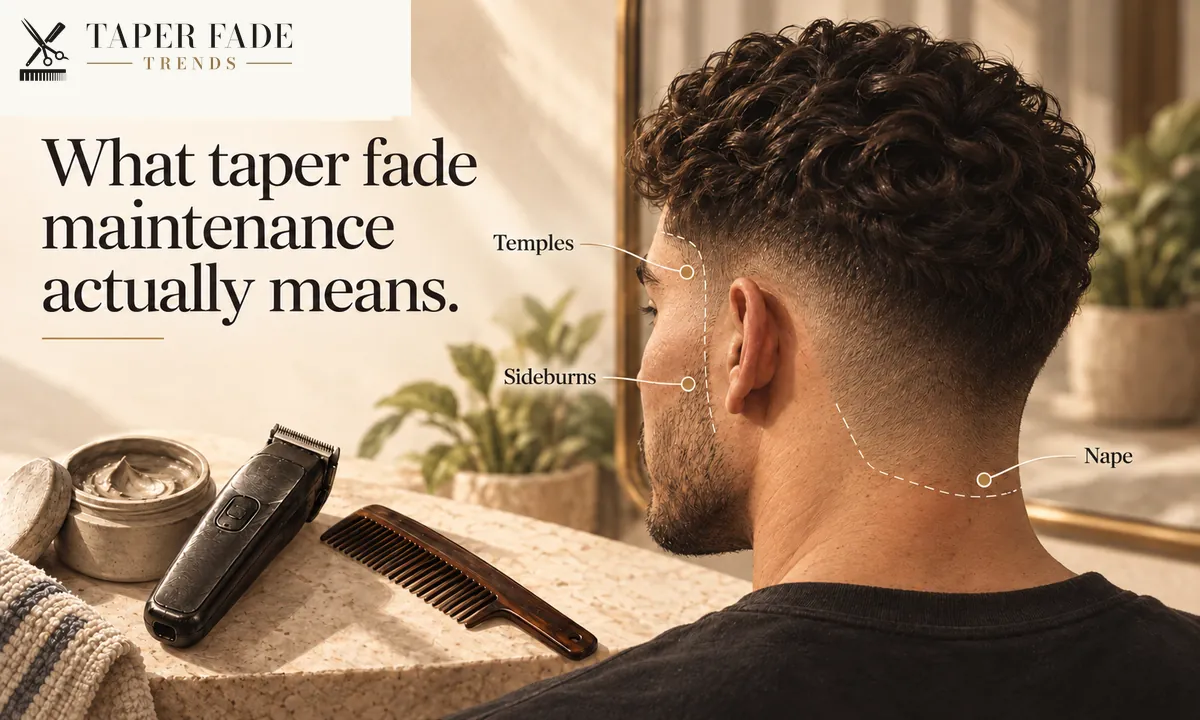
A taper fade keeps its shortest work in two zones, the sideburns and temples and the nape, while the rest of the sides and back keep more length. That is how our taper fade guide defines it, and a barber school (CADMEN Academy) and a former barber (Nick Hall at Man of Many) place the short work in the same areas.
Three more terms recur below. A taper cleanup is a barber service that restores the taper zones and perimeter while keeping the rest of the haircut, used when the overall shape still works. A full haircut resets the overall length and shape, not only the shortest zones. Edge cleanup is removal of obvious stray hair outside an established perimeter; it is not reconstruction of the gradient.
Here, the edge is that perimeter. The blend is the gradual change in length from the shortest finish up to the longer hair above it. Shops also disagree on whether “taper fade” implies bare skin, which taper vs fade covers.
Check the cut before you touch it
Check a taper fade only after the top is styled the way you wear it, then compare the mirror with the placement and shortest finish you recorded. The question is narrow: have only the taper zones softened, or has the overall shape moved? That answer decides between leaving it, a light edge tidy, a taper cleanup or a full haircut.

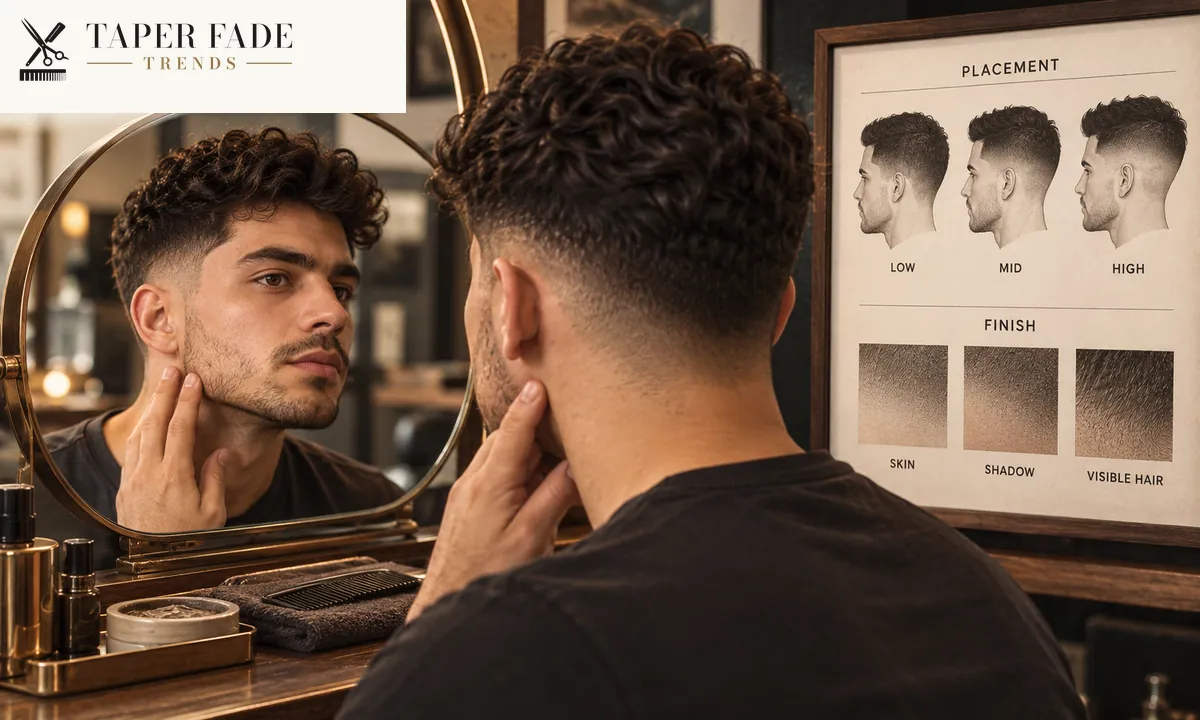
Keep placement (how high the blend reaches) separate from the shortest finish (skin, shadow or visible hair). A skin taper names the finish, not the height, as the taper fade height, finish and coverage guide explains.
- Height. If the blend now reads higher or lower than you recorded, leave it for the barber. Evening it out at home moves it further.
- Edge. If you can still trace the edge at the sideburns and nape and the strays sit outside it, a home tidy is enough. If you can’t trace it, book a taper cleanup.
- Sides. Bulk above the taper that has grown past the original shape points to a full haircut.
- Top. If length has to come off the top, it is a full haircut, whatever the taper looks like.
What you need at home
For a taper fade, the home kit depends on what you will actually do. Care and styling need only good light, a hand mirror plus a second mirror or phone camera for the back, and your usual comb, brush and products. A trimmer is optional, and only useful if you can clearly see an established edge to stay outside.

No guard, blade or lever setting is given here. Guard markings vary by brand and the lever changes the length between them, as haircut numbers shows, and none of it can be read from a photo of your cut. If you want to match your barber’s settings, ask them.
The between-appointment routine
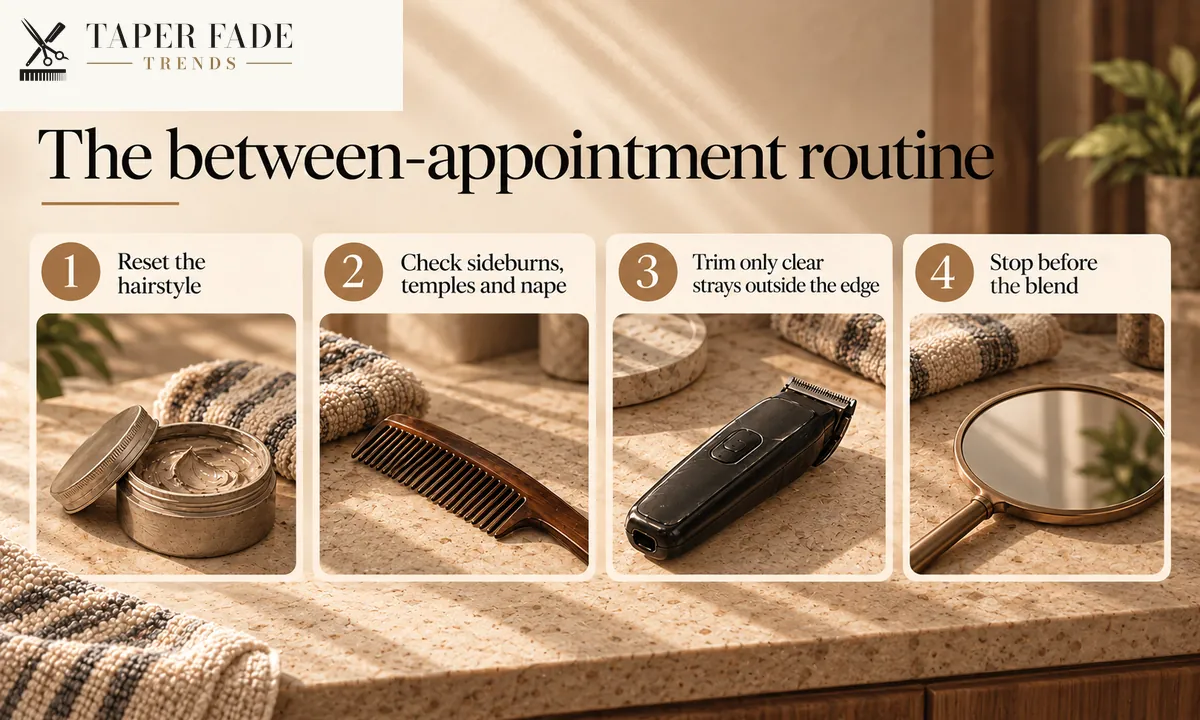
Between appointments, a taper fade needs four steps in order: reset the hairstyle, check the sideburns, temples and nape, trim only strays outside an edge you can clearly trace, and stop before the blend. Washing and styling are always safe. Once a trimmer would move up into the gradient, you are recutting the haircut, not maintaining it.
1. Reset the hairstyle before judging the taper
A flat or unstyled top can make a sound haircut look overgrown, so judge the cut in the state you actually wear it.
Washing and styling make a growing taper fade look more orderly, but they do not slow growth or rebuild a lost blend. Pick a wash routine that suits your scalp, hair texture, activity and products rather than a fixed schedule. Judge the cut once it is clean, dry and styled the way you normally wear it.
2. Check the sideburns, temples and nape
Use the same light and the same views each time, so any change comes from the hair and not the setup. A hand mirror covers the sides; the nape needs a second mirror or a phone photo.
Strays outside an edge you can trace go to step 3. Bulk inside the taper zones, a shortest finish that has grown longer, or an edge you can no longer trace go straight to step 4. Where hair grows in more than one direction at the nape, a hair that looks stray may belong to the edge.
3. Clean only outside the established edge
Trim the neckline only when the hair is clean, dry and sitting normally, and only hairs clearly below the established nape edge. If your nape was tapered, keep it tapered: squaring it off changes the cut, and former barber Nick Hall says a tapered neckline grows out more naturally. If you can’t see where the edge ends, stop.
The same rule applies at the sideburns, around the ears and at the front hairline. Taper Empire’s maintenance guide limits home work to following those existing lines without moving or raising them. Treatwell reports that a neckline and sideburn tidy can buy roughly an extra week before the next appointment.
There is no trimmer technique on this page because we have no recorded demonstration to show it with.
4. Stop before you enter the blend
Stop when the next pass would enter the blend. You have reached that point when:
- the hair you want to remove sits inside the blend, not below or outside the edge;
- you can’t tell where the edge ends and the blend begins;
- evening one side up would mean taking hair off above the edge.
Taper Empire’s guide is blunt about why: the gradient takes shears, a comb and real practice, and home attempts to freshen it usually damage it. Living with slightly soft sides for a few days costs less.
Touch-up or full haircut?
A taper cleanup is enough when the top and side shape still work but the sideburns, temples, nape or shortest finish have lost definition. Ask for the taper restored at the same placement, with everything above it kept. If the top needs length off, the sides are bulky or the shape has gone, book a full haircut instead.
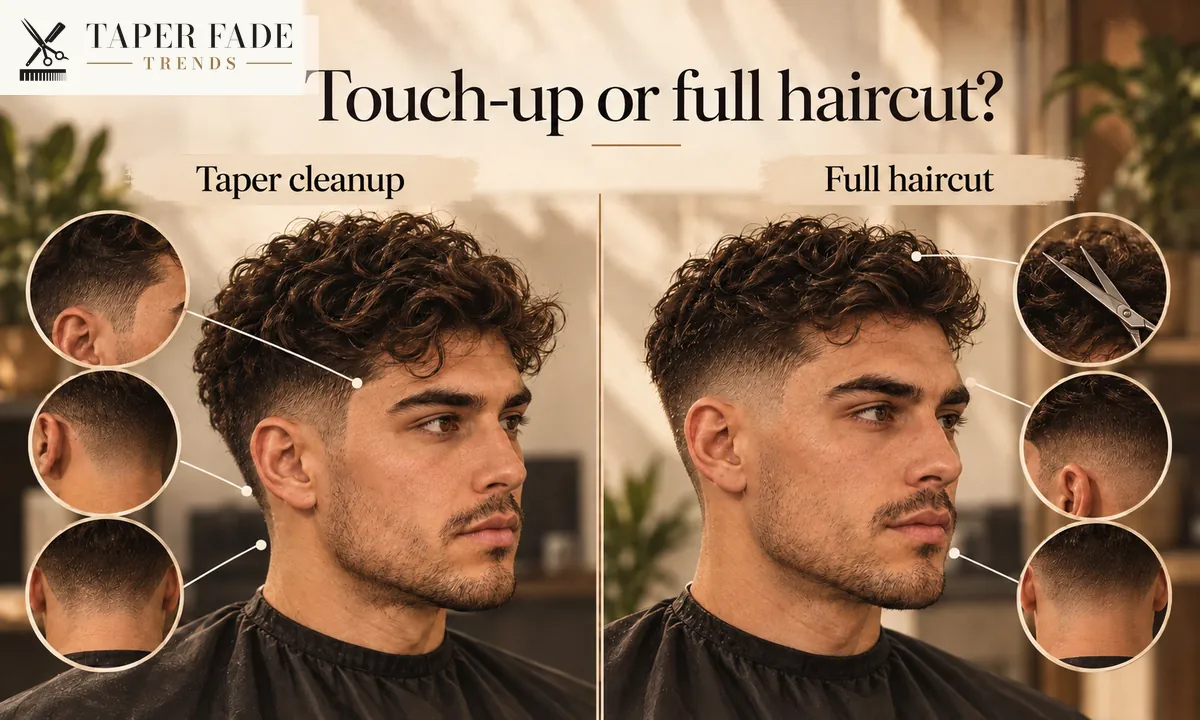
Choose a full haircut when the problem has spread beyond the taper zones: the top needs length removed, the sides have filled out past the original shape, the style no longer holds its silhouette, or you want a different shape. A taper cleanup preserves what sits above the taper; a full haircut resets the length and shape of the whole cut.
| Taper cleanup | Full haircut | |
|---|---|---|
| Deciding question | Does the overall shape still work? Yes | No, or you want a change |
| What the barber cuts | Sideburns, temples, nape and neckline | Top, sides and back |
| Placement and finish | Kept as they are | Agreed again at the consultation |
| Typical trigger | Soft edges, blurred shortest finish | Heavy sides, long top, lost silhouette |
Taper Empire splits upkeep the same way, into a short edge cycle and a longer full refresh. When you book, ask whether the shop offers a cleanup as its own service.
What to tell your barber
Tell the barber what must stay and what can change: the taper’s height, the shortest finish and the length on top stay; the sideburns, temples and nape get refreshed. Bring a reference photo from your last full haircut. Guard numbers matter less than placement, because the same number can cut differently across brands and lever settings.
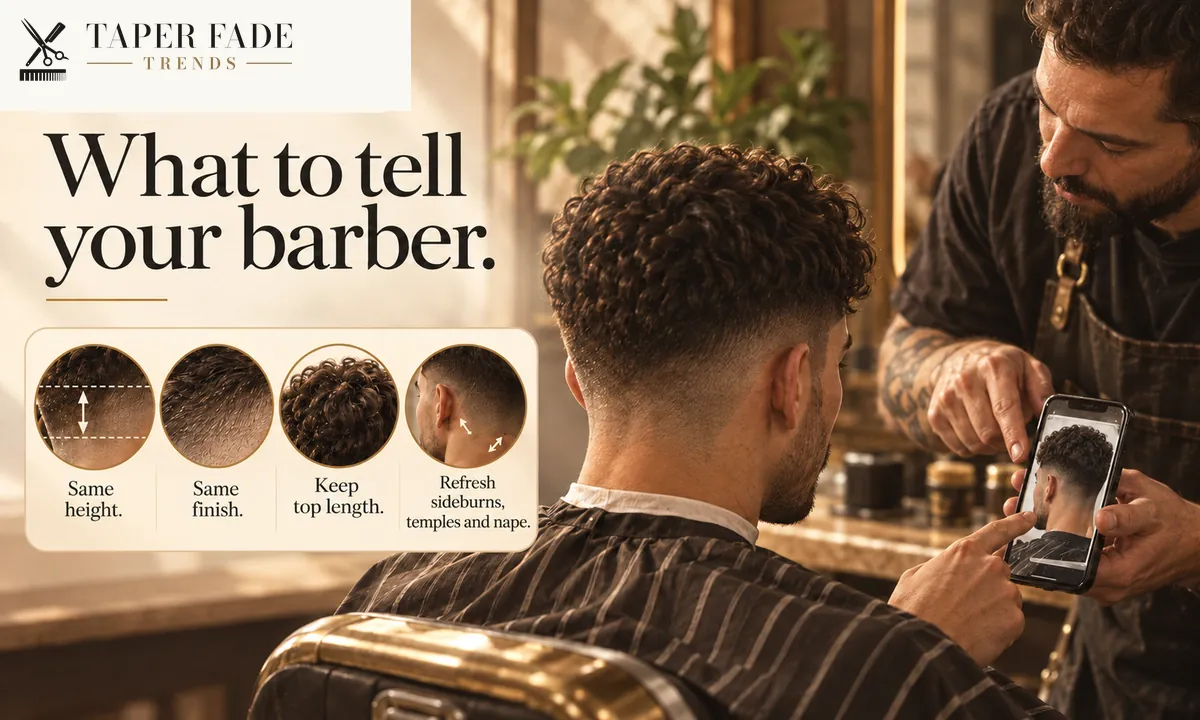
Current photos help too: front, both sides and the back, styled as usual and taken in the same light. Mention any cowlick or growth direction at the nape. Before you leave, ask which guard and lever settings were used and note them, so the next cleanup can match. For a fuller script, see how to ask for a taper fade.
Common taper fade maintenance mistakes
To stop a taper fade creeping higher, make placement part of every request: ask for the taper restored at the same height, not cleaned up above it. At home, never chase softness by moving the trimmer upward. Each pass above the edge raises it, and as Nick Hall notes, a barber can always go higher but can’t put hair back.
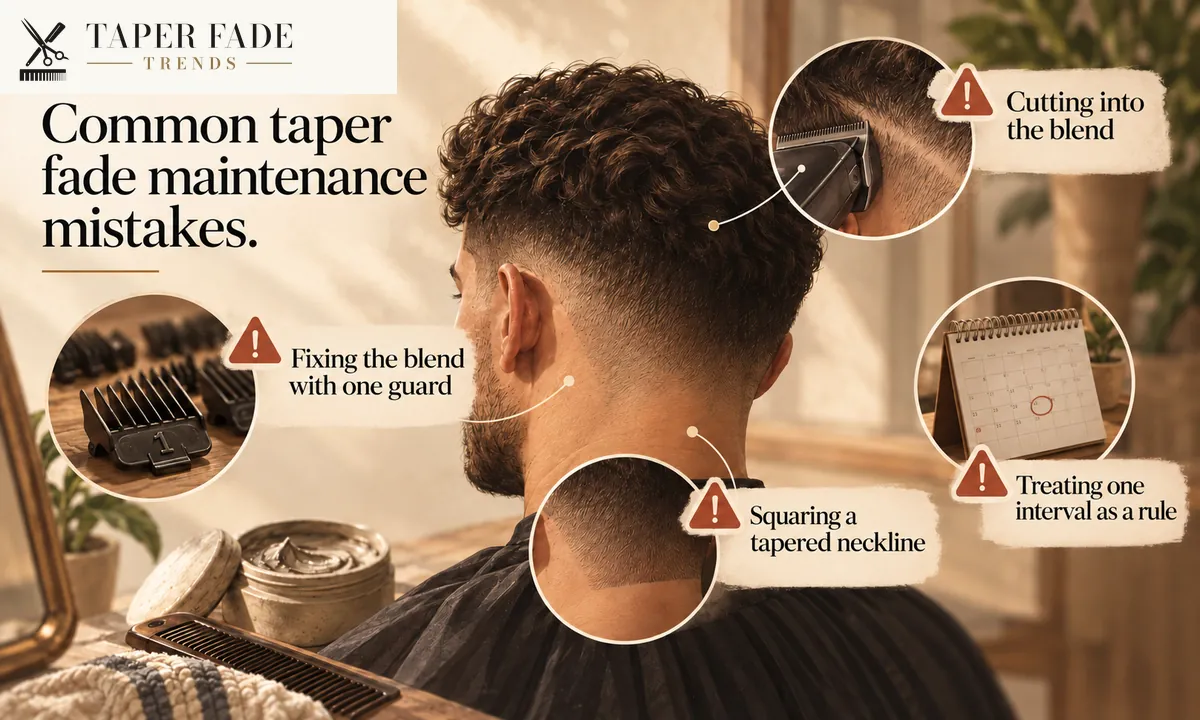
- Cutting a stray that sits inside the blend. That is blend work, not edge cleanup.
- Fixing the blend with one guard. One guard cuts one length. A blend is built from several guard sizes with overlapping passes, as CADMEN Academy describes, so a single-guard pass flattens it.
- Squaring a tapered neckline. It changes the cut and grows out less naturally.
- Treating one published interval as a rule. The sources disagree, as the next section shows.
If you have already cut into the blend, stop and don’t try to even it out. Book a cleanup, show the barber what happened, and expect the fix to sit a little higher than before, since the hair you removed can only be blended into, not replaced.
Plan taper fade appointments without a fixed rule
No single rebooking interval fits every taper fade; published guidance disagrees. The four sources below range from about one week for edge work to five weeks for a full refresh, each tied to taper height, finish, growth rate or how sharp you want to look. Use the calendar as a reminder; book when your own threshold is crossed.
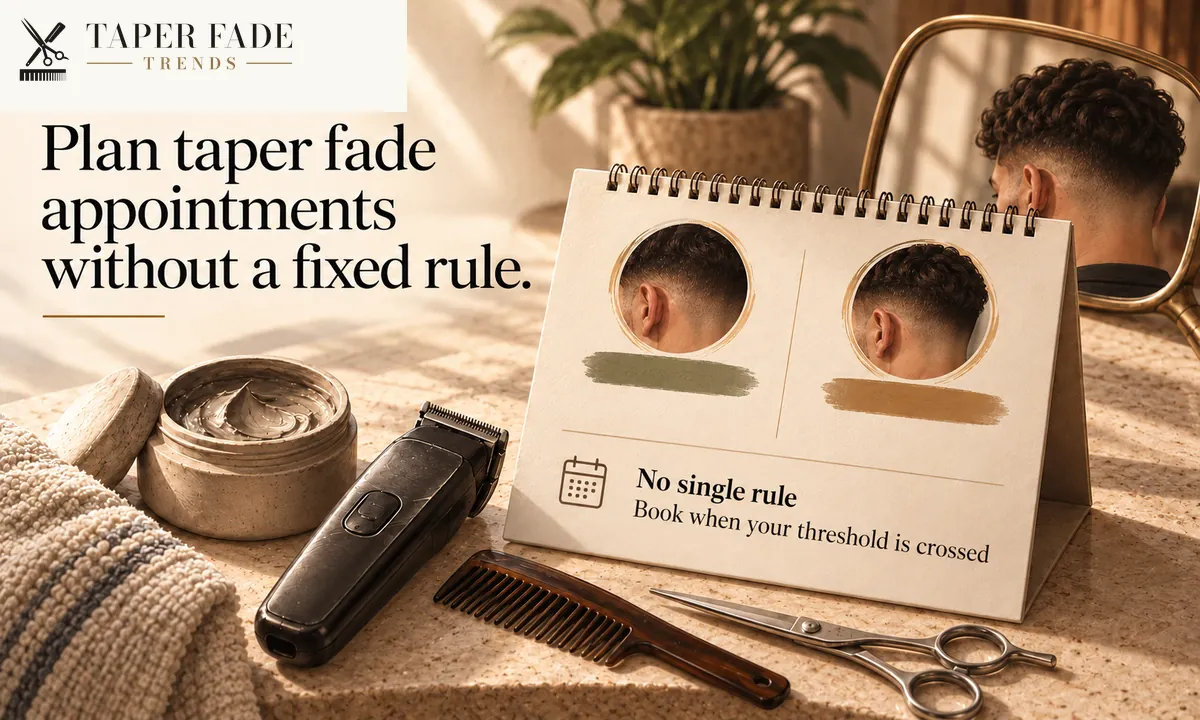
| Source | Who wrote it | Stated interval | Condition attached |
|---|---|---|---|
| CADMEN Academy | Barber school | 2 to 4 weeks; 2 to 3 if you want it always sharp, 4 to 5 if not | A high skin finish shows growth within 10 to 14 days |
| Treatwell | Booking platform’s editorial desk | 2 to 3 weeks for most | Low tapers 3 to 4 weeks; high tapers about 2 |
| Taper Empire | Organization, no named reviewer | Edge cleanup every 7 to 14 days; full refresh every 2 to 5 weeks | Shortest cycles for high tapers |
| Man of Many | Nick Hall, former barber | Sharpest for about two weeks; cleanup every 2 to 3 weeks for crisp edges | Applies to mid and high tapers; low tapers last longest |
The figures move for the same reasons. A closer finish and a higher taper show regrowth sooner, which all four sources reflect. Growth rate differs from person to person. A tapered neckline grows out more gently than a squared one. And “fresh” is your own standard: someone who wants crisp edges every day will book at the short end of every range above.
Fill in this worksheet to see what a cadence costs. It is arithmetic, not a recommended cadence, and it assumes no price.
| Line | Your number | How to get it |
|---|---|---|
| Weeks between visits | Your choice | |
| Visits per year | 52 ÷ weeks between visits | |
| Price of one visit | Your shop’s price | |
| Yearly cost | Visits per year × price |
If you alternate taper cleanups with full haircuts, fill it in once for each visit type, using that type’s own weeks between visits, then add the two yearly costs.
How this guide was checked
Taper Fade Trends compared current maintenance guidance from a barber school, a former barber, a grooming publisher and a taper-focused guide, and separated visible haircut condition from calendar rules. Where the sources disagree, the page shows each source’s figure instead of picking one. This is a researched framework, not a tested routine.

The images are illustrations, not photos of a real cut. No original photo record, edge-cleanup demonstration or tool-settings record exists for this guide, and no barber has reviewed this version; when one does, their name, role and review date will be added here.
A photo can’t show tool settings, your growth rate or where your cut’s established edge ends, so treat any reference photo as a guide to the look, not to settings. This page doesn’t teach cutting a fade or growing one out, and it makes no scalp or skin claims.
Sources: CADMEN Academy, Man of Many (Nick Hall), Treatwell and Taper Empire, each linked where cited, plus our taper fade guide. Last checked October 12, 2026. Found an error? Our editorial policy explains how corrections are made and dated, or you can contact us.
Next: confirm your taper’s placement and finish
Every upkeep decision above depends on your taper’s placement and shortest finish, so confirm both first in the guide to taper fade height, finish and coverage. If you already know your height, the low taper fade, mid taper fade and high taper fade guides cover what each one keeps and how it grows out.
Keep reading
All guides
Taper fade: a visual guide to heights, finishes and top styles
Where a taper fade sits from the front, side and back, how low, mid and high differ, and how to ask for side coverage and a finish with or without skin.
How to ask for a taper fade: a five-part barber brief
How to ask for a taper fade: say where it may reach, how short the base goes, how much side weight stays and what to do on top, then check the plan first.
Haircut numbers: clipper guard sizes in millimeters and inches
Haircut numbers in mm and inches, checked against Wahl, Andis and Oster specs, plus why #0 isn’t always no guard and what to tell your barber.

Taper vs fade: what changes in area, finish and side weight
Taper vs fade compared by coverage, height, shortest finish and side weight, with a back-view check and word-for-word barber scripts for either cut.
More in barber brief and upkeep
Barber brief and upkeep: all 4- How to ask for a taper fade: a five-part barber brief9 min
- Haircut numbers: clipper guard sizes in millimeters and inches10 min
- How to maintain a taper fade between haircutsYou are here
- How long does a taper fade last? Fresh, tidy and grown-out stages13 min