Taper vs fade: what changes in area, finish and side weight
Taper vs fade is mostly a question of area. A taper usually keeps its shortest work at the temples, sideburns and nape and leaves more weight through the sides, while a fade carries the transition across a wider part of the sides and back. Neither word fixes the shortest finish, so name skin, shadow or visible hair yourself.
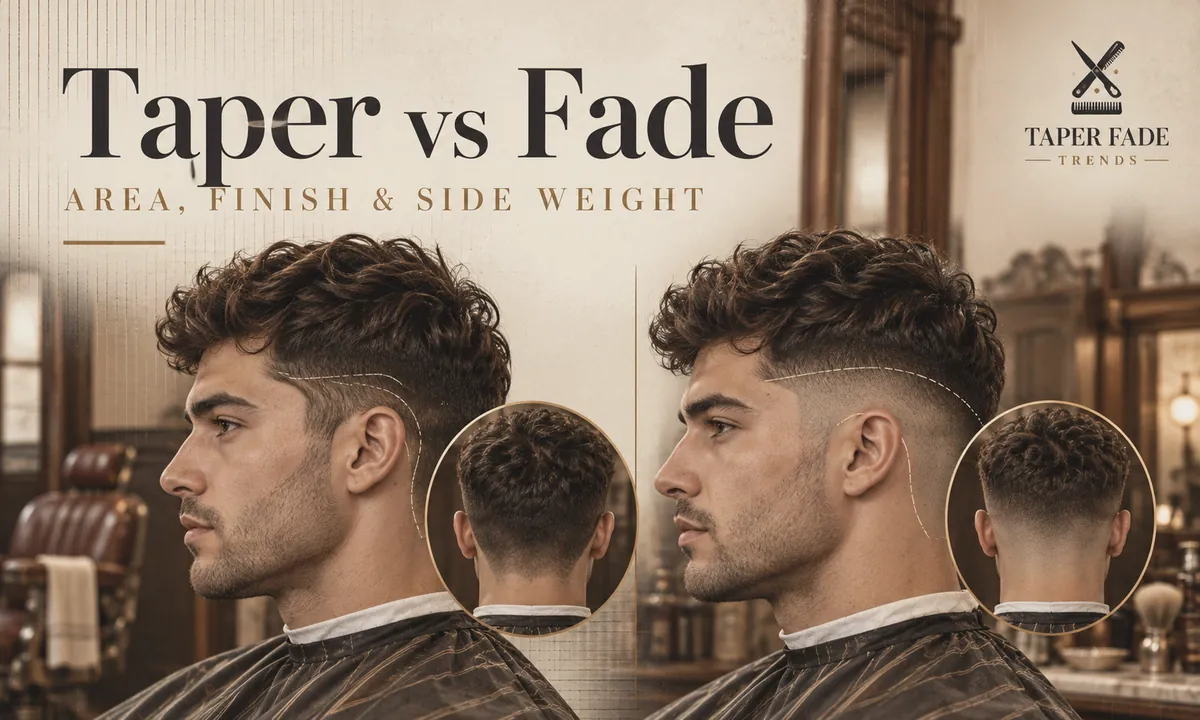
| Control | Taper | Fade |
|---|---|---|
| Area shortened (coverage) | The perimeter: temples, sideburns and nape | A wider band across the sides and back |
| Retained side weight | More, at a comparable height | Less, at a comparable height |
| Contrast | Usually subtle | Anywhere from soft to very strong |
| Height | Low, mid or high, chosen separately | Low, mid or high, chosen separately |
| Shortest finish | Visible hair, shadow or skin, depending on the shop | Visible hair, shadow or skin, depending on the shop |
| Back view | Short work stays at the nape | Transition wraps around the back |
| Say it as | “Keep the short work to my sideburns and nape” | “Carry the short work around the sides and back” |
| The name won’t tell you | Guard, lever or blade setting; density; growth direction | Same |
What is the difference between a taper and a fade?
A taper is a graduated shortening concentrated at the perimeter zones of the haircut that usually preserves more length through the side panel. A fade is a graduated shortening carried across a wider part of the sides and back, with its height and shortest finish specified separately. The real split is where the short work goes.
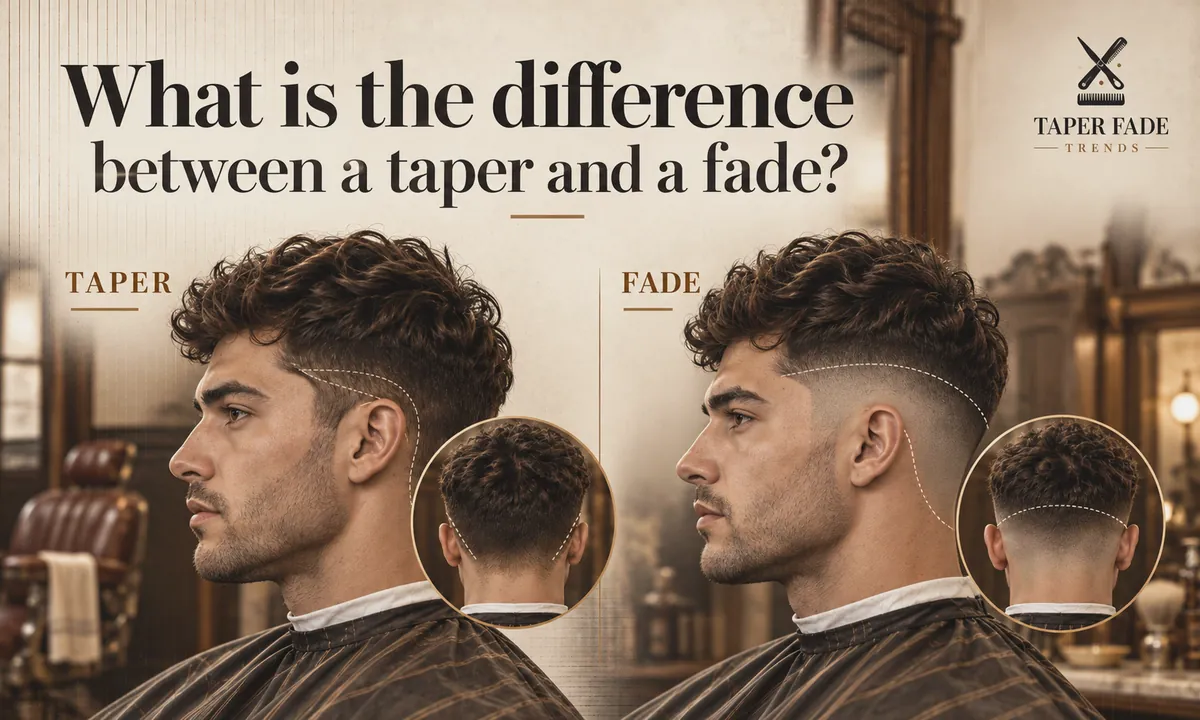
That coverage split is the part working barbers agree on most. Barber.Style and Montreal barber Youssef Ouda both describe a taper as a blend at the temples and neckline and a fade as a broader transition around the head. Arizona master barber Adrian Carranza frames it differently: one technique at two intensities, with the fade going shorter and higher. The disagreement is almost always about the bottom of the cut, which is why this page treats the finish as its own question.
Taper vs fade on the same four criteria
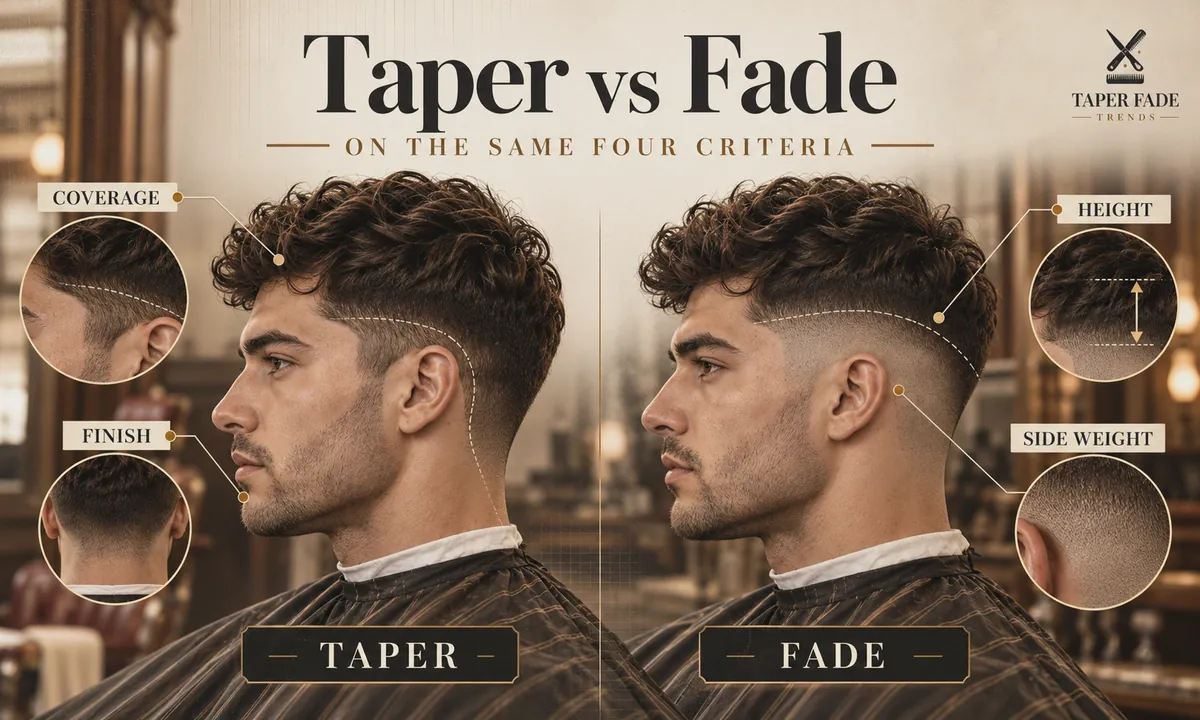
Four controls describe either cut: coverage, height, shortest finish and retained side weight. Change any one of them and the haircut changes, even when the name on the request stays the same.
Area and side coverage
Coverage is where the shortest work happens. On a taper it stays at the sideburns, temples and nape, so most of the side panel keeps its length. On a fade it spreads across more of the sides and back before meeting the top. Check coverage from the side and the back, because the nape never shows in profile.
Coverage and finish are different requests. A wide fade can stop at visible hair, and a narrow taper can reach skin in shops that offer a skin taper. Ask for the area first, then the finish.
Height and shortest finish
Height and shortest finish are separate choices. Height is where the transition sits: low near the ear, mid toward the temple, high at or above the temple corner. Shortest finish is what remains at the lowest point: visible hair, a shadow of stubble, or bare skin. Picking one never picks the other.
Shops draw those height landmarks slightly differently, so point to the spot on your head instead of trusting the word. The combinations below all exist:
| Height | Finish at visible hair | Finish at skin |
|---|---|---|
| Low | The softest version; the transition stays near the ear and neckline | Bare scalp in a thin band just above the ear and neckline |
| High | Short sides with no scalp showing | The most scalp showing and the strongest contrast |
Retained side weight
Retained side weight is the hair left on the side panel once the short work is done, and coverage decides most of it. At the same height, a taper’s narrow coverage leaves more length through the sides than a fade’s wider band. Height matters too: the higher the transition, the more weight comes off. That is why two cuts both called “mid” can look nothing alike from the front.
See the difference from the side and back
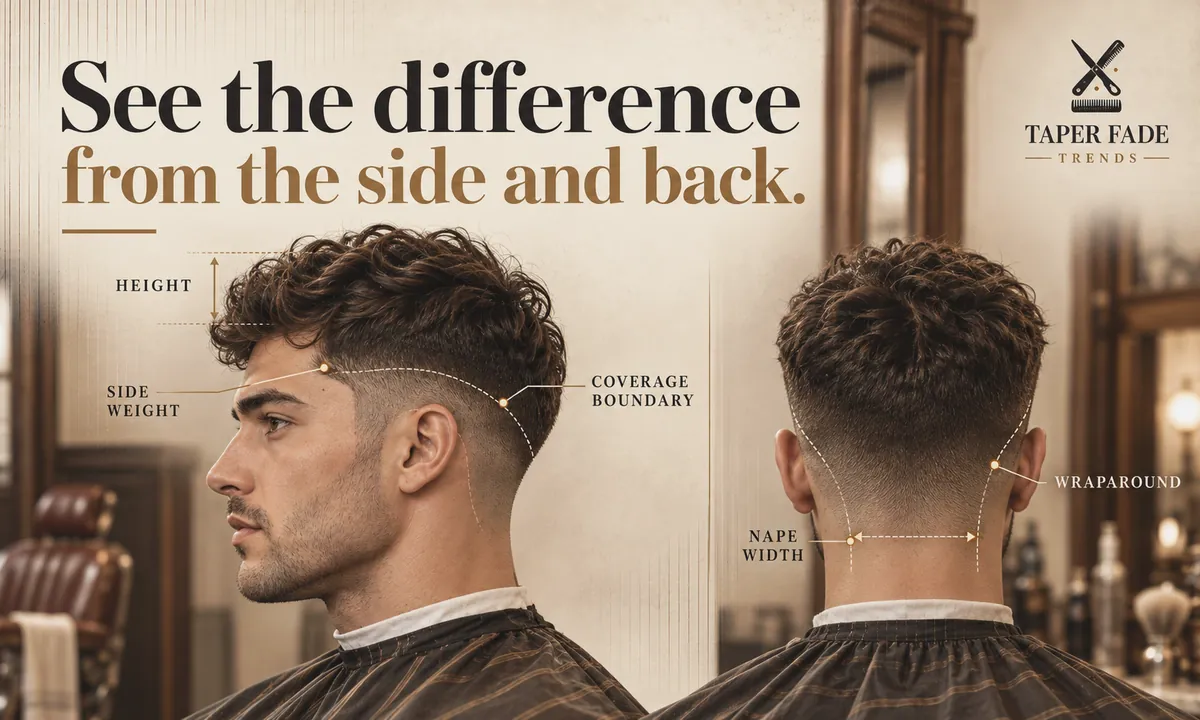
A side view shows height, the coverage boundary and how much side weight is left. A back view shows how far the short work wraps around the nape, which a profile hides completely. Two cuts can match from the side and still differ from behind, so judge any taper or fade reference from both angles.
What the side view shows
In profile, look at how high the transition sits near the temple and ear, and how much hair remains on the side panel below the top. That boundary is the easiest thing to point at in a photo. One profile is not proof the other side matches, and it won’t show density or how the hair sits once it dries.
What the back view shows
From behind, the nape tells you which cut you’re looking at. A taper keeps the short work in a narrow band at the neckline; a fade carries it across the back so the short area joins up from one side to the other. If the wraparound matters to you, bring a rear reference.
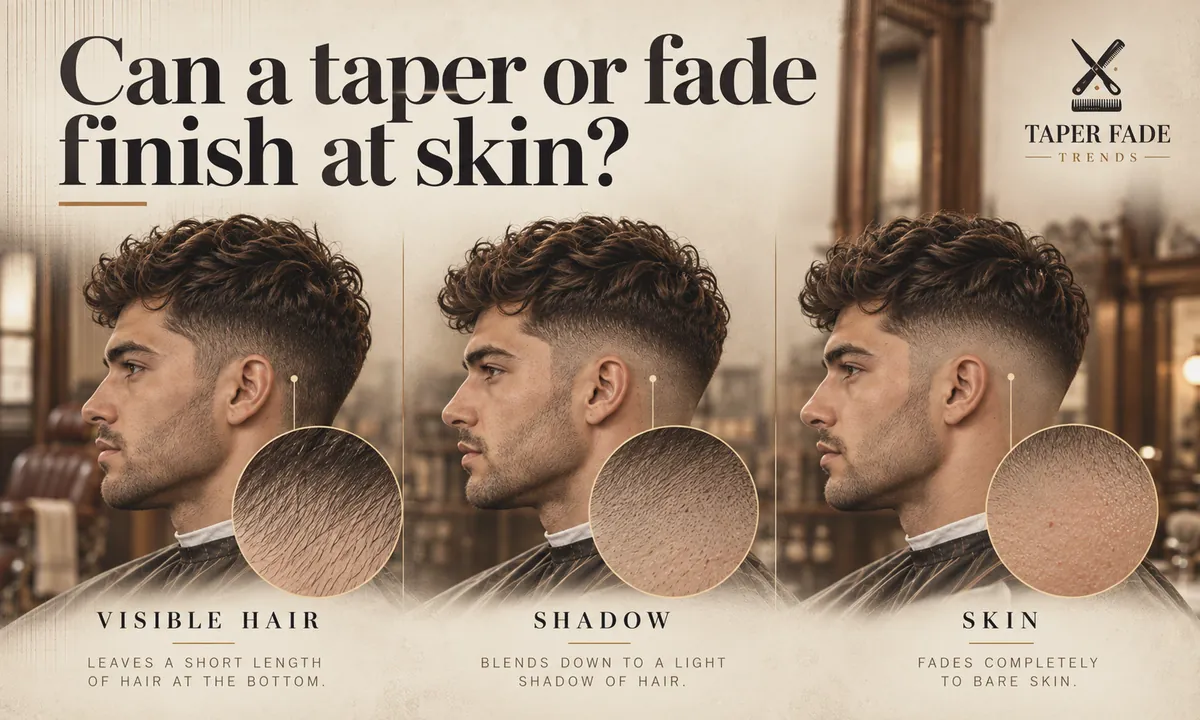
Can a taper or fade finish at skin?
Both can, depending on the shop. Some barbers treat a fade as a cut that reaches skin and a taper as one that never does. Others use “fade” for any wide gradient, save “skin fade” for bare scalp, and offer a “skin taper” that stays local. Both habits are common, so name the finish yourself.
| How the shop uses the words | “Fade” means | “Taper” means | Published example |
|---|---|---|---|
| Finish decides | A blend down to skin | Shortens gradually but never reaches skin | Men’s Hairstyles Today, Taper Empire |
| Coverage decides | A wider gradient at any finish; “skin fade” means bare scalp | A local blend that can go to skin | Barber.Style, Youssef Ouda, StyleSeat |
| Intensity decides | The same technique taken shorter and higher, usually to skin | The gentler, lower version of that technique | Adrian Carranza |
Even a written fade request can stop short of skin: Barber.Style’s sample fade script starts at a 0.5 guard, which leaves close stubble rather than bare scalp. Say “skin,” “shadow” or “leave some hair” before the barber sets the bottom line.
A skin finish is also a skin decision. The American Academy of Dermatology explains that razor bumps form when a blade cuts coarse, curly hair short enough to curve back into the skin; its advice is written for the beard. If you get bumps after close shaves, mention it and consider stopping at a shadow. The AAD also notes that bumps on the back of the neck that feel like razor bumps may be a separate condition, acne keloidalis nuchae, and recommends a dermatologist when bumps persist.
Which one fits your routine?
Neither cut wins outright. The right one depends on how full you want the sides, how much contrast you want at the transition, and how the cut should look two or three weeks later. The labels also combine: a single haircut can keep taper-style work at the perimeter and a wider fade higher up, which is where “taper fade” comes in.
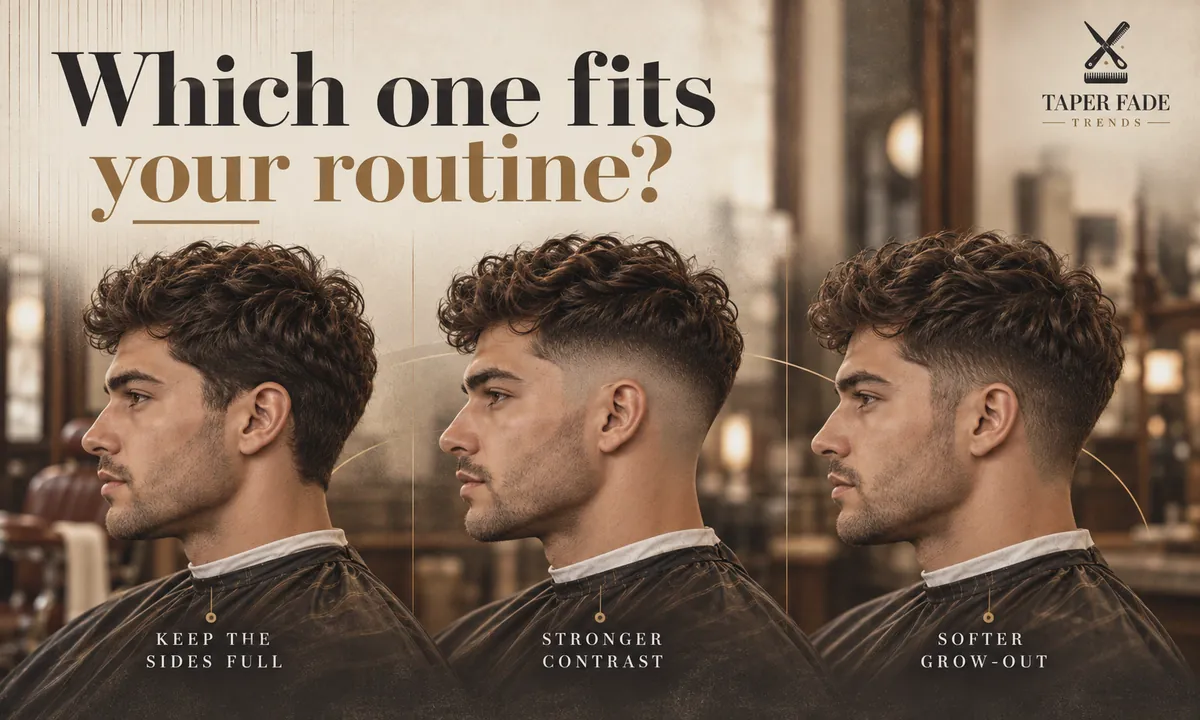
| If you want | Deciding control | What to ask for |
|---|---|---|
| Full sides | Coverage | Short work kept local to the sideburns and nape; visible hair or a shadow at the bottom |
| Strong contrast | Coverage and finish | Wider coverage, a higher transition, a closer finish, or all three |
| A softer grow-out | Finish | A longer finish with less contrast between the shortest point and the rest |
Texture changes how any of these reads. Curly and coily hair shrinks after cutting, fine hair shows scalp sooner at the same guard, and growth direction decides how the top falls, so describe your hair alongside the cut.
If you want to keep the sides full
To keep the sides full, limit coverage rather than picking “taper” over “fade” by name. Ask for the shortest work only at the sideburns and nape, and name the highest point the blend may reach. Then state the bottom finish separately. A side and a rear reference mark that boundary more precisely than any label.
If you want stronger contrast
Contrast comes from wider coverage, a closer finish, a higher transition, or a mix of them. The more area that changes and the shorter it gets, the harder the line stands out against the top. The trade-off is upkeep: high contrast shows regrowth first. For a very high, sharp version, see the high taper fade guide for placement and finish.
If you want a softer grow-out
A longer, lower-contrast finish usually changes shape less as it grows than a skin-level one, because there is less contrast to lose. Growth rate, hair color against the scalp, and how crisp you want the edge all shift the timing, so no fixed rebooking schedule applies. Compare finishes, not just the names taper and fade.
The arithmetic explains why. MedlinePlus puts healthy hair growth at about half an inch a month, or roughly an eighth of an inch a week. An eighth of an inch is the length Wahl lists for its #1 guard, so a strip cut to bare skin is back to close stubble within about a week. Shop rules of thumb follow the same logic. Adrian Carranza says a skin fade looks its best for about a week and a taper holds three to four weeks; Barber.Style gives a taper three to five weeks and a sharp skin taper two to three. Those are estimates, not a timetable.
What should you tell your barber?
Tell your barber four things: where the shortest work should sit, how far around the head it may travel, what should remain at the lowest point, and how much side weight to keep. Those four outcomes cover what “taper” or “fade” leaves open. Show a side and a back reference, then ask for the plan back before cutting.
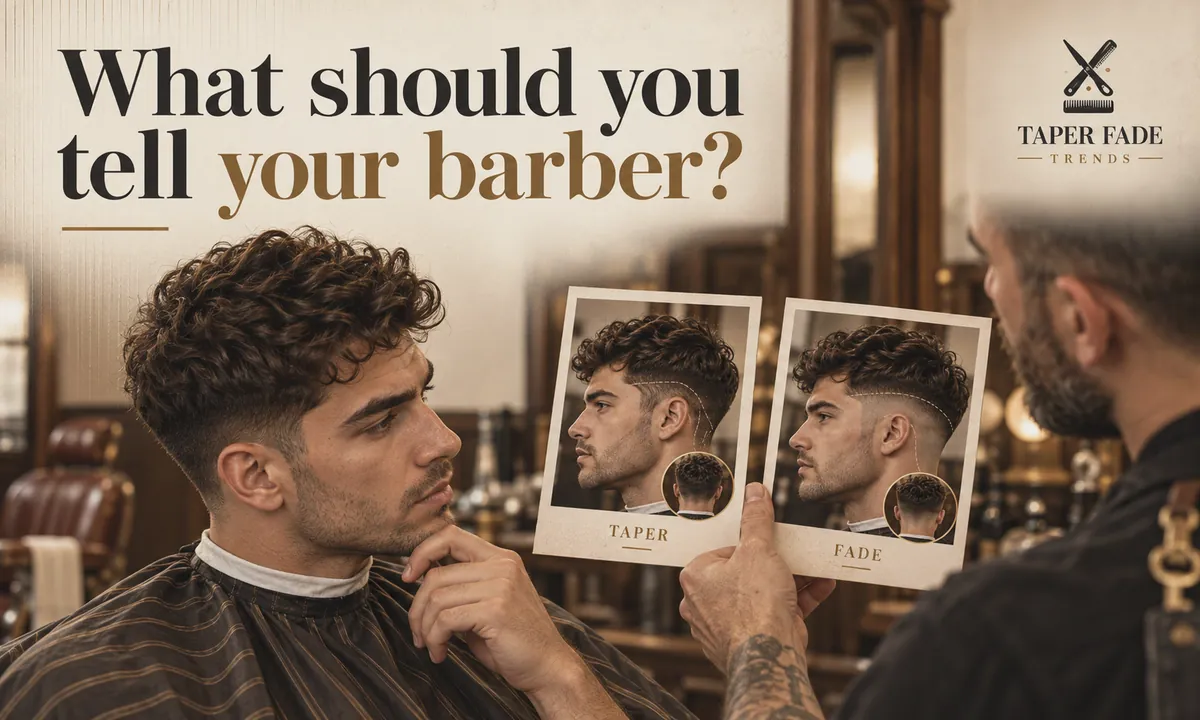
- Height: where the shortest work sits, low, mid or high.
- Coverage: kept local to the sideburns and nape, or carried across the sides and back.
- Shortest finish: visible hair, shadow or skin.
- Retained side weight: how full the side panel should stay.
Bring references from the front, both sides and the back, and point to the parts you want. Ask the barber to repeat the height and finish before the clippers start; those are the two details neither word guarantees. If you’re torn between two versions, ask for the longer, lower one first. More can come off in the same appointment. Nothing goes back on.
Barber brief for a taper
“Keep the short work to my sideburns, temples and nape, and don’t take it higher than [point on your head]. Leave [visible hair / a shadow / skin] at the lowest point, and keep as much weight through the sides as you can. Here’s the side and the back I’m after.”
Barber brief for a fade
“I’d like a [low / mid / high] fade carried around the sides and back, finishing at [visible hair / a shadow / skin]. Blend it into [length] on top and leave [some / very little] weight on the sides above the transition. This is the profile, and this is the back.”
Where “taper fade” fits
“Taper fade” has no single meaning in barbershops, so treat it as a starting point and then name the coverage, height and finish. Some barbers use it for localized short work at the temples and nape, others for a taper taken very short, and others for any fade. The label settles nothing on its own.
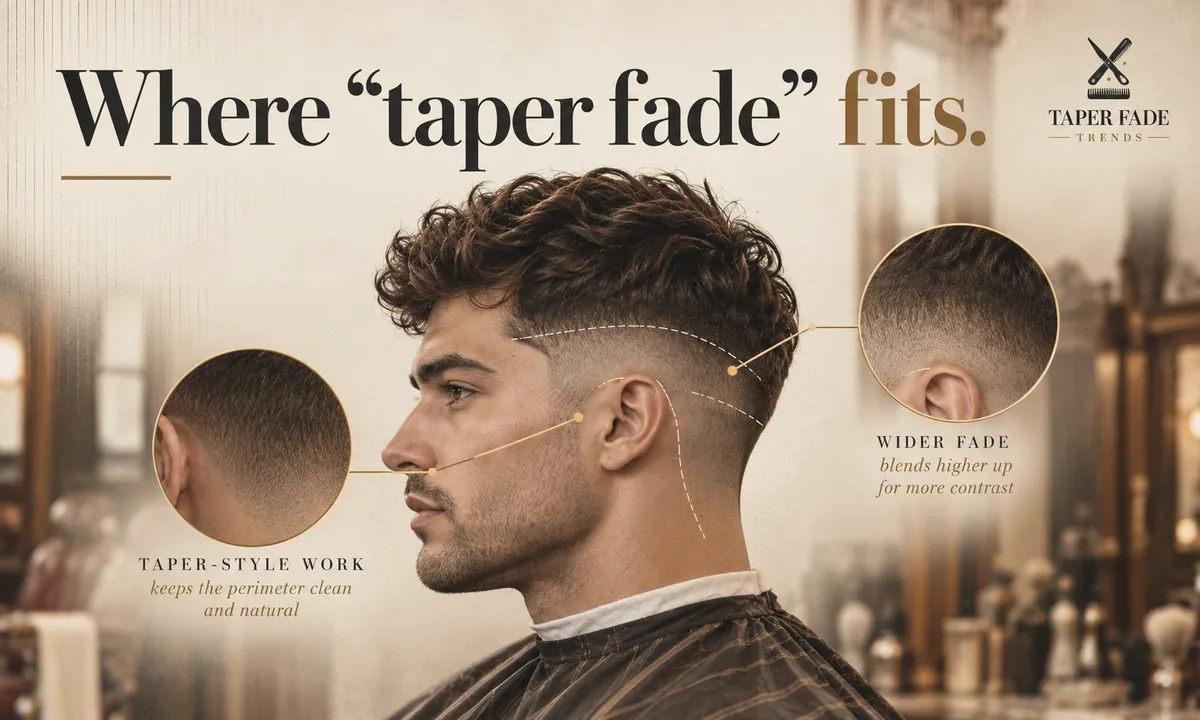
For height, finish and top choices under that name, see the taper fade guide.
What photos and haircut labels cannot tell you
A reference photo shows approximate placement, coverage, side weight and whether scalp is visible at the lowest point. It cannot reliably show the guard, blade or lever setting, hair density, growth direction, how many days have passed since the cut, or what lighting and editing did. Use a photo to agree on the visible result.
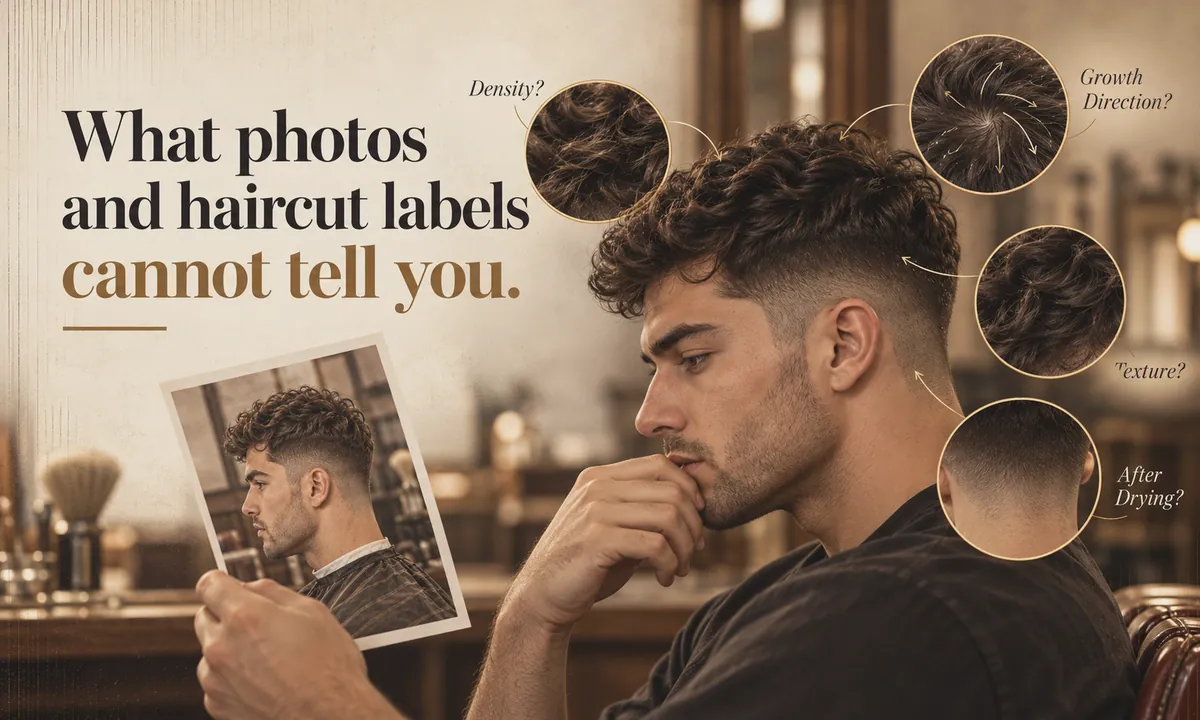
| Visible in a photo | Not reliably visible in a photo |
|---|---|
| Approximate placement and coverage | Guard, blade or lever setting |
| Side weight and overall silhouette | Hair density |
| Whether scalp shows at the lowest point | Growth direction |
| General shape from the angle shown | Days since the cut, lighting and editing |
Guard numbers don’t close the gap. The #1 = 1/8 inch and #2 = 1/4 inch figures are Wahl’s own, and Wahl notes that its taper lever moves the cut closer or longer between guard sizes, so one number can land at more than one length. Leave the settings to the barber.
How this comparison was checked
Taper Fade Trends Editorial built this comparison by reading how working barbers, a booking platform and haircut publishers currently use “taper” and “fade,” then separating the parts those labels blur: coverage, height, shortest finish and retained side weight. Where sources disagree, mainly over skin, the page shows the disagreement instead of choosing a winner. The aim is to help you describe a visible result before your next appointment.
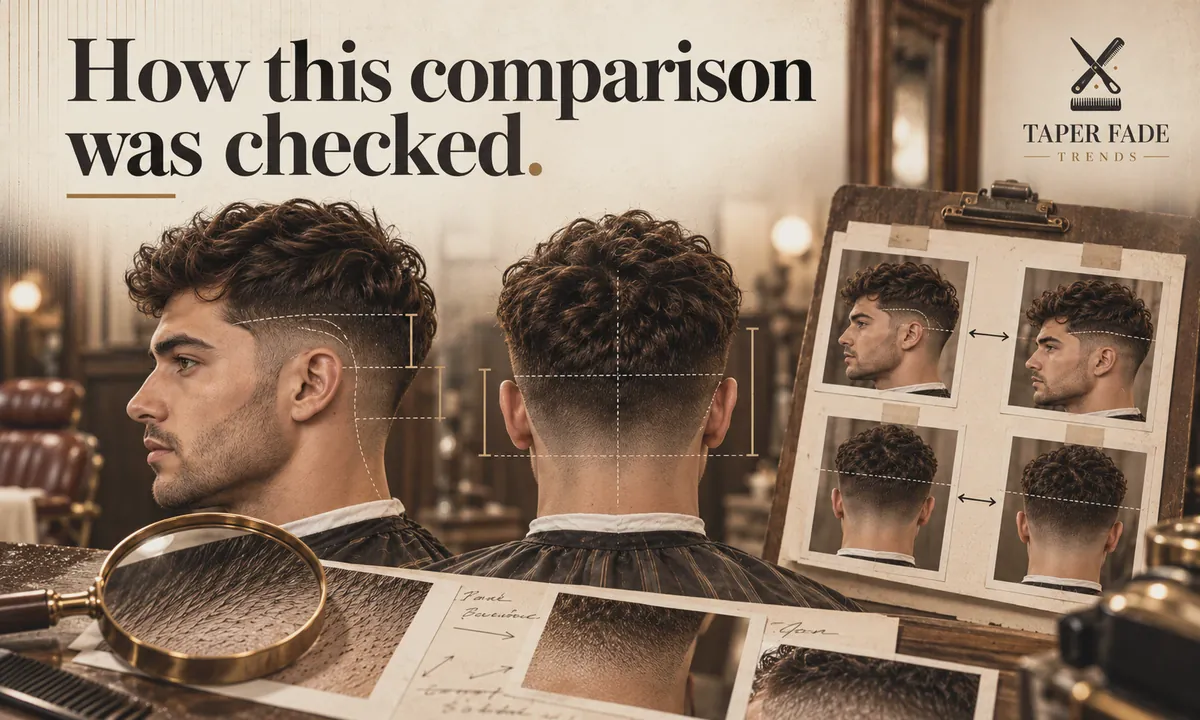
Terminology sources are linked where they are used above: Barber.Style, Youssef Ouda, Adrian Carranza (AC the Barber), StyleSeat, Men’s Hairstyles Today and Taper Empire. Growth rate comes from MedlinePlus, guard lengths from Wahl USA, and the skin note from the American Academy of Dermatology.
The diagrams on this page are illustrations, not photographs of documented cuts. No barber has reviewed this version yet; when one does, their name, role and review date will be added here.
Published and last checked September 27, 2026. Found an error? The editorial policy explains how corrections are made and dated, or you can contact us.
Next: choose the placement and finish
Once you know the coverage and finish you want, open the taper fade guide to choose the height and the top. If you’re leaning toward a high, sharp line, the high taper fade guide covers that placement. If you want a fade that curves around the ear and leaves the back longer, read the burst fade guide. To run the same coverage check at low height only, see low taper vs low fade. Either way, save a side and a back reference to your phone before the appointment.
Keep reading
All guides
Taper fade: a visual guide to heights, finishes and top styles
Where a taper fade sits from the front, side and back, how low, mid and high differ, and how to ask for side coverage and a finish with or without skin.
High taper fade: placement, finish and barber brief
Where a high taper fade sits, how much side weight stays, skin vs shadow finishes, what the back should look like, and exactly what to tell your barber.
Burst fade: arc height, shortest finish and back view
A burst fade curves around the ear. It doesn’t have to reach skin, and the back is a separate choice. See the three controls and what to tell your barber.
Low taper vs low fade: compare coverage and side weight
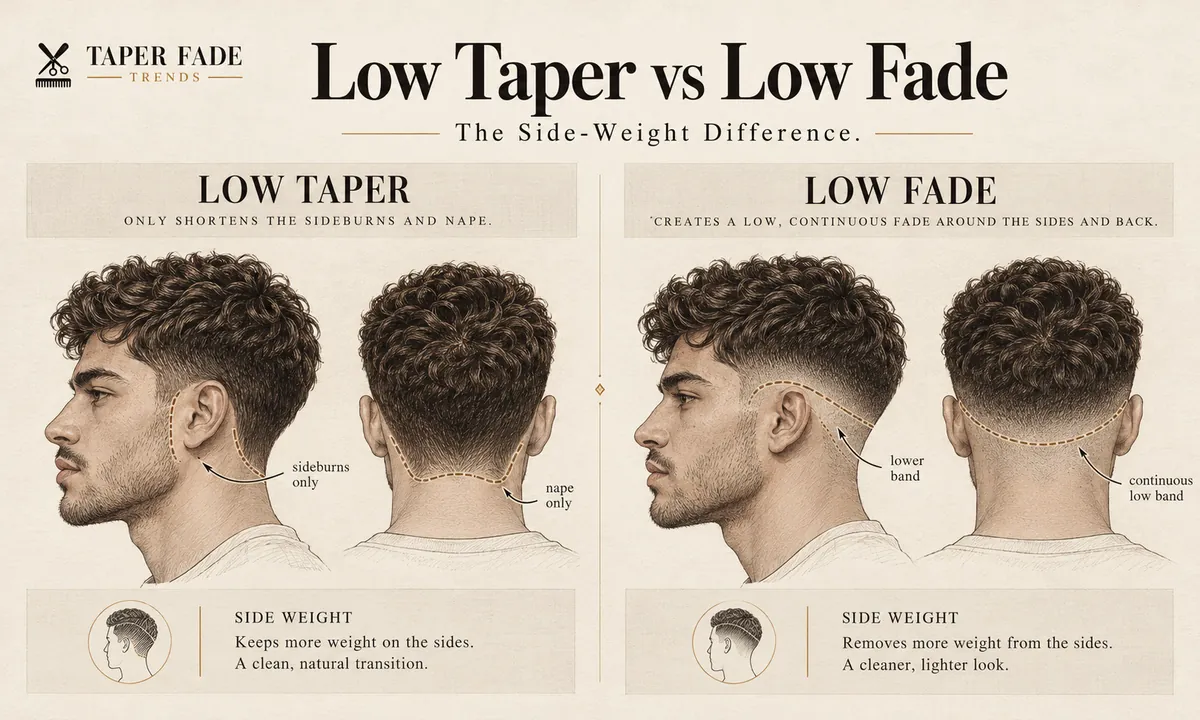
Low taper vs low fade: a low taper shortens the sideburns and nape; a low fade shortens a band around the lower sides and back. Compare finish and upkeep.
More in taper and fade comparisons
Taper and fade comparisons: all 5- Taper vs fade: what changes in area, finish and side weightYou are here
- High taper vs high fade: side, back and coverage8 min
- Low taper vs mid taper: what changes when only the height moves10 min
- Burst fade vs taper: compare the ear arc and nape10 min
- Low taper vs low fade: compare coverage and side weight11 min