Low taper vs low fade: compare coverage and side weight
Low taper vs low fade is a question of coverage. A low taper keeps its shortest work at the sideburns and nape, so most of the side panel stays full. A low fade carries the short work around a band of the lower sides and back. Either can end at skin or at a guarded length, so name that separately.
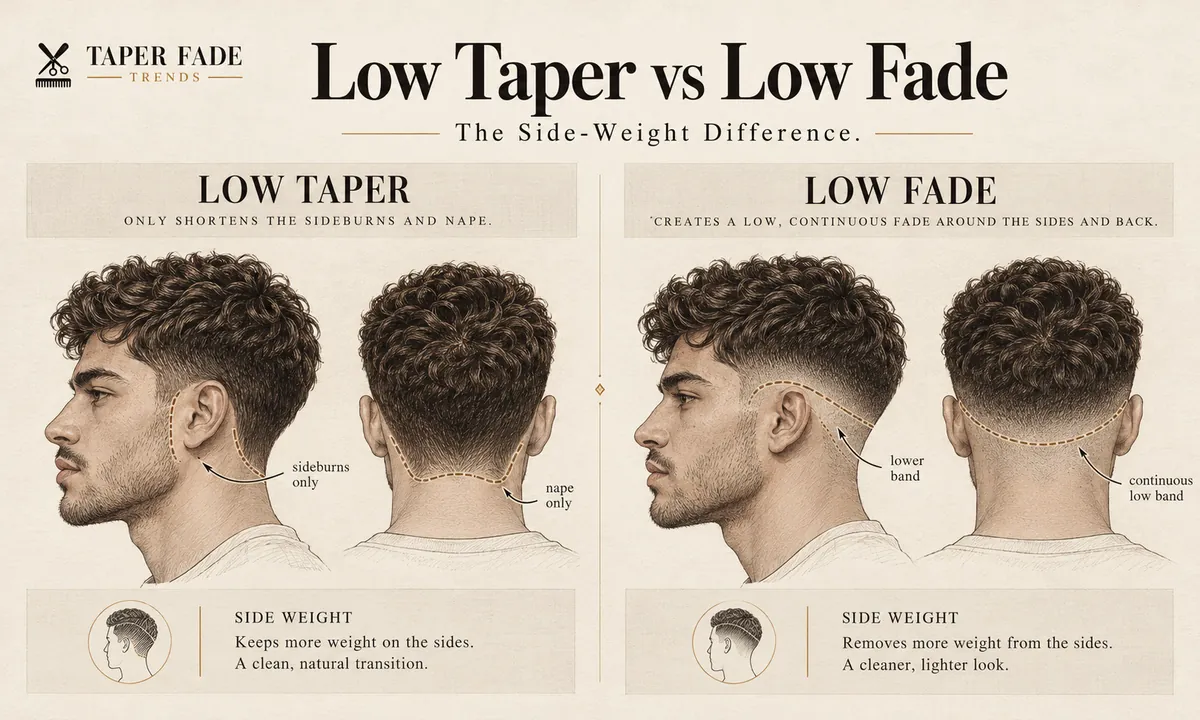
Low taper vs low fade at a glance
A low taper shortens only the perimeter: the sideburns and the nape. A low fade shortens a continuous band around the lower sides and back, so it takes more weight off the side panel. Neither name sets the shortest finish. Skin, stubble or visible hair is a separate request for either cut.
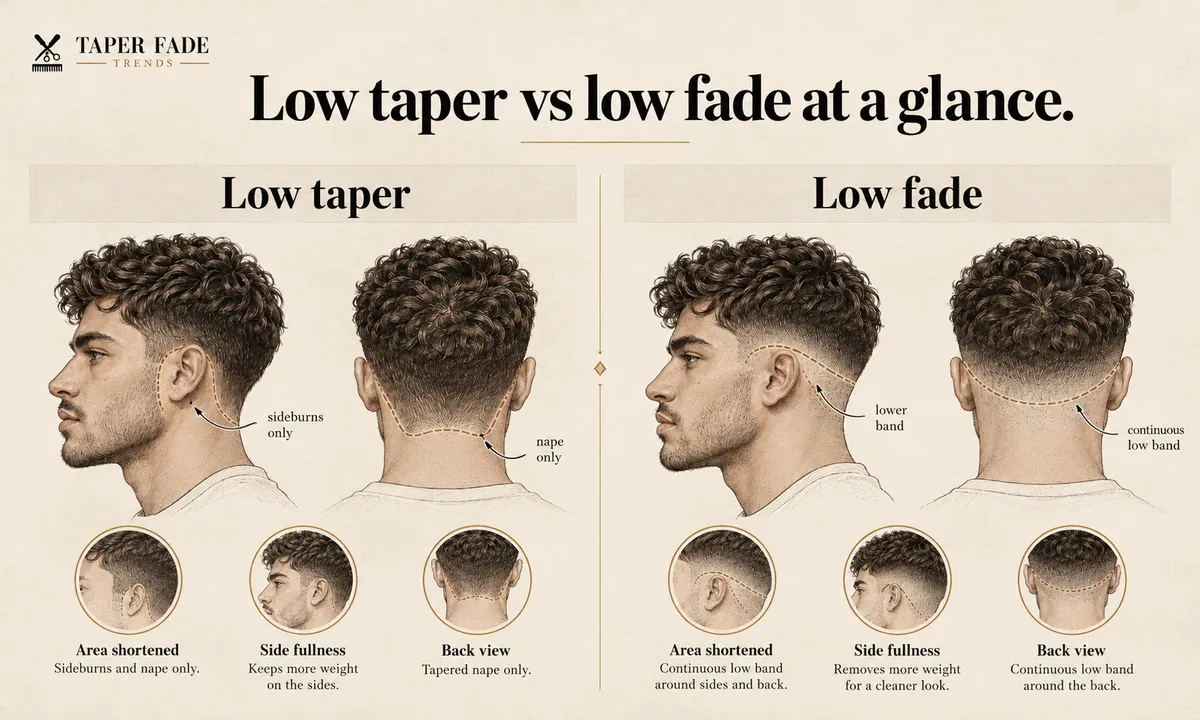
| Criterion | Low taper | Low fade |
|---|---|---|
| Area shortened | Sideburns and nape only | A continuous band around the lower sides and back |
| Side panel | Mostly left at full length, including around the ear | Shortened through the lower part, so less weight stays |
| Back view | Short work stays at the neckline | Short work joins up across the back |
| Shortest finish | Skin, stubble or a guarded length, as requested | Same range |
| Height | Low on both; no standard measurement, so point to the spot | Same |
| What shows first as it grows | Regrowth at two small edges | Regrowth across the whole band |
The nape is the hairline at the back of the neck. The side panel is the hair between the ear and the top. Side weight is this site’s working term for how much hair stays on that panel; it is not standard barber vocabulary.
Four independent guides draw the same line. Barber.Style contrasts separate areas at the sideburn and nape with a continuous band. Haircut.info notes that the hair around the ear is cleaned up on a low taper but faded on a low fade. MensMinimal and Beard Beasts describe the same split.
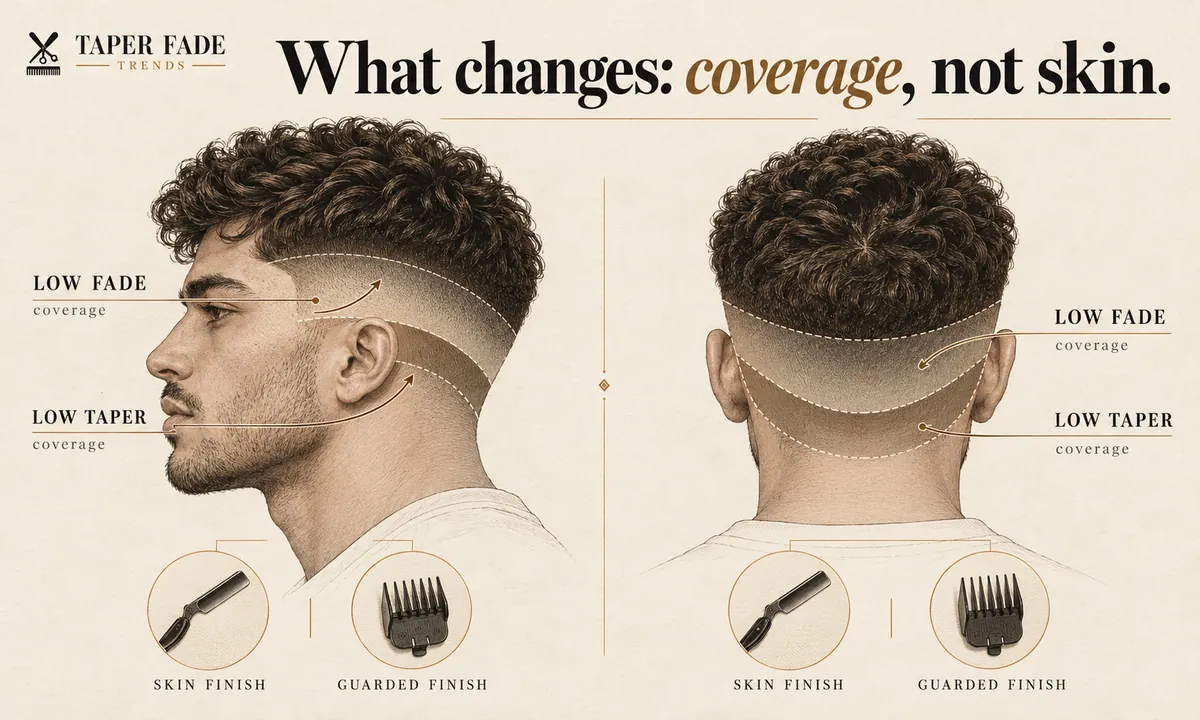
What changes: coverage, not skin
Coverage is the footprint of the area that gets shortened, and it is the one thing that reliably separates the two cuts. Skin exposure is not, because both can stop at bare skin or at a guarded length. Ask for the area first and the shortest finish second, and you have described either cut completely.
The same comparison across every height is in taper vs fade. This page covers low placement only.
What a low taper changes
A low taper is graduated shortening kept to two perimeter areas: the sideburns in front of the ear and the nape at the back. The hair above and around the ear keeps its side length, so from the front the cut barely changes. Because so little area is shortened, most of the side weight stays.
What a low fade changes
A low fade is graduated shortening carried as one continuous band around the lower sides and back. The band passes around the ear instead of stopping at the sideburn, so more of the lower side panel comes off than on a low taper at the same height. “Low” describes where the band sits, not how short its bottom gets.
Does a low fade have to show skin?
No. A low fade describes where the blend runs, a low band around the sides and back, not how short its bottom gets. A barber can finish a low fade at bare skin, at a zero with fine stubble, or at a guarded length. Shops use the words differently, so state the finish you want, not just “low fade.”
Can a low taper go to skin?
Yes. A low taper can be taken to bare skin at the sideburns and nape while the side panel above stays full. Barber.Style lists skin, zero, 0.5 and 1 as base options for a low taper, and Haircut.info’s low taper goes to skin or a #0.5. Some shops call this a skin taper, so name the finish yourself.
| Coverage | Finished at skin | Finished at a guarded length |
|---|---|---|
| Low taper | Bare skin at the sideburns and nape only; sides stay full | Close stubble or short hair at the two edges; the softest version |
| Low fade | A band of bare skin around the lower sides and back; the strongest contrast | A short band around the lower sides and back with no scalp showing |
A guard is a clipper attachment that leaves a set length. Wahl lists its #1/2 guard at 1/16 inch and its #1 at 1/8 inch, but other clipper systems run differently, so this page names no guard for either cut. The haircut numbers and guard sizes chart compares the systems.
Tell a low taper from a low fade in photos
Look at the area just above the ear, then the back. If the hair above the ear is at full side length and only the sideburn is short, it is a taper. If a short band runs around the ear and joins up across the back, it is a fade. A side view alone cannot show the back.
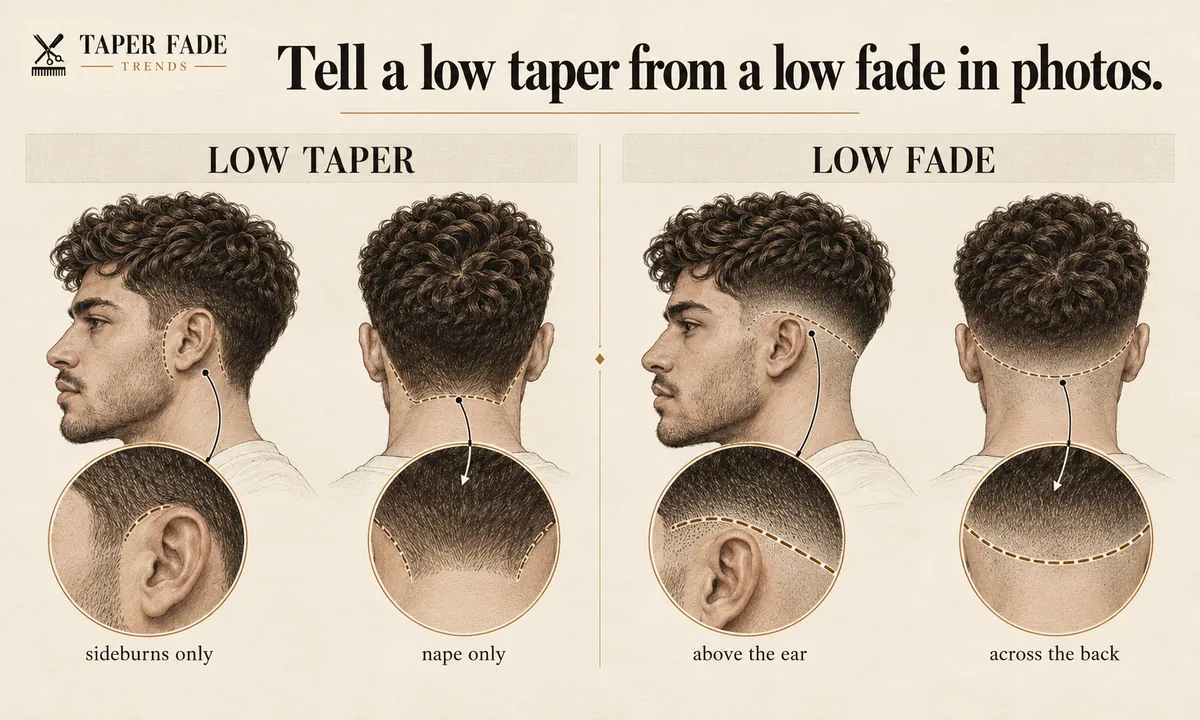
Compare photos only when the angle, lighting, top length and styling roughly match, because a styled top or a higher camera changes how full the sides look. A photo also cannot confirm the guard, the lever setting or how many days have passed since the cut, so say the shortest finish in words.
Which keeps more side weight?
At the same low height, top length and shortest finish, a low taper keeps more side weight because only the sideburns and nape are shortened. A low fade takes length off a whole band of the lower sides. Hair density, texture and growth direction still change how full either version looks on your head.
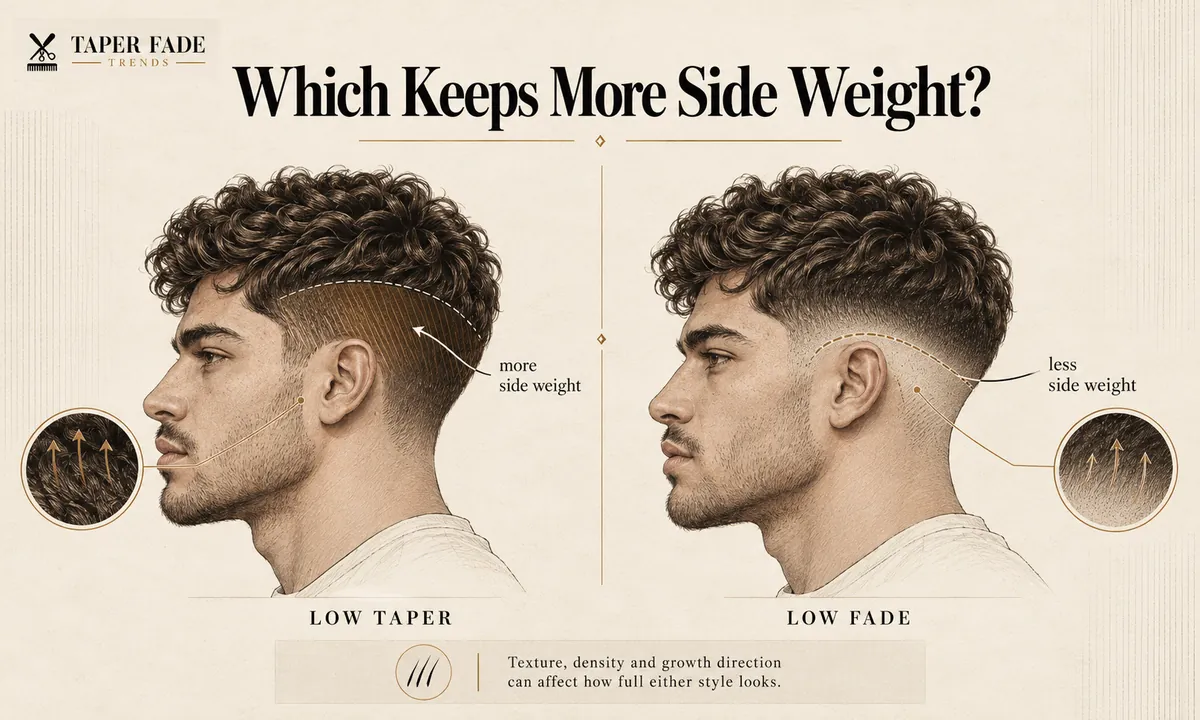
That comparison only holds when the other settings match. If one cut sits higher, finishes closer or has a shorter top, the sides look different for reasons that have nothing to do with taper versus fade. Growth direction means the way the hair lies as it leaves the scalp; a cowlick above the ear can make a taper look thinner than the reference.
How a low taper and a low fade grow out
There is no universal winner. A low taper usually looks less changed as it grows because only two small edges were shortened, but the shortest finish matters more than the name. A skin finish shows regrowth first on either cut. Plan upkeep from the finish you choose and how crisp you want the edge.
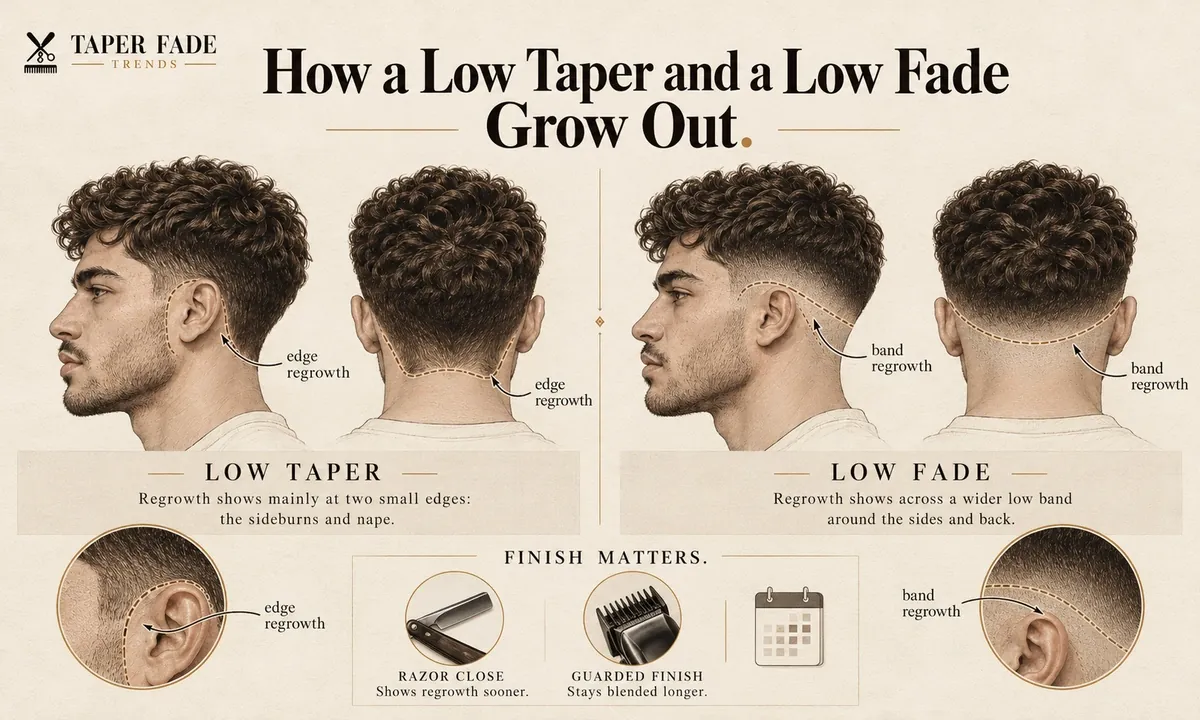
The arithmetic is simple. MedlinePlus puts healthy hair growth at about half an inch a month, roughly an eighth of an inch a week, and an eighth of an inch is the length Wahl lists for its #1 guard. A strip cut to skin is back to #1 length in about a week.
Published comparisons give fixed touch-up intervals, and the numbers move with the finish each source assumes:
| Source | Low taper | Low fade | Finish the source assumes |
|---|---|---|---|
| Taper Empire | 3 to 4 weeks, up to 6 | 1 to 2 weeks | Taper at #2 to #3; fade at #0 to #0.5 |
| BarberFaxhion | 3 to 5 weeks | 2 to 3 weeks | Taper with little or no skin; fade often to skin |
| PHD Barbers | 5 to 6 weeks | 2 to 3 weeks | Not stated |
| Haircut.info | 2 to 3 weeks; 3 to 4 with a #1 base | 3 to 4 weeks | Taper at skin or #0.5 |
| Barber.Style | 2 to 3 weeks at skin; 3 to 5 at a 0.5 or 1 | Not given | Stated per finish |
Read the table by its last column. When the taper is guarded and the fade goes to skin, the taper lasts far longer. When Haircut.info takes the taper to skin, its low taper needs a touch-up sooner than its low fade. Beard Beasts calls the low taper easier to grow out, which matches the common pattern. None of these figures is a measured result, and this page has no dated grow-out record of its own.
Choose a low taper or a low fade by routine
Choose a low taper to keep more side weight and a low fade to tighten a whole band of the lower sides. Choose coverage first, then the shortest finish, because either coverage works with either finish. The finish then sets most of the upkeep.
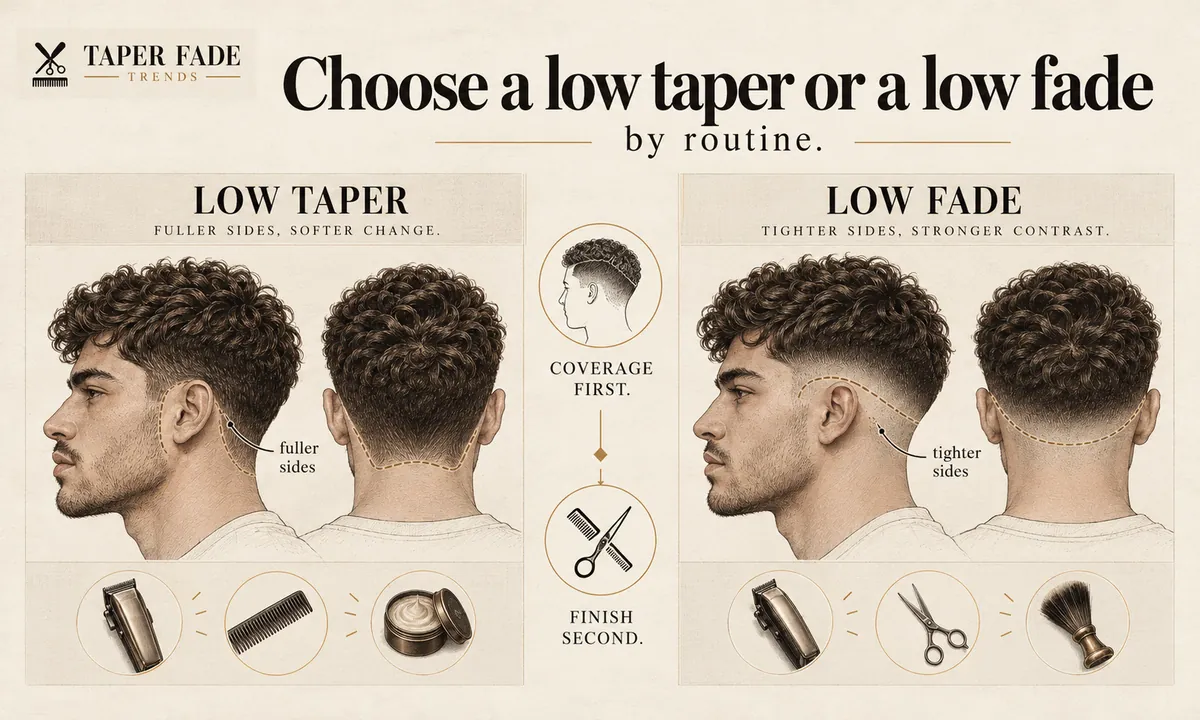
| If you want | Ask for | Trade-off |
|---|---|---|
| Fuller sides, sharp edges | Low taper at a guarded length | The least change to the sides; the softest contrast |
| Fuller sides with bare skin at the edges | Low taper at skin | Edges show regrowth within about a week |
| Tighter lower sides without bare scalp | Low fade at a guarded length | More side weight comes off; regrowth shows across a wider area |
| The strongest contrast | Low fade at skin | The most upkeep of the four |
If you are unsure, start with the taper or the longer finish. A barber can take more off in the same appointment; nothing goes back on. For choosing a low taper on its own terms, see the low taper fade guide.
What to ask your barber
Name three things: the area to shorten, the shortest finish, and how much side weight to keep. Then show a side photo and a back photo of the cut you want. The cut’s name is the least useful part of the request, because shops use “taper” and “fade” differently.
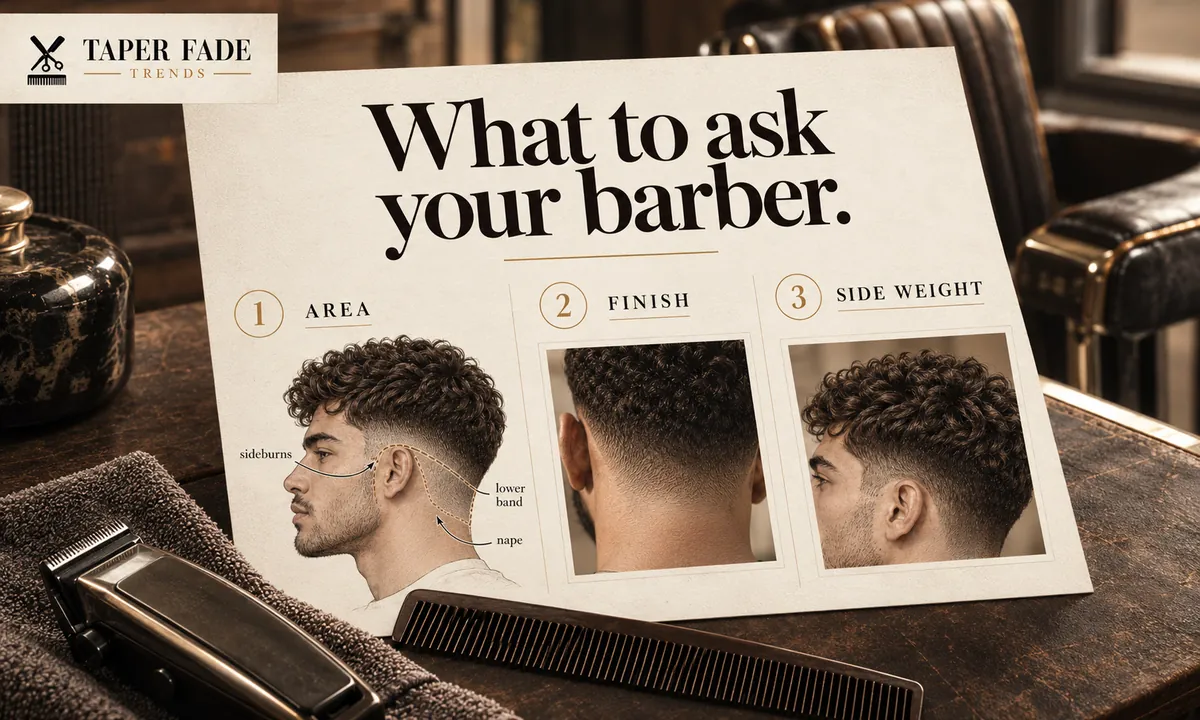
Start with one of these:
- Low taper: “Low taper, sideburns and nape only. Leave the hair above and around my ears at full side length.”
- Low fade: “Low fade, carried as a band around my lower sides and back.”
Then add the same lines to either request:
- “Take the shortest point to skin,” or “Leave a guarded length, no skin.”
- “Keep it low, and check with me before it goes any higher.”
- “Keep the neckline natural,” or “Give the neckline a defined edge.”
- “Leave the top at its current length,” or give the length you want.
Bring photos from the side and the back at minimum, ideally both sides. Before the clippers start, ask the barber to repeat back the area and the shortest finish. The how to ask for a taper fade guide covers the full consultation, and the haircut numbers and guard sizes chart explains any number the barber quotes.
Limits, terms and related cuts
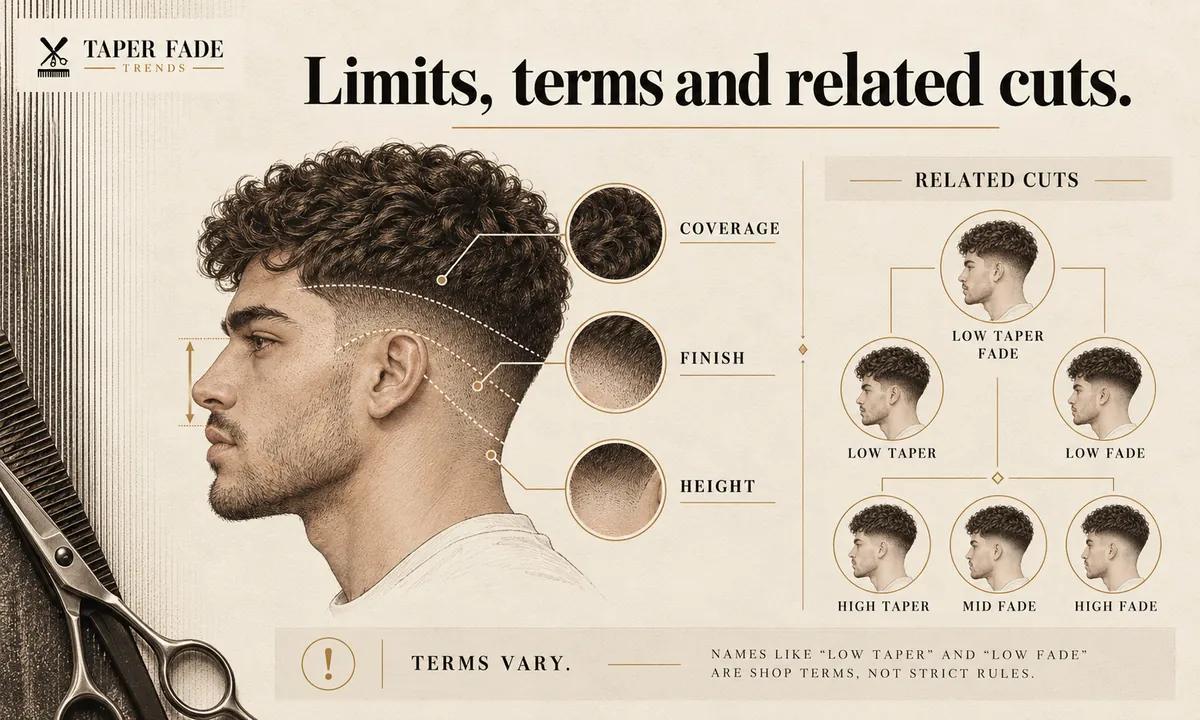
“Low taper” and “low fade” are shop terms, not standards, so a name alone cannot guarantee the cut. This page compares footprints and finishes as published guides describe them and makes no claims about skin or scalp reactions to close clipping. If close shaves give you bumps, the skin note in taper vs fade is the place to start.
Is low taper fade the same as low fade?
Usually not. Barber.Style says “low taper” and “low taper fade” are often used for the same localized edge work, and Haircut.info treats a low taper fade as a taper’s small footprint taken fade-short at the bottom. Taper Empire calls it a hybrid. None of the three equates it with a full low fade, so state the coverage and the finish.
The low taper fade guide covers that cut on its own.
Can you switch from a high taper to a low taper next visit?
Not in one visit if the sides are already short. A low taper keeps the side panel at full length, so the hair above the new, lower edge has to grow back first. The next appointment can lower the line and start the transition, but the result depends on your current length and growth rate. Going higher is immediate.
The low taper vs mid taper guide covers moving between heights.
Does a higher taper always need more frequent appointments?
Not always. Height is one factor, but the shortest finish, how much area was shortened, your growth rate and how crisp you like the edge also set the timing. MensMinimal lists base length and height among five factors, and Barber.Style gives a skin taper a shorter interval than a guarded one.
How this low taper and low fade comparison was researched
Taper Fade Trends Editorial compared how barber and reference guides define the two cuts, then separated the parts the names blur: coverage, height, shortest finish and side weight. Where the sources agree, this page states the definition. Where they disagree, mainly over skin and upkeep, it shows the disagreement. The cited guides were last checked on October 14, 2026.
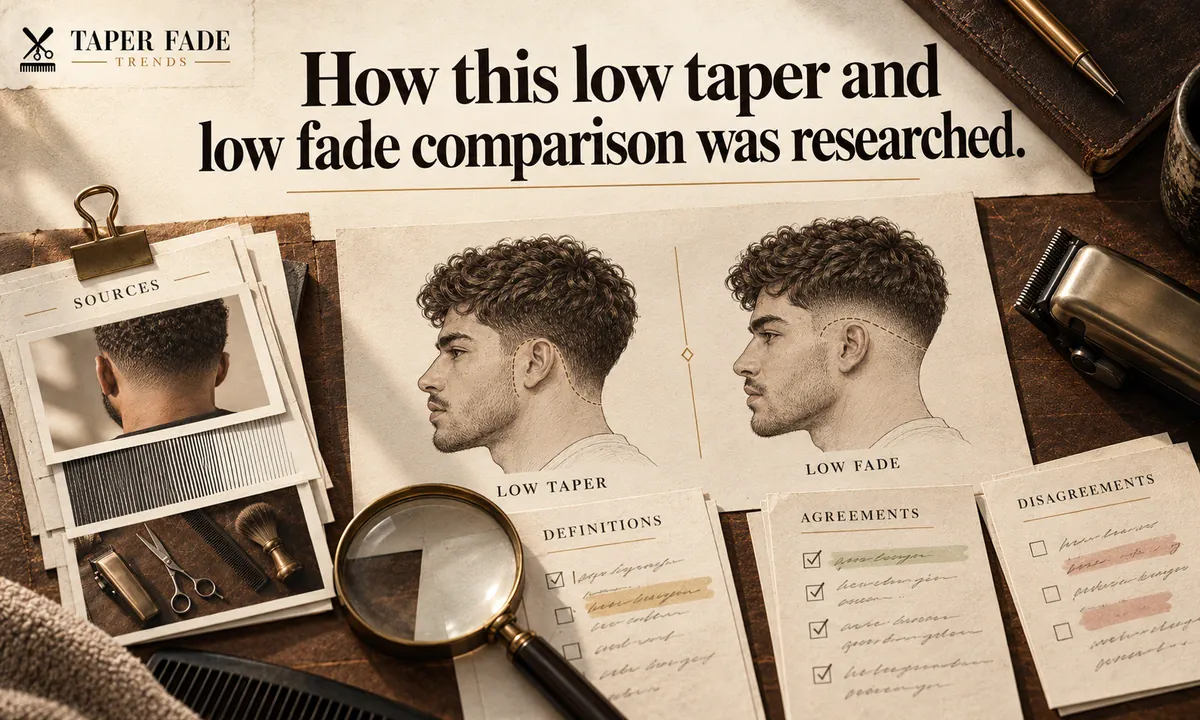
The diagrams on this page are illustrations, not photographs of documented cuts. This page reports no haircut test and no dated grow-out record, and no barber has reviewed this version yet. When one does, their name, role and review date will be added here.
Sources: Barber.Style, Haircut.info, MensMinimal, Beard Beasts, Taper Empire, BarberFaxhion, PHD Barbers, MedlinePlus for growth rate and Wahl USA for guard lengths and the taper lever.
Found an error? The editorial policy explains how corrections are made and dated, or you can contact us.
Next guides for a low taper or low fade
Pick the next guide by the decision still open.
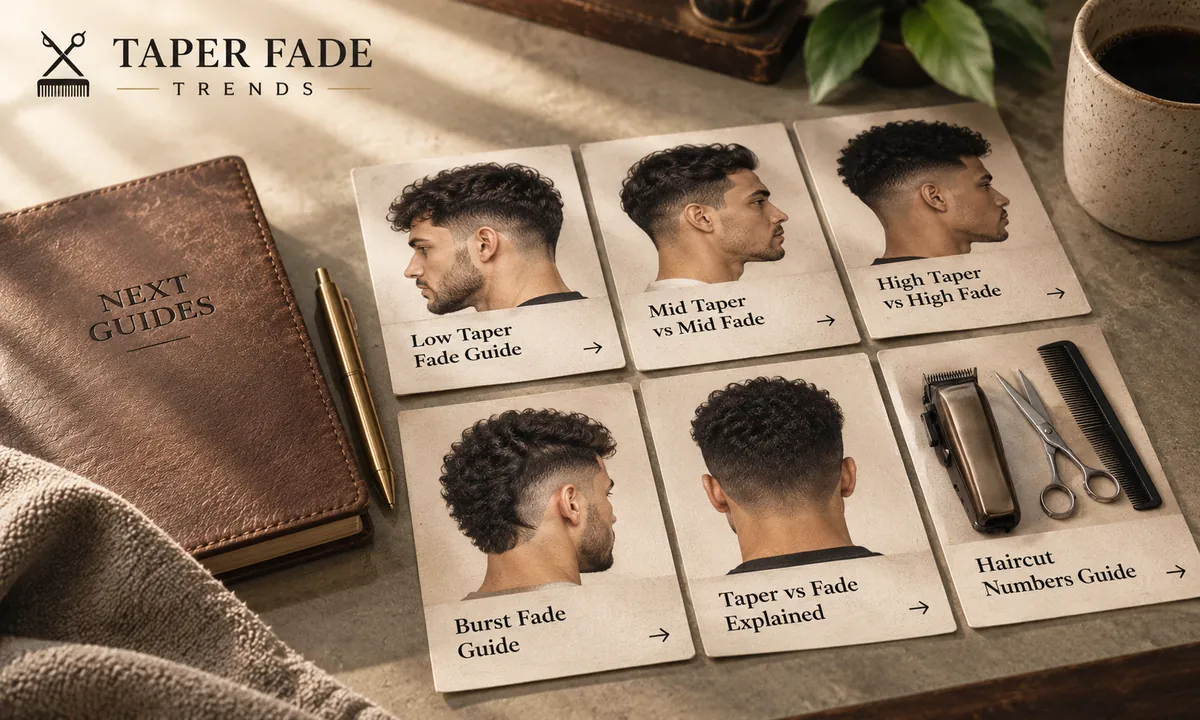
- For a higher blend: low taper vs mid taper.
- For the same comparison at the top of the head: high taper vs high fade.
- For the general terms at every height: taper vs fade.
- For a low taper under a longer back: low taper mullet.
If the footprint is settled but the shortest finish is not, choose the length in the haircut numbers and guard sizes chart.
Keep reading
All guides
Low taper fade: placement, finish, side length and upkeep
A low taper fade shortens the sideburns and nape and keeps the sides full. See the four choices to make, whether it can go to skin, and what to say.
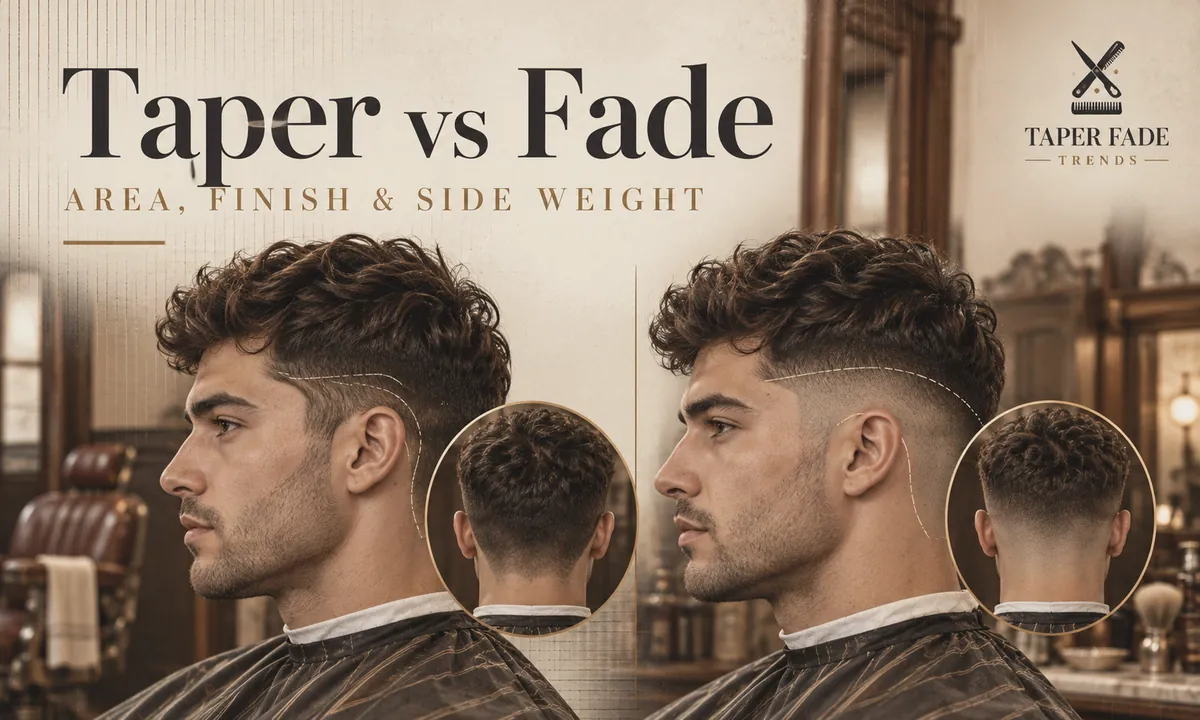
Taper vs fade: what changes in area, finish and side weight
Taper vs fade compared by coverage, height, shortest finish and side weight, with a back-view check and word-for-word barber scripts for either cut.
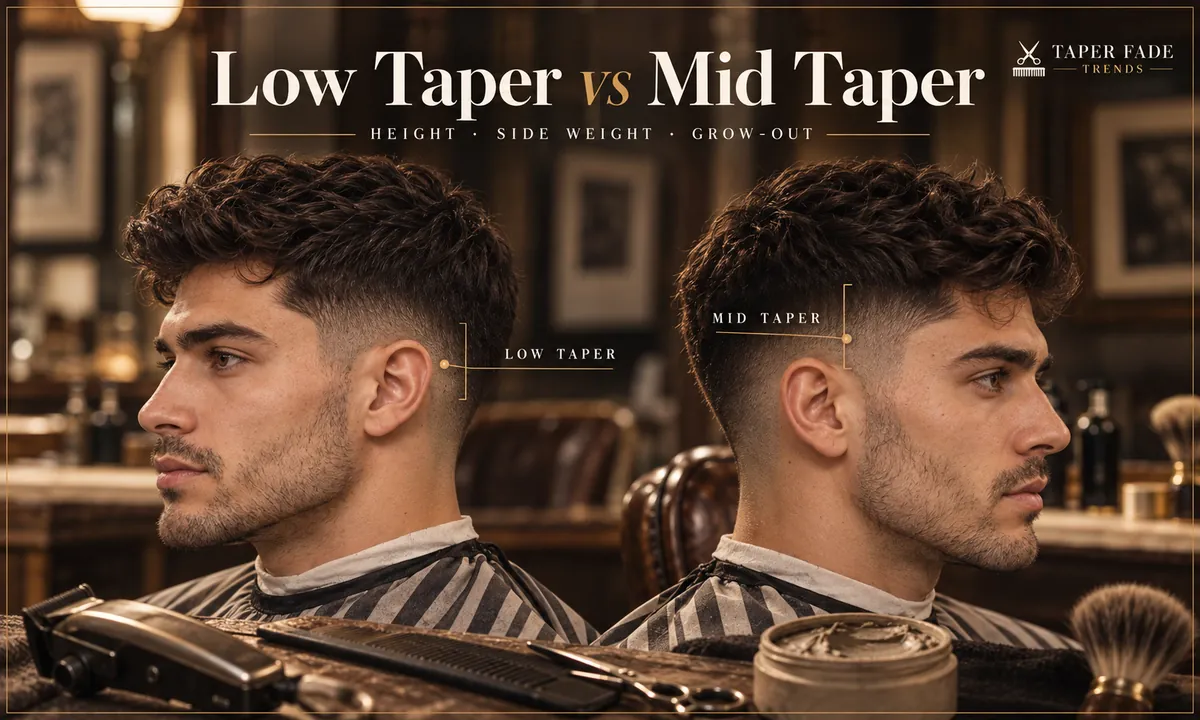
Low taper vs mid taper: what changes when only the height moves
Low taper vs mid taper compared on height, side weight, shortest finish and grow-out, why switching mid to low takes time, and what to tell your barber.
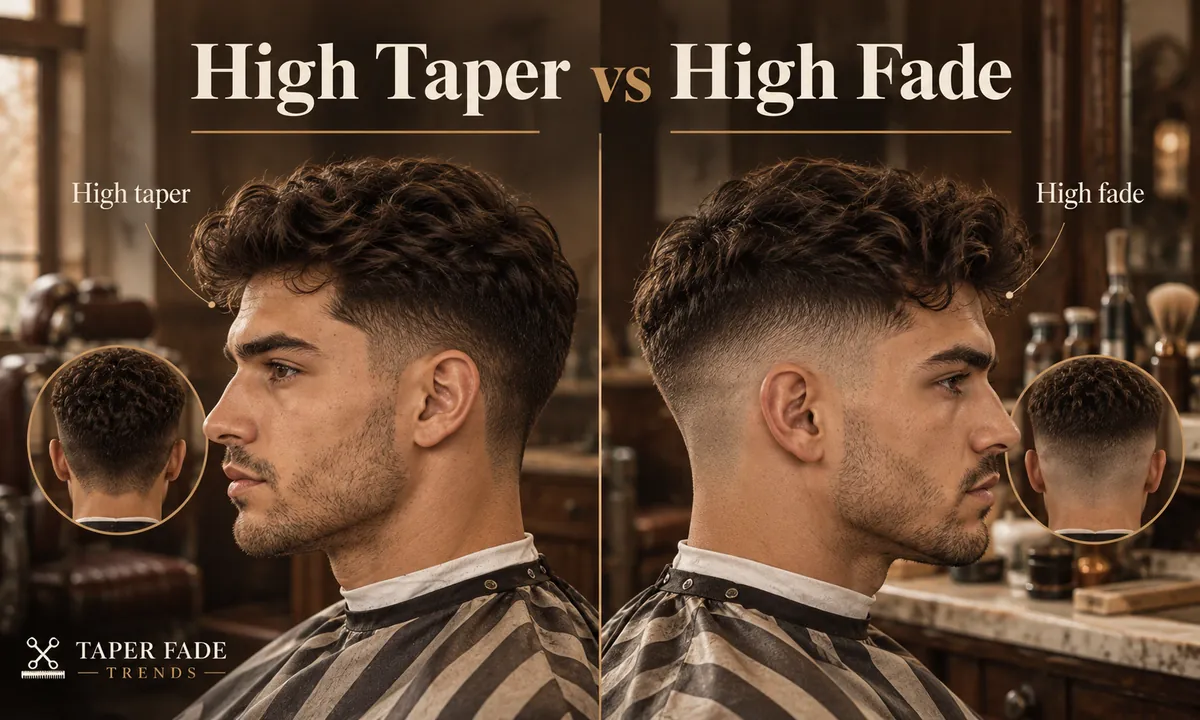
High taper vs high fade: side, back and coverage
High taper vs high fade compared by side weight, back coverage and shortest finish, plus why barbers use the names differently and a four-point brief.
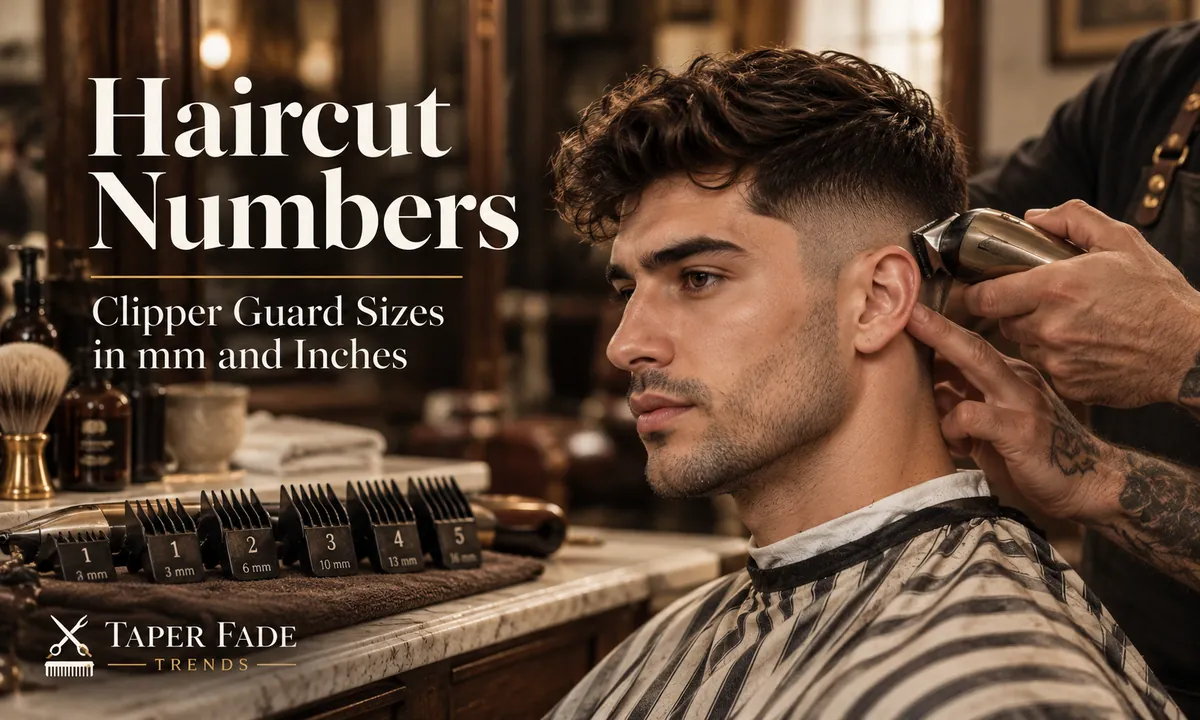
Haircut numbers: clipper guard sizes in millimeters and inches
Haircut numbers in mm and inches, checked against Wahl, Andis and Oster specs, plus why #0 isn’t always no guard and what to tell your barber.
How to ask for a taper fade: a five-part barber brief
How to ask for a taper fade: say where it may reach, how short the base goes, how much side weight stays and what to do on top, then check the plan first.
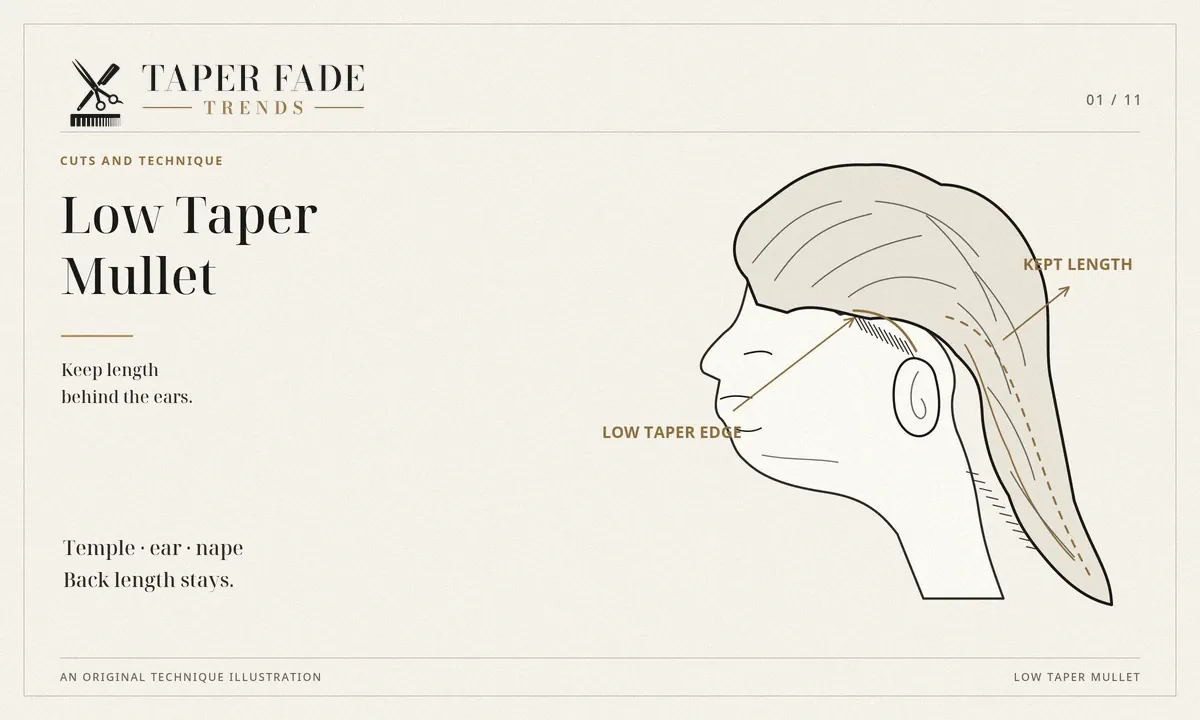
Low taper mullet: keep length behind the ears
A low taper mullet keeps length behind the ears and through the back. See what to tell your barber, how texture changes it, and how to grow it out.
More in taper and fade comparisons
Taper and fade comparisons: all 5- Taper vs fade: what changes in area, finish and side weight10 min
- High taper vs high fade: side, back and coverage8 min
- Low taper vs mid taper: what changes when only the height moves10 min
- Burst fade vs taper: compare the ear arc and nape10 min
- Low taper vs low fade: compare coverage and side weightYou are here