Mid taper fade curly hair: choose dry length, side width and finish
A mid taper fade on curly hair starts the blend around temple height and keeps the shortest work at the sideburns, around the ears and at the nape, so more curl width stays on the sides than a full mid fade leaves. Choose the dry length, the width you keep and the shortest finish, then show your barber all three.
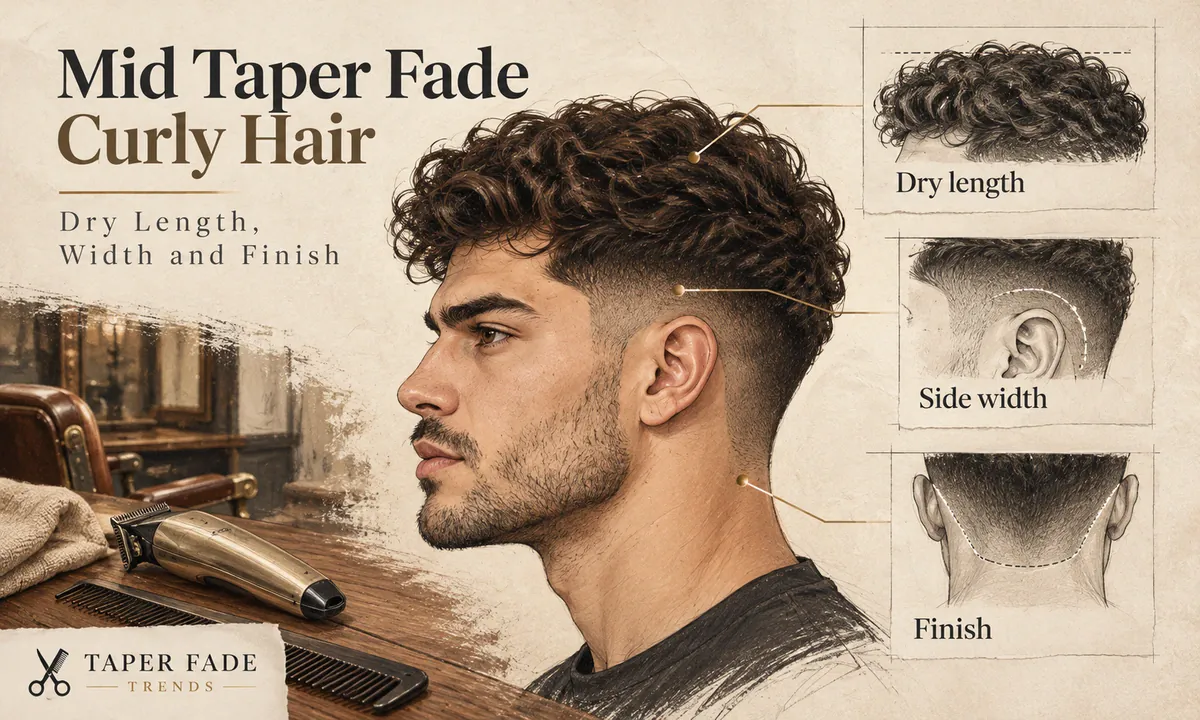
Seven fields turn the name into an order. “Unknown” means this guide has no recorded value, so that decision is yours and your barber’s.
| Decision | What it settles |
|---|---|
| Placement | Where the blend starts, around temple height. Point to it on your head, because shops place “mid” differently. |
| Side coverage | How far the short work travels. A mid taper fade stays at the sideburns, ear perimeter and nape. |
| Shortest finish | Skin, shadow or a short visible length at the base. This is a separate choice from placement. |
| Dry top length | Where the curls sit once dry. Unknown until it is measured on your own hair. |
| Retained width | The curl width kept above the ear, judged dry. |
| Curl-state check | The barber looks at your curls dry before cutting and checks the result dry. The cutting method is the barber’s call. |
| What this guide records | Cited guidance and labeled illustrations. No real cut was photographed or measured for it. |
What a mid taper fade changes on curly hair
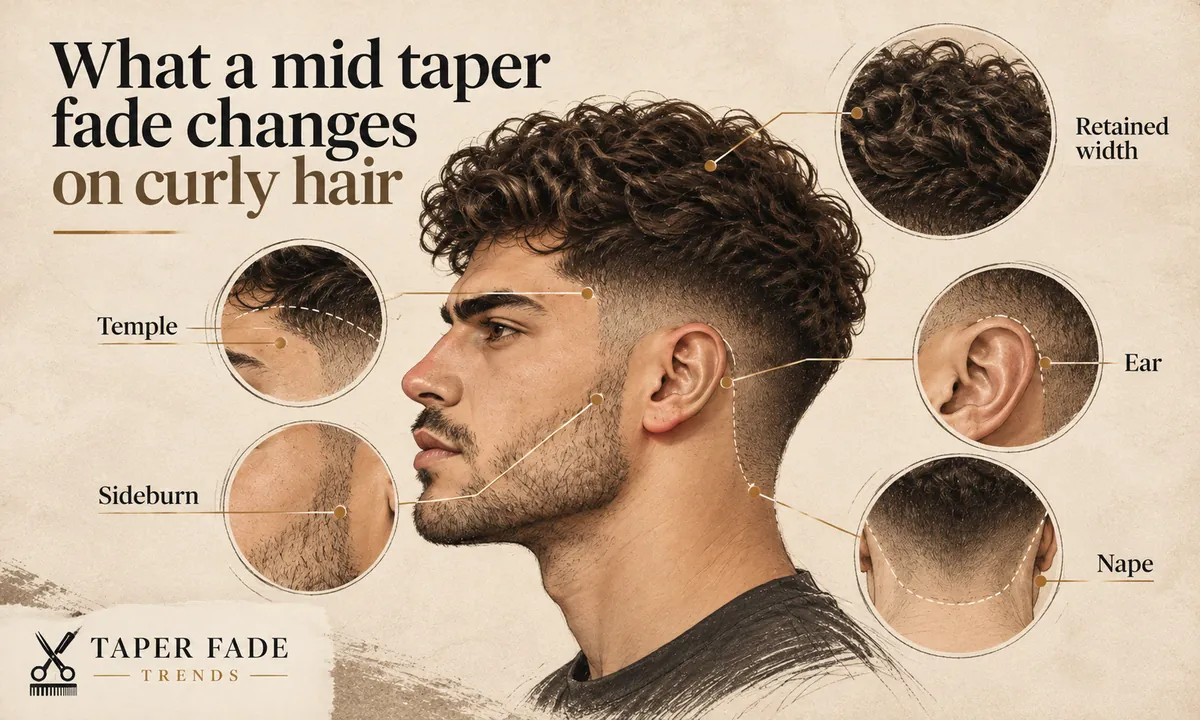
A mid taper fade is a perimeter-focused taper that starts around temple height. It keeps its shortest work at the sideburns, around the ears and at the nape, and leaves more side coverage than a full mid fade. On curly hair the name fixes only that placement and coverage. Dry length, retained width and shortest finish are separate choices.
A taper shortens hair gradually toward the perimeter, which is the outer edge around the ears and along the neckline. StyleSeat describes a taper as keeping the shortest hair at the hairline and leaving the sides longer than a fade does. Wolf’s Head, a California barbershop, draws the same line: a taper stays at the sideburns and neckline, while a fade climbs the sides. Wolf’s Head also says plainly that these terms are not standardized from shop to shop.
This page covers what curly hair changes. The mid taper fade guide covers placement, finish and side weight on every hair type. For straight sides that lie flat or push outward, see mid taper fade on straight hair. For coily tops, waves or locs, see the mid taper fade for Black men guide.
Choose dry curl length and silhouette
Curly hair does not have to be cut only dry. A dry assessment shows the shape and spring you actually wear. Wet cutting suits big length changes and a strong perimeter, according to Redken Pro. For a mid taper fade on curly hair, ask for your curls to be judged dry before cutting and checked dry at the end.
Redken’s curl education says no two heads of curls are the same, and that dry cutting shows how hair with strong bounce-back responds. Paula Peralta, a Paul Mitchell international trainer, told American Salon that a wet cut works for clients who wear their hair both curly and straight. A dry cut suits clients who wear it curly most of the time. If you wear your curls natural every day, say so before the cut starts.
Dry length is where the curl actually sits after it returns to its ordinary worn state. It is not the length measured while the hair is stretched or wet. The silhouette is the outline that dry length draws above the tapered sides.
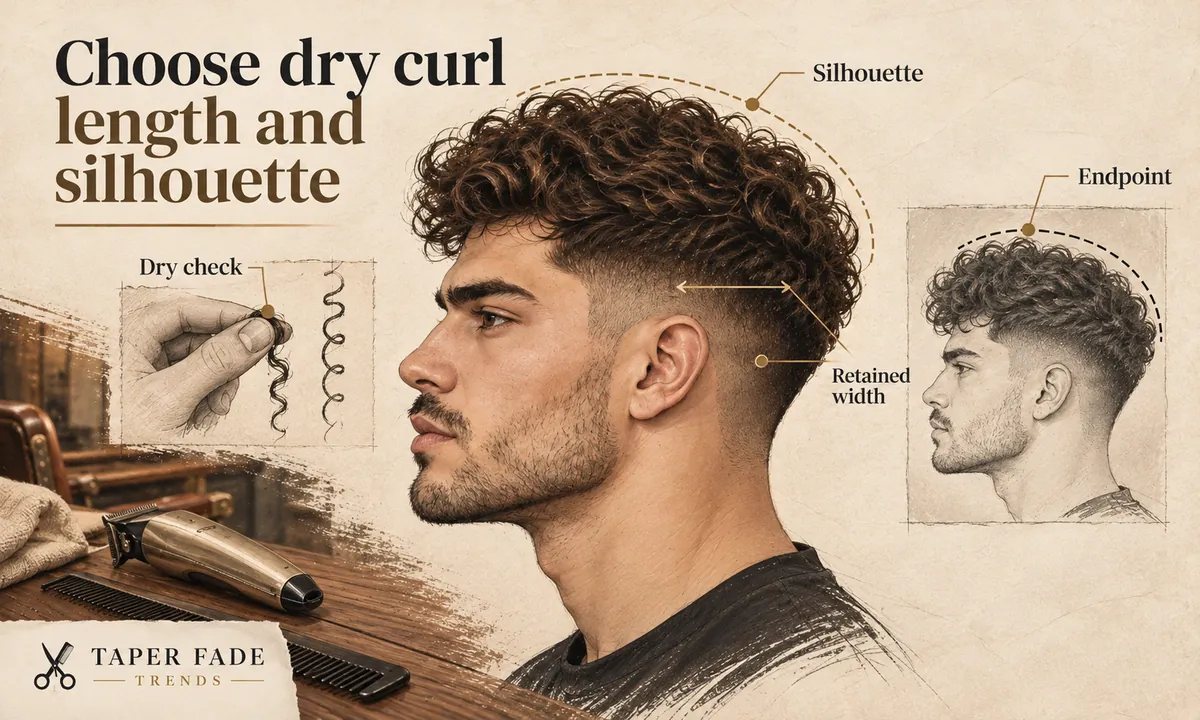
Curl-type labels such as 3A or 4B describe broad appearance, not a taper recipe. Density, growth direction, mixed patterns, current length, styling state and the width you want to keep can all change the result within one curl type. Use the label as context, and decide from how your curls actually sit dry.
Decide the dry endpoint for curly hair
There is no reliable universal shrinkage percentage to subtract from wet curly hair. Hair Muse notes that the change varies between people, across one head, and from one wash routine or weather condition to the next. Measure one section damp and again dry, then plan the cut from your shortest everyday dry length.
Curl shrinkage is the loss in apparent length as hair returns from stretched or wet to its curled dry state. The amount is individual. Peralta describes a quick check barbers use: spray one section with water and compare how far it stretches against the dry hair beside it. She adds that most curly-haired clients already know their own shrinkage.
At home, the same comparison works with a ruler. Measure one top curl at rest when it is dry. Then measure it damp and gently straightened, and note the date and whether you used product.
Some gallery guides print shrinkage tables by curl type, with ranges from about 10% to over 70%, and they disagree with each other. None that we checked explains how its numbers were measured. This guide has no measured example, so it gives no number.
Keep width above the taper
To keep width above a mid taper fade, decide where the short perimeter work must stop and where fuller curls should start. Point to that boundary on your head and on a side photo. Ask the barber to keep the weight line above it, and judge the balance only once the curls are dry.
Retained width is the curl width kept above the taper. The weight line is the visible edge where the short work meets that width. This is a way to communicate the shape, not a measured standard.
Does a mid taper stop curls going triangular?
A mid taper fade can narrow a curly outline at the sideburns and around the ears, because that is where its shortest work sits. It does not touch the curls above the blend. Width carried higher on the sides or on top stays until the top itself is shaped. Several guides promise the cut “fixes” a triangular outline, so show your barber where yours is widest.
Mid taper vs full mid fade on curly hair
A mid taper fade and a full mid fade can start at the same height but remove different amounts of side hair. The taper keeps its shortest work at the sideburns, ears and nape. A full mid fade shortens a broad band across the side and back. Shops use the names loosely, so show the coverage you want instead of relying on the label.
A full mid fade is a broader side-and-back graduation whose shortest zone extends across more of the head than a perimeter taper.
| Attribute | Mid taper fade | Full mid fade |
|---|---|---|
| Side coverage | Short work stays at the edges | Short work runs across the side and back |
| Curl width kept above the ear | More | Less |
| Contrast with a curly top | Softer, held at the perimeter | Stronger, visible across the side |
| Label risk | Some shops call it a mid fade | Some shops call it a mid taper |
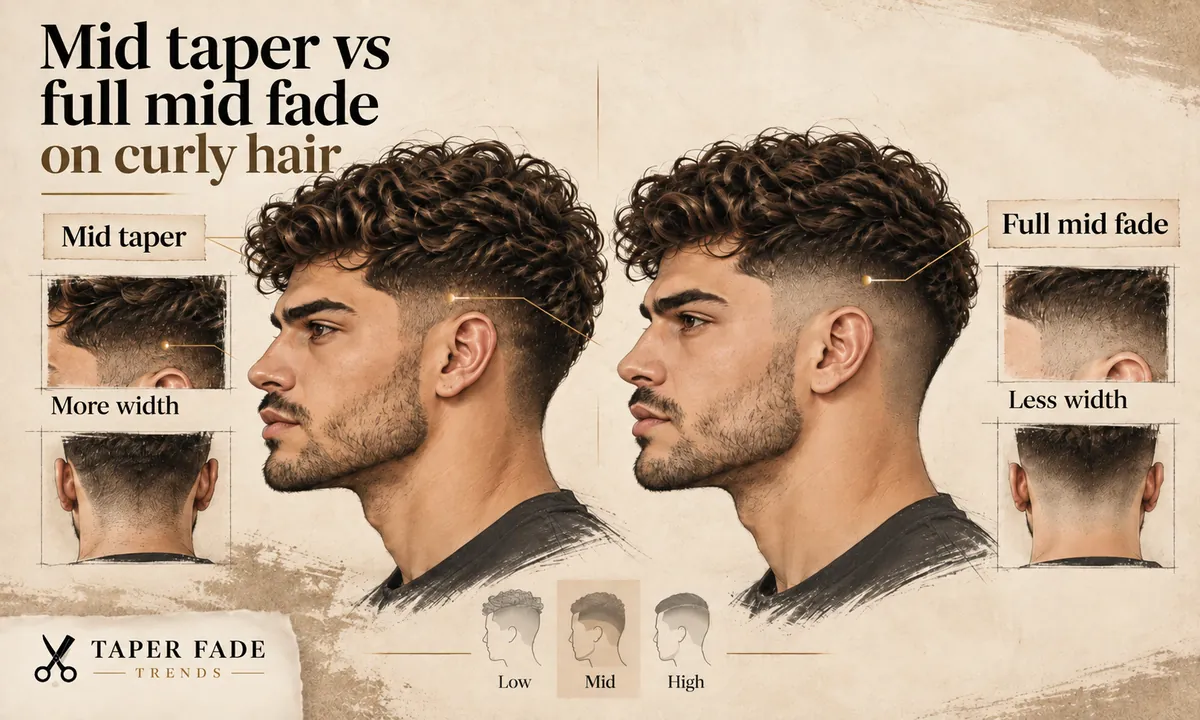
Skin or shadow can sit on either cut, so the finish does not tell them apart. Coverage does. Guides that define a mid fade as one that “goes to skin” are mixing the finish with the coverage. The taper vs fade guide covers that distinction on every hair type.
Mid taper vs the low and high curly tapers
Moving the start of the blend higher takes more side hair off and raises contrast. Moving it lower keeps more curl beside the top.
| Cut | Where the blend starts | Curl width kept above the ear | Guide |
|---|---|---|---|
| Low taper | Low, at the temples, sideburns and nape | Most | Curly low taper fade |
| Mid taper | Around temple height | Between the two | This guide |
| High taper | High, around the temple and nape | Least | High taper fade on curly hair |
A barber can take the blend higher at your next visit. Going lower means waiting for the sides to grow back.
Compare dry shapes before you choose a reference
Choose the dry top length first, then check it against your own density and growth direction. The taper sets the sides and the dry length sets the top. That means one mid taper fade can sit under a short, compact top or under a longer, fringe-led one.
Density is how much hair covers the scalp, and it changes how full the same retained width looks. Growth direction is the way hair leaves the scalp, as at a cowlick or a crown whorl. It can push curls away from the shape in a photo.
This guide does not match shapes to face shapes. The gallery guides that do so cite no source for their tables.
| Criterion | Shorter dry shape | Longer or fringe-led shape |
|---|---|---|
| Dry length | Curls sit close to the head | Curls extend further, and the front can fall forward |
| Step from taper to top | Smaller | Larger |
| Daily handling | Less length to shape and detangle | More length to shape and detangle |
| Check at the consultation | Retained width, which carries more of the outline | Growth direction at the front hairline and crown |
| Choose it if | You want a tight outline and quick mornings | You want curls falling forward and accept the extra work |
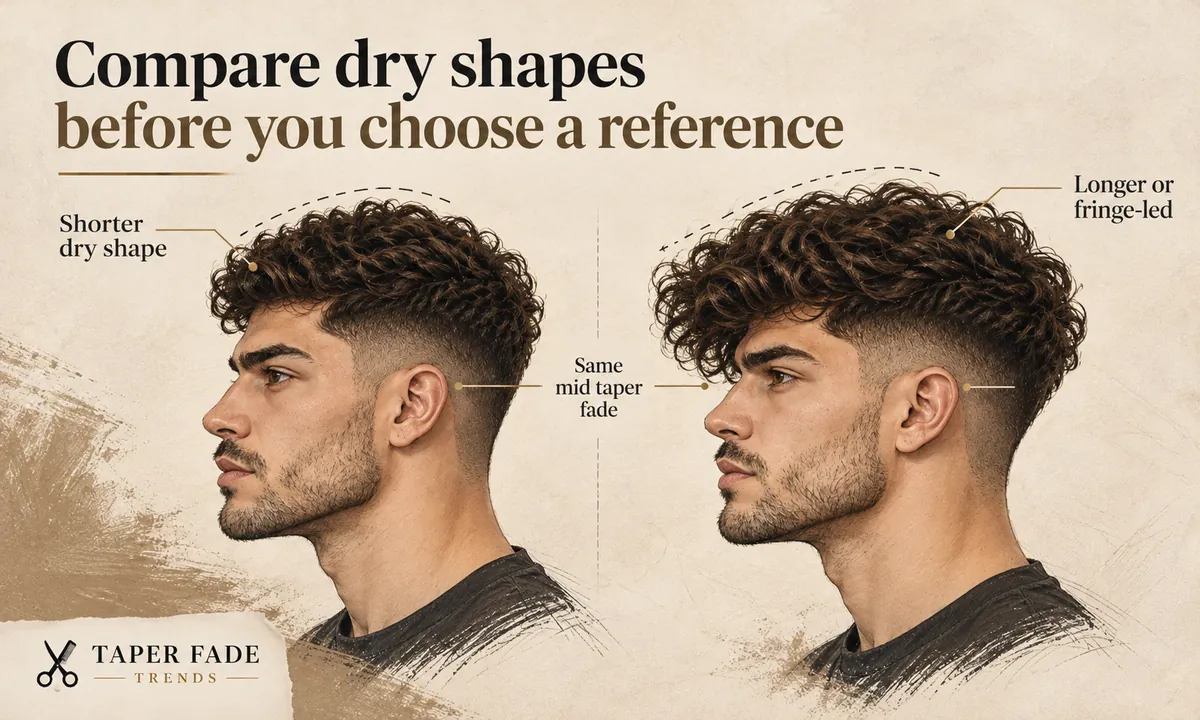
Shorter dry shape above the taper
Choose the shorter dry shape when quick styling matters more than top volume. With the curls close to the head, the width above the taper carries more of the silhouette, so settle that first. A shorter top also leaves less length to correct if the dry check misses.
Longer or fringe-led shape
Choose the longer shape when you want the front curls to fall forward and you will handle more length each day. A cowlick at the front hairline can push curls away from where a fringe needs to sit. Ask the barber to check growth direction before cutting.
What to tell your barber
Tell your barber four things for a mid taper fade on curly hair: where the blend starts, how much curl width stays above the ear, how short the shortest finish goes, and where the curls should sit when dry. Back it up with front, side and back photos of one cut, then ask how the barber reads “mid.”
- Placement: point to where the blend starts at the temple and sideburn.
- Side coverage: show where fuller curls begin above the ear, using a side photo.
- Shortest finish: say skin, shadow or a short visible length at the base.
- Dry length: show where the top should sit once dry, not wet.
“Start the taper here, keep my curls full above this line, finish the base at a shadow, and judge the top dry.”
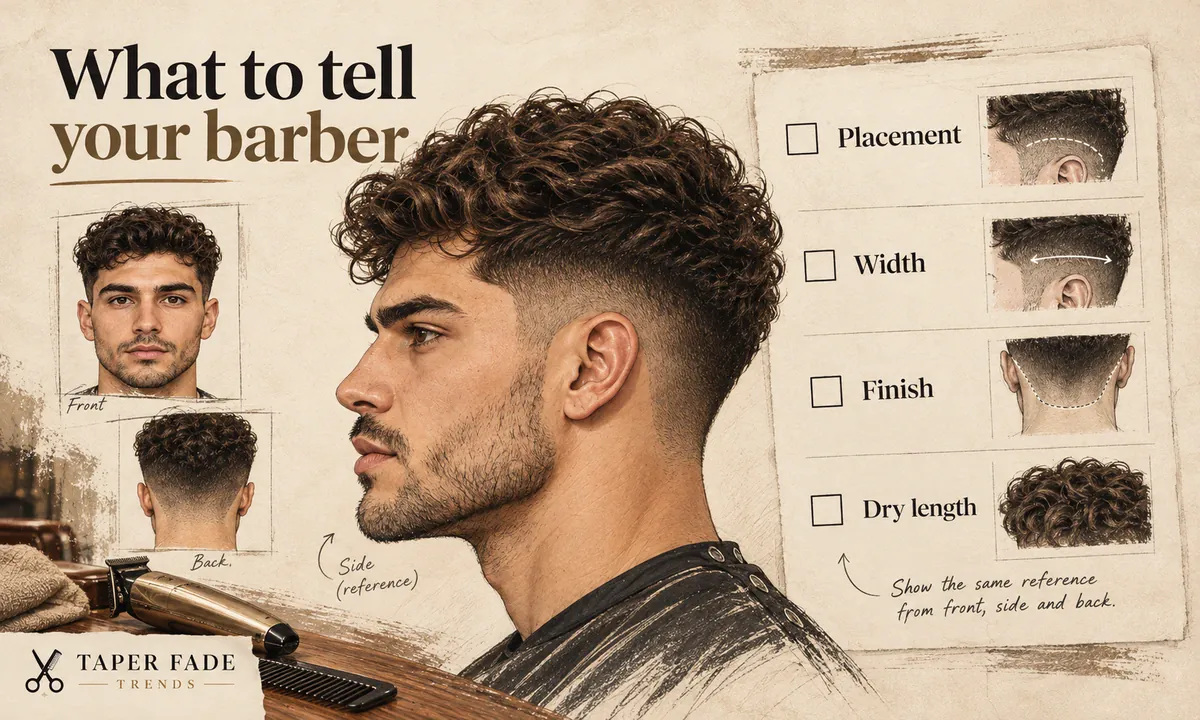
Name the neckline as well. StyleSeat notes that a tapered neckline grows out most naturally, while rounded or blocked shapes need upkeep to hold their line.
Bring these photos:
- One reference cut from the front, both sides and the back
- Your own hair, dry, from the same angles
- A note on any difference in density or curl size between you and the reference
Leave guard and blade choices to the barber. A guard number sets a length inside one clipper system, not how far the short work travels. For the general version of this brief, see how to ask for a taper fade.
Style the curly top without changing the taper
Style only the top, since nothing you do at the mirror moves the taper. These steps follow the American Academy of Dermatology (AAD) curly-hair page, last updated in June 2022.
- Wash only when needed. Frequent washing leaves curls dry, frizzy and hard to manage. The AAD still sets a minimum of every two to three weeks for scalp and hair health.
- Keep the curls moisturized. The AAD calls curly hair drier than other types. It suggests a moisturizing shampoo made for curls, conditioner on all of the hair, then a leave-in or oil.
- Detangle wet, not dry. Wet the hair thoroughly, add leave-in conditioner, and work through it with fingers or a wide-toothed comb. The AAD warns against brushing curly hair dry.
- Limit heat and strong sun. Both can dry curly hair out, and the AAD suggests a wide-brimmed hat outdoors.
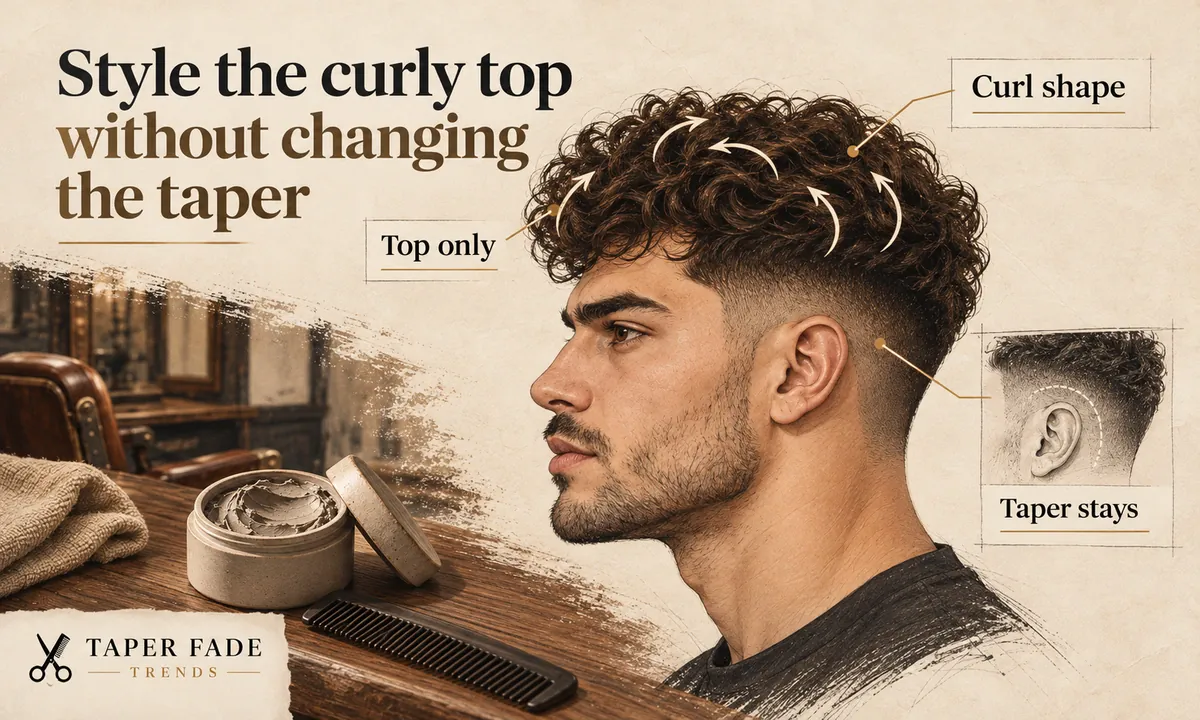
The AAD expects some trial and error before a routine works. This guide names no products and makes no claim that the cut improves hair or scalp health.
Grow-out, upkeep and alternatives
No single evidence-backed rebooking interval fits every curly mid taper fade. A closer shortest finish usually shows regrowth sooner than a softer one, and your own growth rate moves the date. Rebook when the sideburns or nape stop matching your reference photo, rather than after a fixed number of weeks.
Published advice disagrees. Gallery guides give anywhere from two to four weeks. Wolf’s Head says most of its taper clients get three to four weeks before the neckline needs cleaning up, and that sharper fades show regrowth sooner. Treat any figure as one shop’s experience.
| Factor | Effect on timing | What to decide |
|---|---|---|
| Shortest finish | Skin shows regrowth sooner than a shadow | How close the base should go |
| Hair and skin contrast | Regrowth is easier to see where the colors differ more | How much regrowth you accept |
| Neckline | A blocked or rounded edge blurs before a tapered one | How crisp the nape should look |
| Growth rate | Sets how fast the outline softens | Note the weeks it took, then repeat |
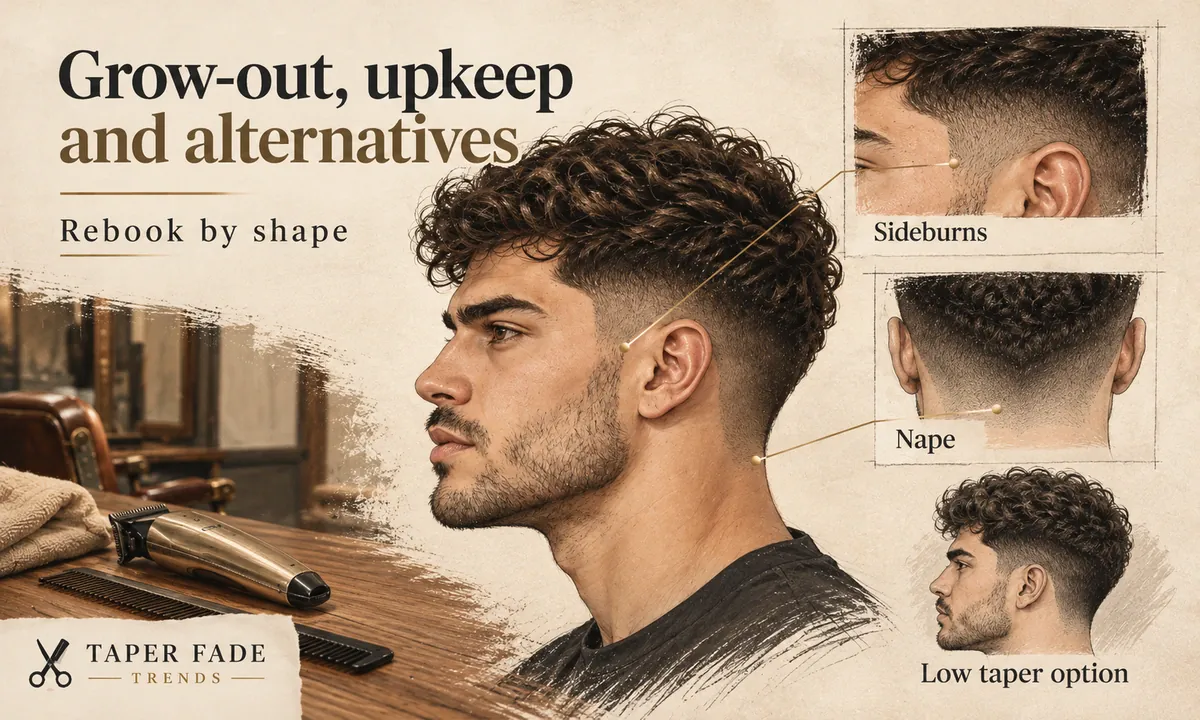
The top runs on its own schedule. A perimeter-only cleanup can leave the curls alone.
What if I want less side removal?
Ask for a lower start or a softer finish. Starting the blend lower keeps more curl beside the top, which is a curly low taper fade. A less close shortest finish leaves more hair at the edge and shows regrowth later. For the opposite, a broader faded side, ask for a full mid fade.
What a photo cannot tell you about a taper
A photo shows an outline, not the measurements behind it. It cannot show an unrecorded cut’s dry length, its damp-to-dry change, the subject’s density or growth direction, or the guard and blade used. Use a photo as a target to point at, not a recipe to copy.
Method, sources and photo notes
Taper Fade Trends’ editorial team wrote this guide on October 13, 2026. It compares current haircut guides with professional curl-cutting education and the AAD’s care advice. Where sources disagree, the page says so.
No named barber has reviewed this guide, and no real cut was photographed or measured for it. Dry length, damp-to-dry change and tool settings therefore stay unknown. The figures are labeled illustrations that explain coverage and shape. They are not haircut results.
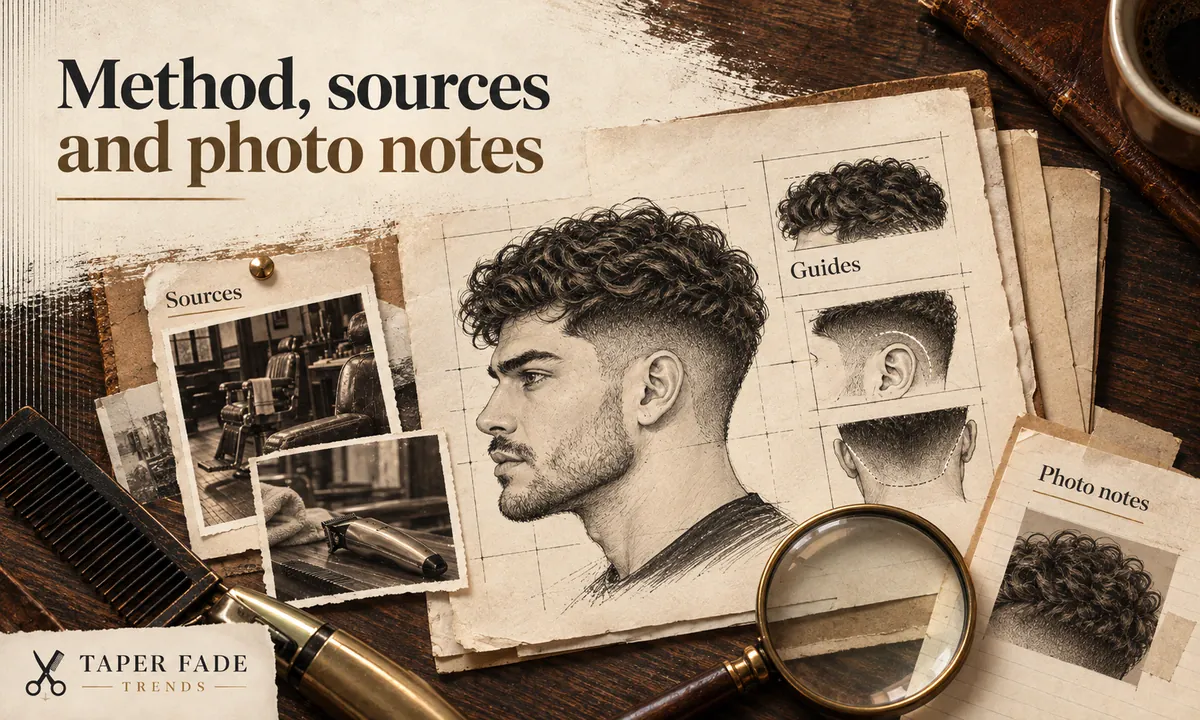
Sources cited in this guide:
- Redken Pro: Curl cutting techniques, on wet and dry cutting
- American Salon: Q & A with Paula Peralta, on the cutting method and the shrinkage check
- Hair Muse: Curly hair shrinkage, on planning from your own dry length
- American Academy of Dermatology: Curly hair care, on the care steps
- Wolf’s Head: Tapers vs fades vs blends, on terminology and taper upkeep
- StyleSeat: Taper vs fade, on terminology and necklines
If you are still choosing a height, compare placements in the mid taper fade guide before saving a curly reference photo.
Keep reading
All guides
Mid taper fade: what it is and what to ask your barber
What a mid taper fade is, how it differs from a full mid fade, why skin is optional, and the four specs to give your barber before the cut starts.
Curly low taper fade: keep curl width above the ears
A curly low taper fade cleans the temples, sideburns and nape but keeps curl width above the ears. What to decide, check dry and tell your barber.
High taper fade curly hair: keep the curl shape, clean the perimeter
How a high taper fade works on curly hair: what side weight to keep, why curls are judged dry, how to measure shrinkage and what to tell your barber.
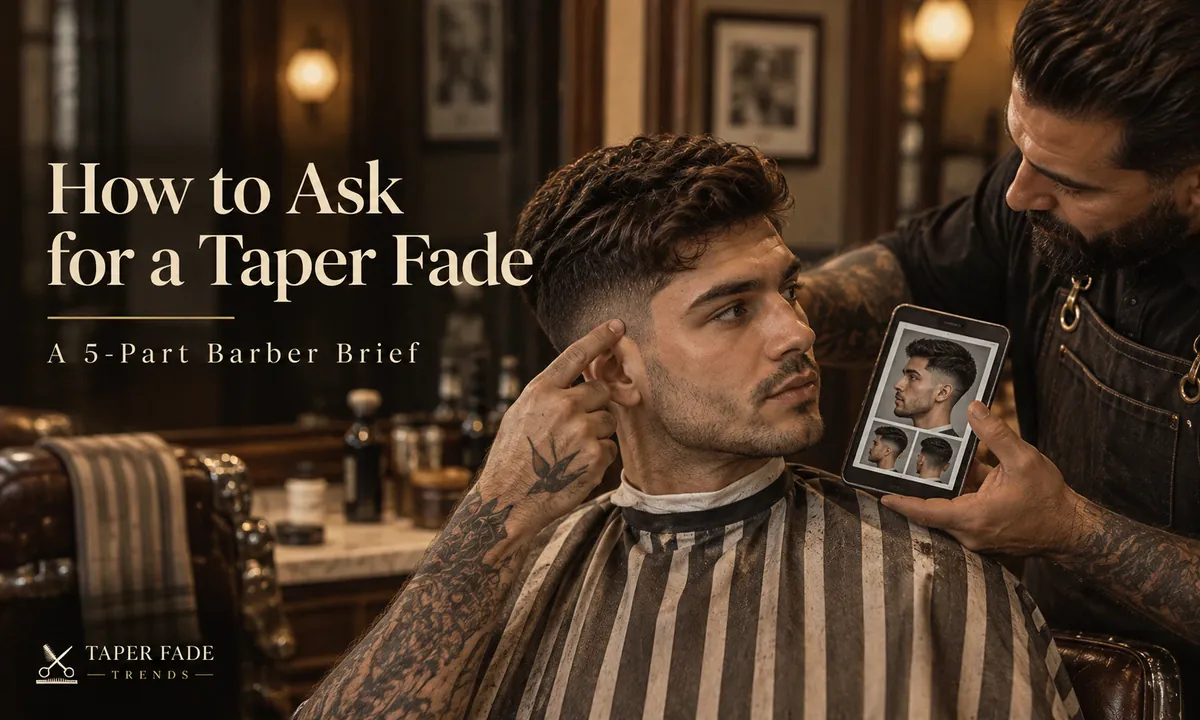
How to ask for a taper fade: a five-part barber brief
How to ask for a taper fade: say where it may reach, how short the base goes, how much side weight stays and what to do on top, then check the plan first.
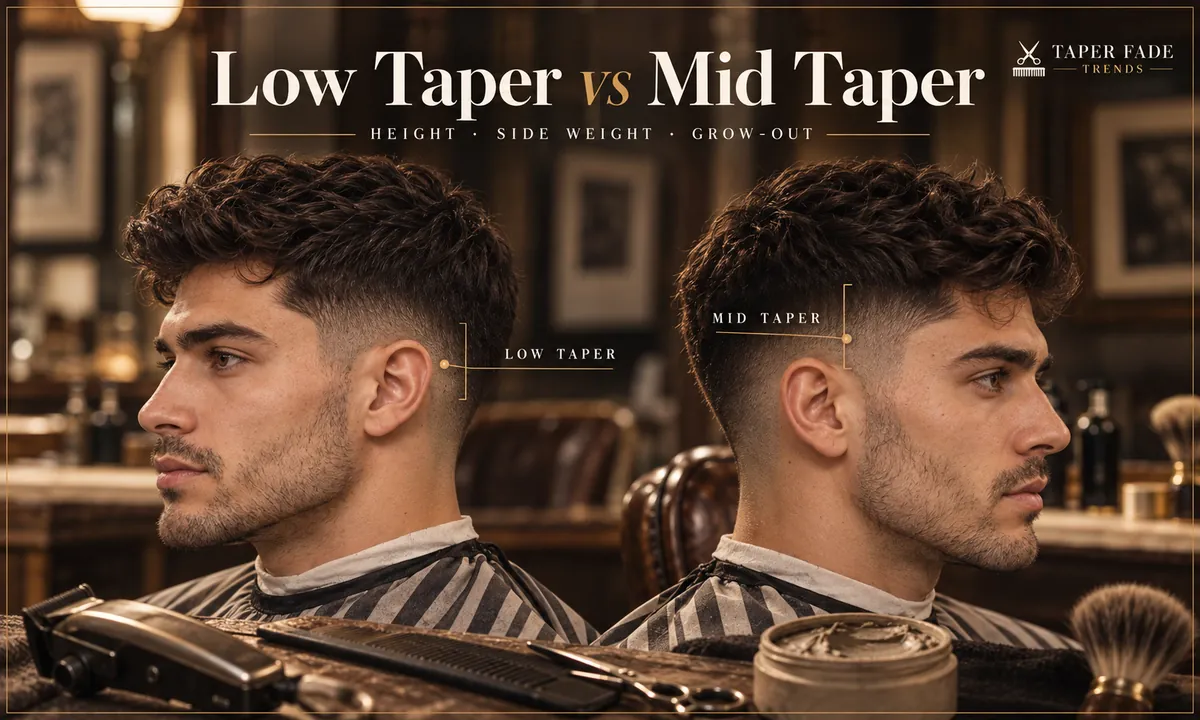
Low taper vs mid taper: what changes when only the height moves
Low taper vs mid taper compared on height, side weight, shortest finish and grow-out, why switching mid to low takes time, and what to tell your barber.
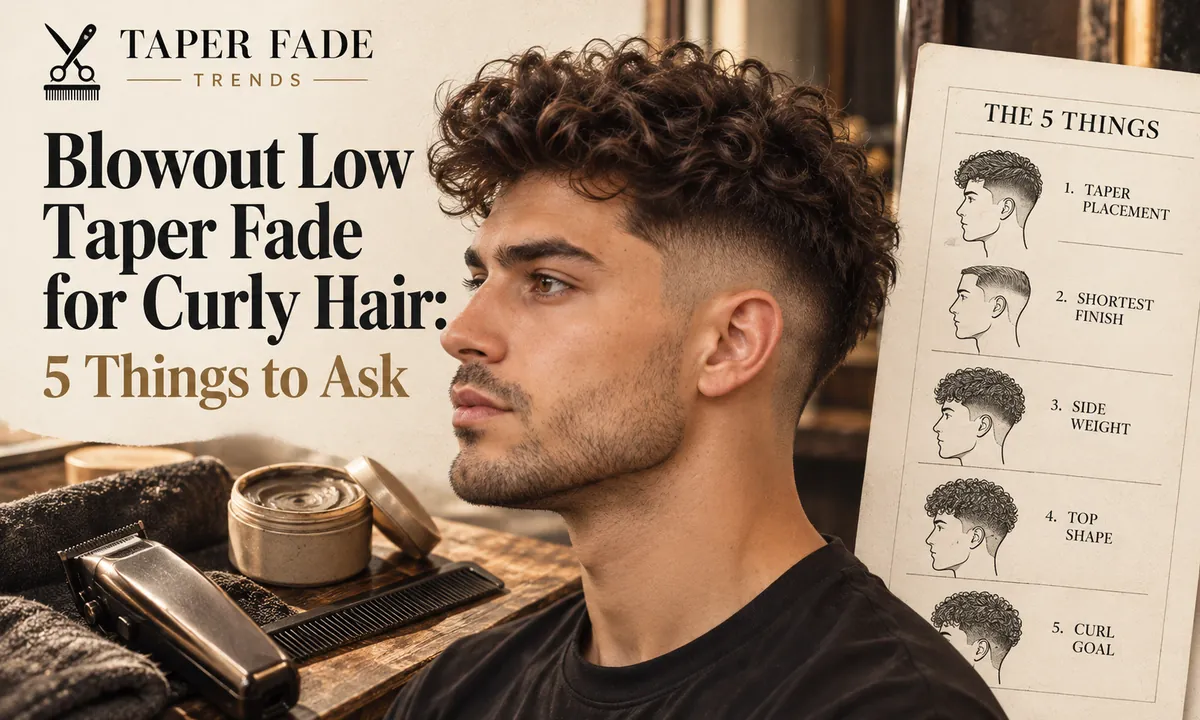
Blowout low taper fade curly hair: keep volume, keep definition
A blowout low taper fade for curly hair is a shape, not a guard recipe. Set the taper placement, shortest finish, side weight, top shape and curl goal.
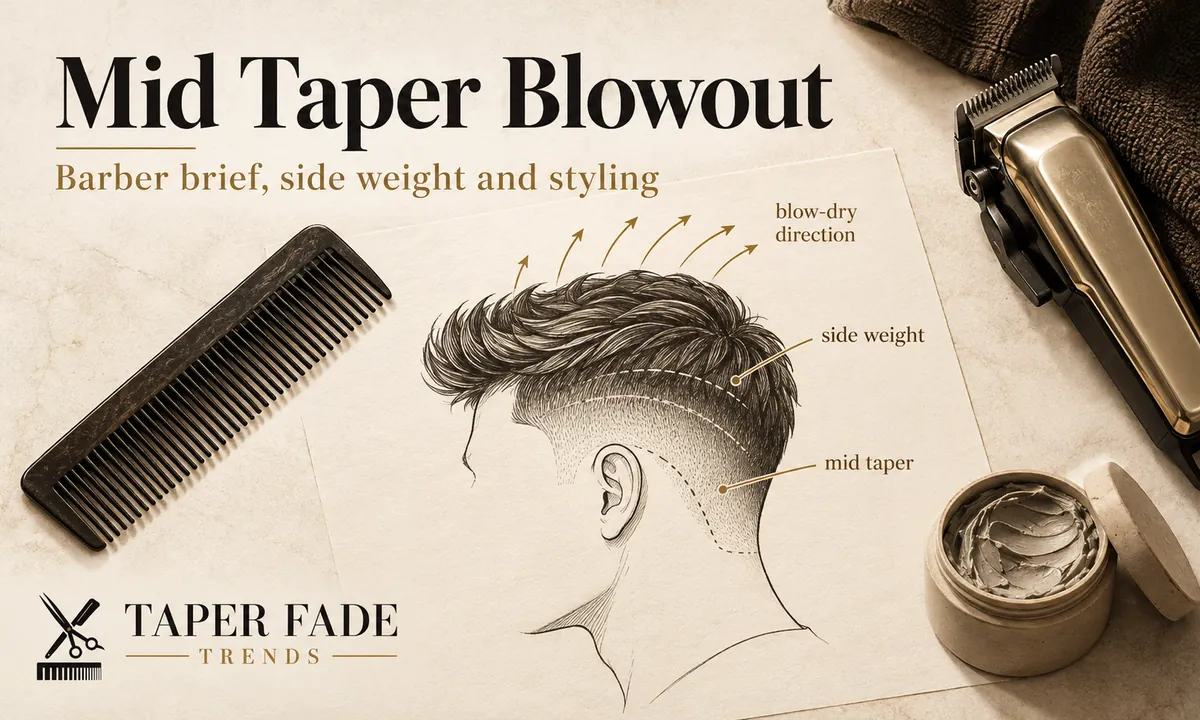
Mid taper blowout: keep volume without flattening the sides
A mid taper blowout is a temple-height taper plus enough top and upper-side length to dry up and out. What to tell your barber and how to style it.
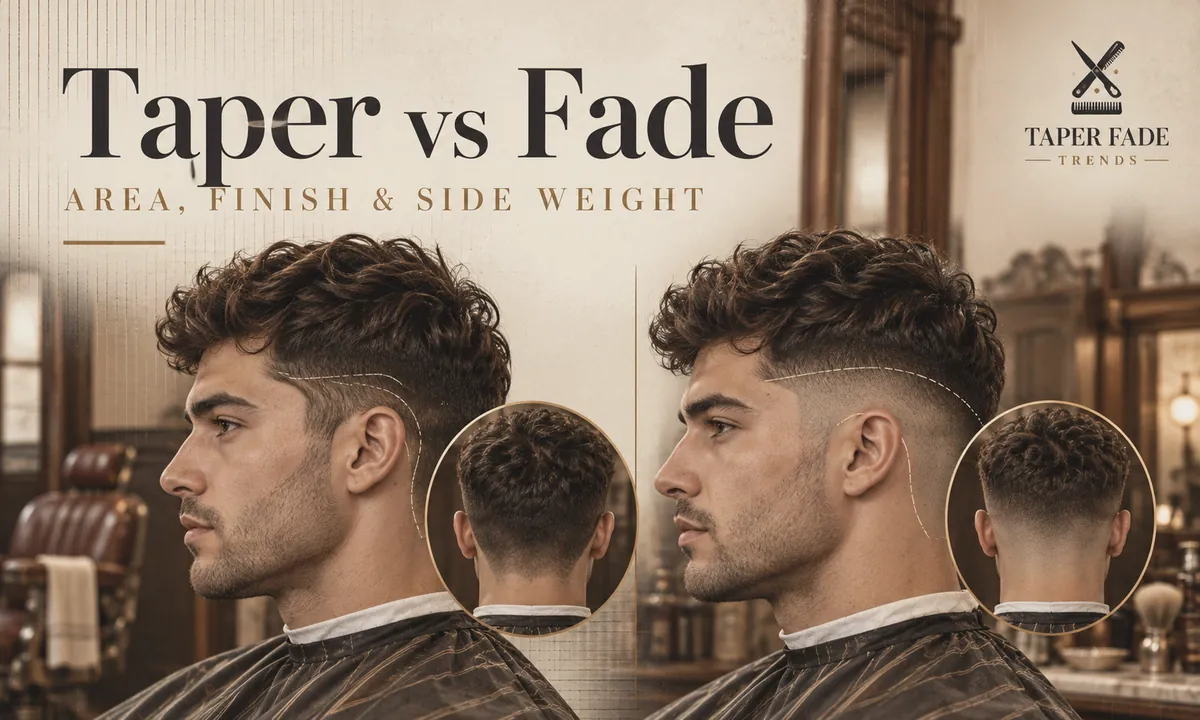
Taper vs fade: what changes in area, finish and side weight
Taper vs fade compared by coverage, height, shortest finish and side weight, with a back-view check and word-for-word barber scripts for either cut.
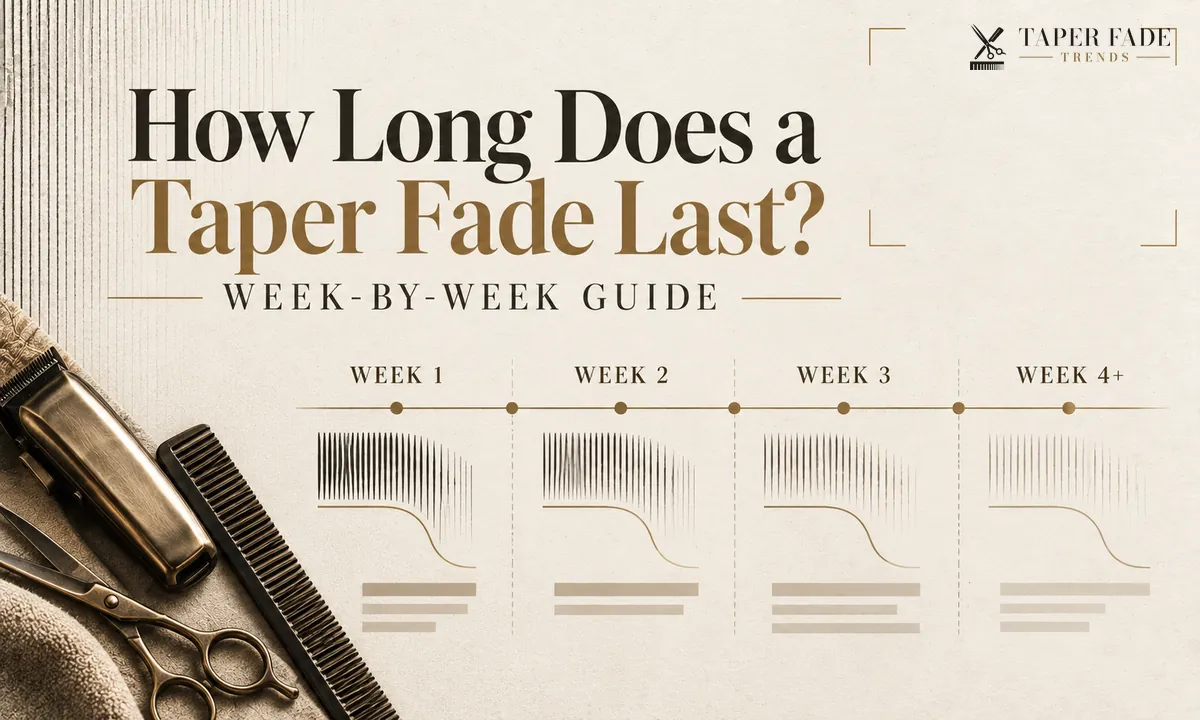
How long does a taper fade last? Fresh, tidy and grown-out stages
How long does a taper fade last? Sharpest for 1 to 2 weeks, tidy for about 2 to 4. See what changes each week and when a touch-up beats a full cut.
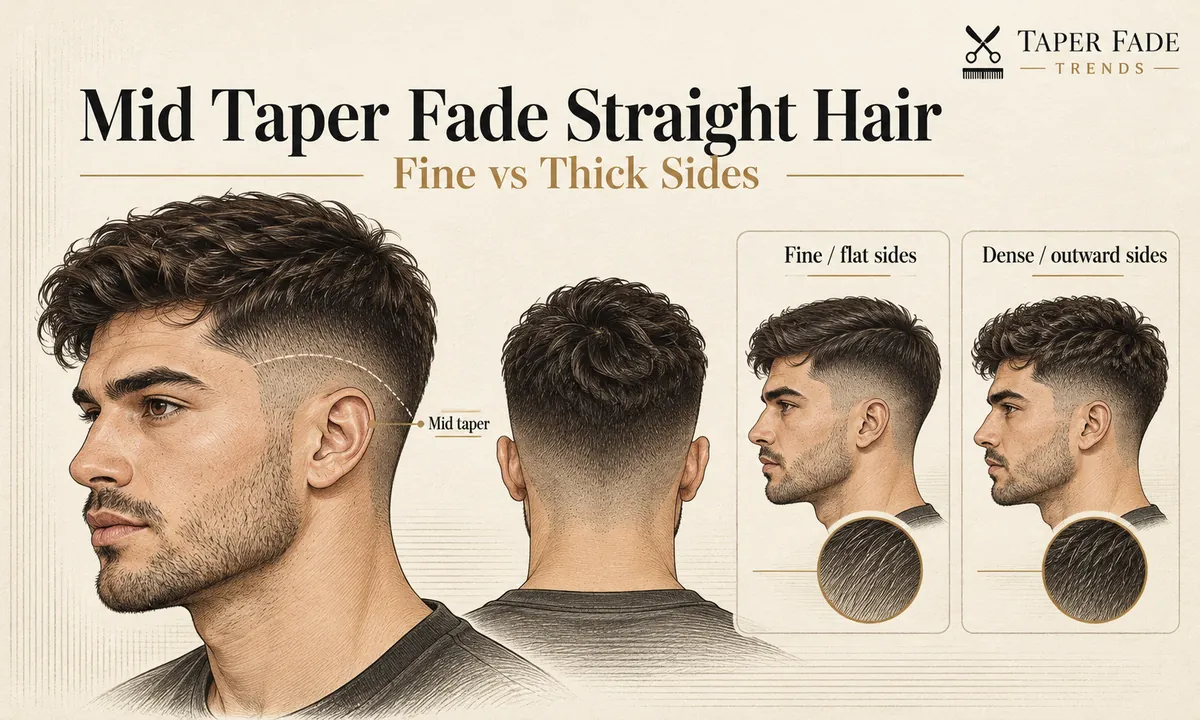
Mid taper fade straight hair: fine, flat and outward-growing sides
Mid taper fade straight hair guide: how much side weight to keep on fine or dense sides, why sides stick out after a cut, and what to tell your barber.
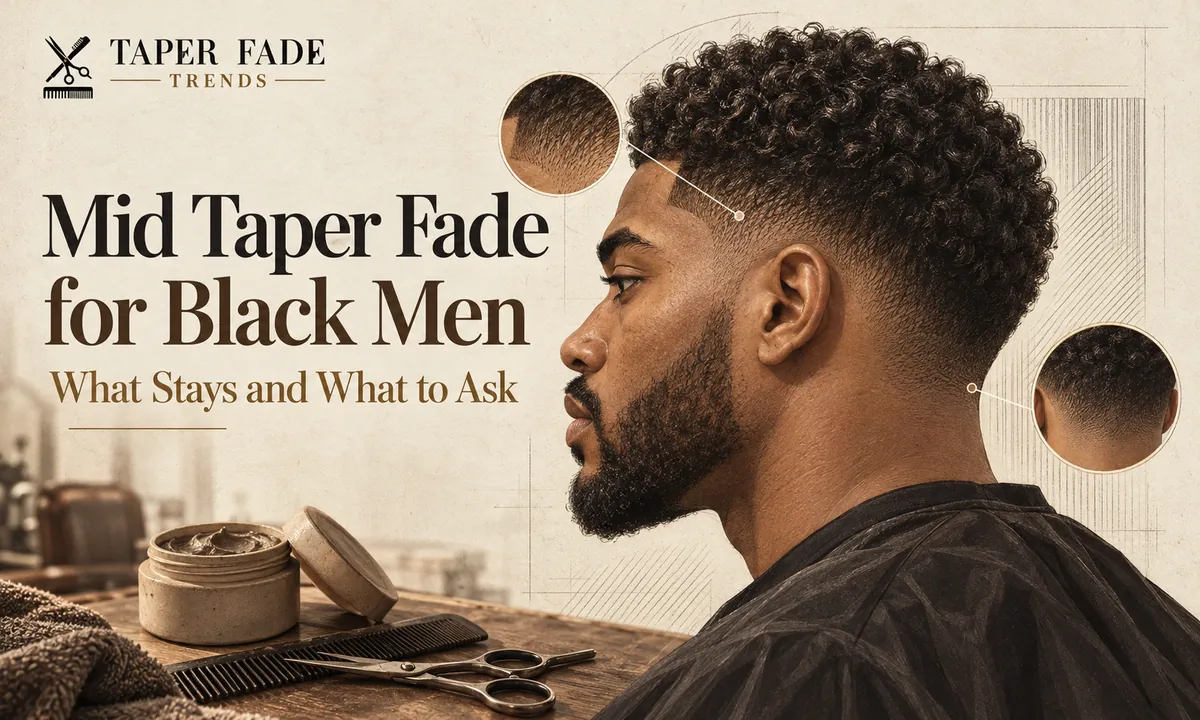
Mid taper fade Black male guide: what stays and what to ask for
Mid taper fade Black male guide: keep more side weight than a full mid fade, set finish and hairline, protect waves, coils or locs, and brief your barber.
More in mid taper fades
Mid taper fades: all 6- Mid taper fade: what it is and what to ask your barber12 min
- Mid taper blowout: keep volume without flattening the sides11 min
- Mid taper fade curly hair: choose dry length, side width and finishYou are here
- Mid taper fade straight hair: fine, flat and outward-growing sides11 min
- Mid taper fade Black male guide: what stays and what to ask for13 min
- Low taper vs mid taper: what changes when only the height moves10 min