Asian low taper fade: choose by how your sides grow
An Asian low taper fade keeps the shortest work low, at the sideburns and nape, and leaves more retained side length above it. “Asian” does not name one hair type. What decides the cut is how your own side hair behaves: whether it lies flat or grows outward as it lengthens.
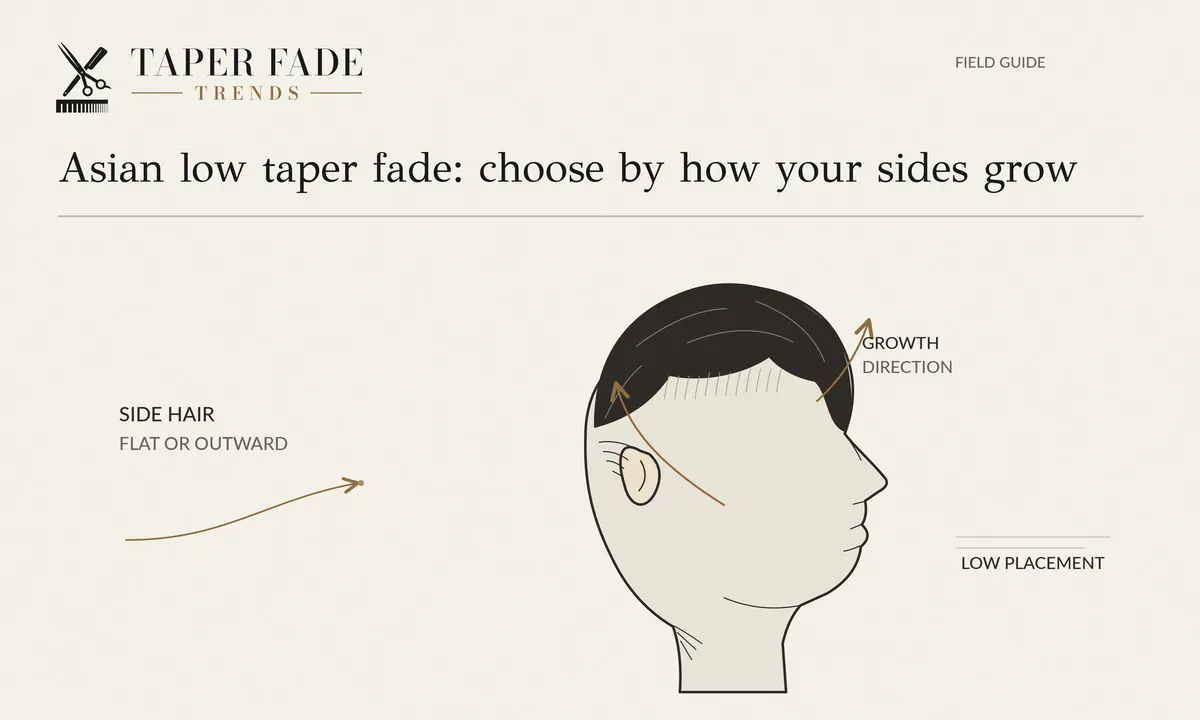
| Setting | What it controls | How to settle it |
|---|---|---|
| Placement | Where the shortest work sits | Low, at the sideburns and nape; point to it on a side photo |
| Retained side length | How much hair stays above the taper | Set by how your sides behave, not by ancestry |
| Shortest finish | What is left at the very bottom | Skin, a zero or a guarded length; say it out loud |
| Growth direction | Whether side hair lies flat or pushes out | Watch your own sides as they grow in |
| Top shape | Length and shape on top | Chosen separately from the taper |
What an Asian low taper fade actually changes
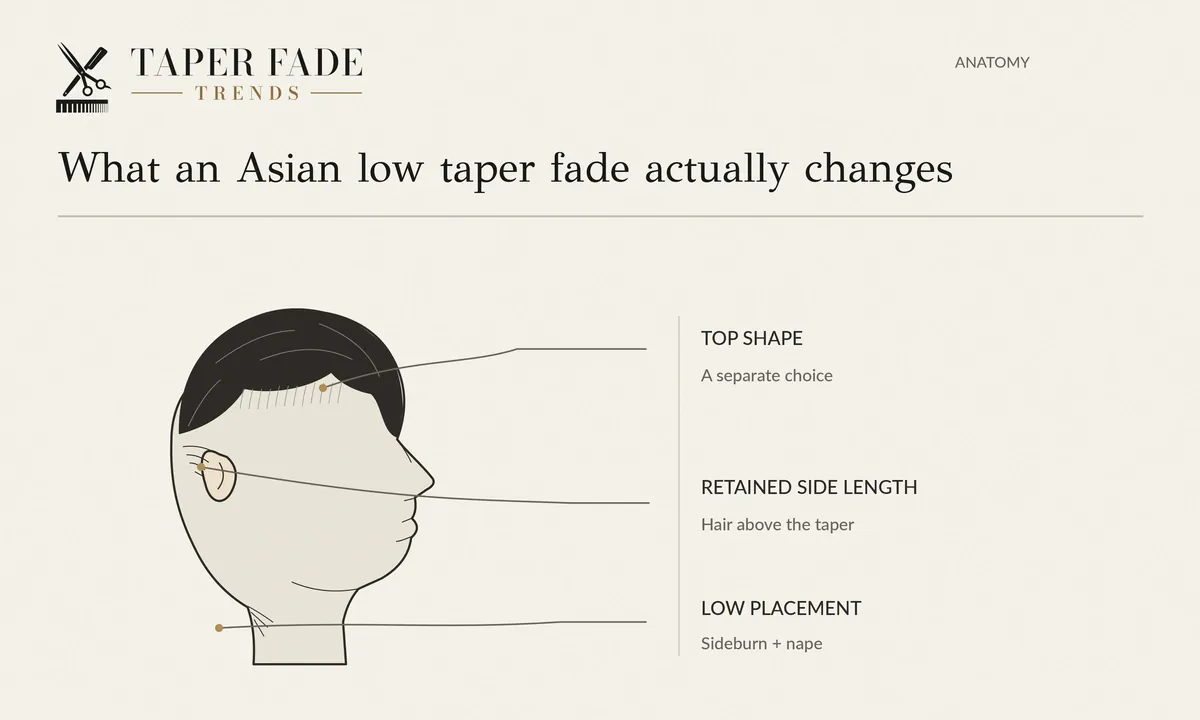
An Asian low taper fade is a low taper fade, with the shortest work kept around the sideburns and nape and more retained side length left above it. The word “Asian” adds search context; it does not change the technique. The useful choices are placement, retained side length, shortest finish and top shape, judged on your own hair.
Retained side length is the hair left above the taper zone, and it is a separate decision from how short the bottom goes. The taper sets the perimeter, the edge of the hair around the ears and nape. Everything above that edge is yours to decide. The low taper fade guide covers each setting in detail, and the taper fade guide compares low, mid and high placement.
Low is placement, not a guard number
No single guard number defines a low taper fade. “Low” describes where the shortest work sits; the shortest finish is a separate choice that can be skin, a zero or a guarded length. If you already know a guard you like, name it. Otherwise show the finish in a photo and let the barber pick the tools.
Guard numbers are cutting lengths on one brand’s guard set, and brands do not always match, as the clipper guard numbers guide explains.
A low taper fade is not always the same cut as a low fade. Some shops separate them by coverage, with the low fade carrying a short band around the whole sides and back; others separate them by whether the bottom reaches skin. Say where the short zone should stop and name the finish. The taper vs fade guide sets out both usages, and low taper vs low fade compares the two at this height.
“Asian” is context, not a hair specification
“Asian” is not one hair type. A 2020 dermatology review describes hair in studied Asian populations as straight and large in diameter on average, but it also says knowledge remains limited. A 2022 critical appraisal finds that the three geo-racial groups miss much of the real variation in hair. Describe your own hair instead: straight or wavy, fine or coarse, sparse or dense, flat or outward-growing.
The research behind that:
- The review of Asian hair structure in Clinical, Cosmetic and Investigational Dermatology reports straightness, large diameter and a thicker cuticle as group averages.
- The critical appraisal of global hair classification in the International Journal of Cosmetic Science says the African, Asian and Caucasian split does not account for worldwide diversity or for variation between groups.
- A microscopy study of hair across three populations found considerable variation in every trait it measured, alongside some ancestry-related patterns.
An average describes a population, not your head. Montreal barber Youssef Ouda makes the same point from the chair in his guide to thick, straight hair: strand thickness, density, stiffness and growth direction decide how hair behaves, and background alone does not define a texture.
Three of those terms matter for this cut:
- Fine means narrow strands.
- Dense means many strands per area of scalp.
- Growth direction is the angle hair leaves the scalp, which decides whether side hair lies close to the head or springs away from it.
You can only learn your growth direction by watching your own sides grow in.
Choose by side-hair behavior
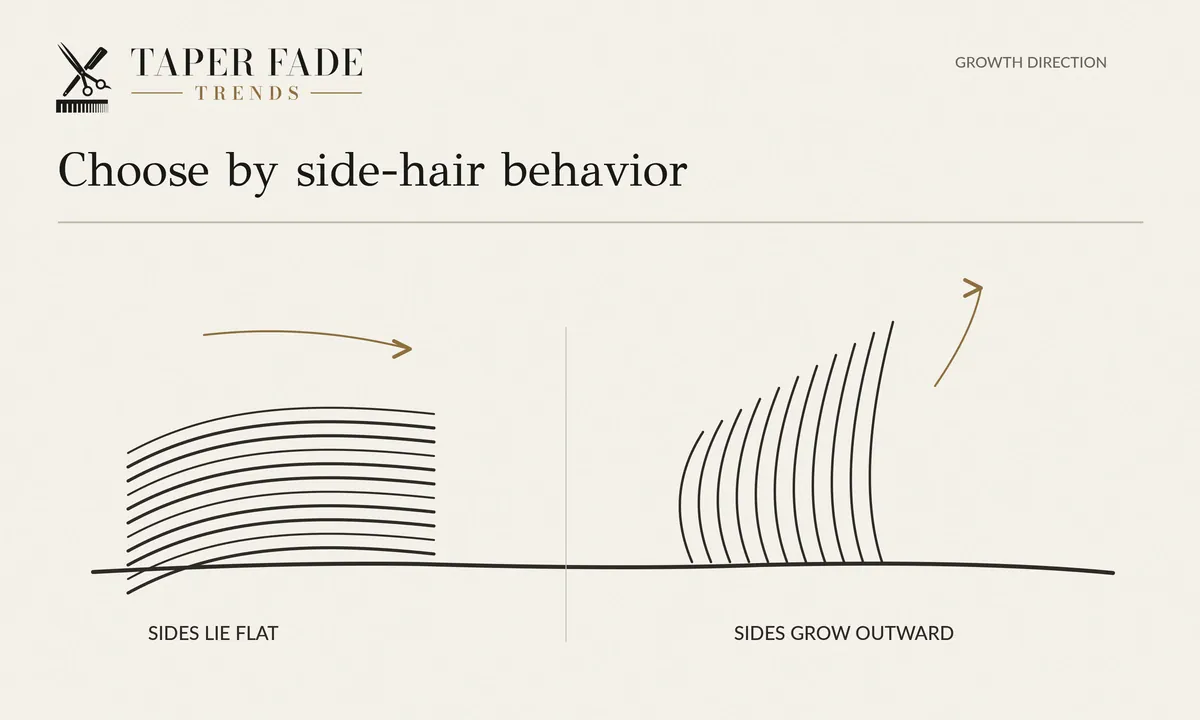
Choose the version of this cut by what your side hair does as it grows past the taper, not by ancestry. Most heads fall closer to one of two patterns: sides that lie flat, or sides that grow outward. Some heads do both in different places. If yours does, tell the barber which area does what.
| Sides lie flat | Sides grow outward | |
|---|---|---|
| What you see as it grows | Hair stays close to the head | Hair lifts away and widens the outline above the ear |
| Decision to make first | How much retained side length to keep for coverage | Whether to keep enough length to lie down, or go short on purpose in a chosen zone |
| What to avoid | Taking length off the sides before deciding the shape | All-over thinning, which can leave short strands that push out as they grow |
| What to show the barber | A side photo at your usual length | Side and back photos taken after your sides have grown in |
Fine, straight hair that lies flat
For fine, straight hair that lies flat, the main decision is how much retained side length to keep above the low taper. Fine and flat are separate traits: fine describes the strand, flat describes how it lies. Dense fine hair and sparse coarse hair both exist. If you can see scalp through your sides at your usual length, say so before any length comes off.
Dense, straight hair that grows outward
Straight side hair can look flat right after a cut and then push out as it grows. Youssef Ouda explains that stiff strands at some middle lengths stand up more than hair that is very short or long enough to settle. The point where that happens differs by head, so this guide gives no day count.
To find your own pattern, compare a side photo taken on the day of the cut with one from the same angle a week or two later.
Ouda’s fix is to keep enough length for the hair to lie down, or to go short on purpose within a chosen zone. He removes weight by section rather than thinning the whole side. DIDA Hair Studio, a Queens shop, likewise reduces bulk above the fade so the sides do not puff out. For a fuller troubleshooting table, see why the sides stick out in the low taper fade for straight hair guide.
What to tell your barber
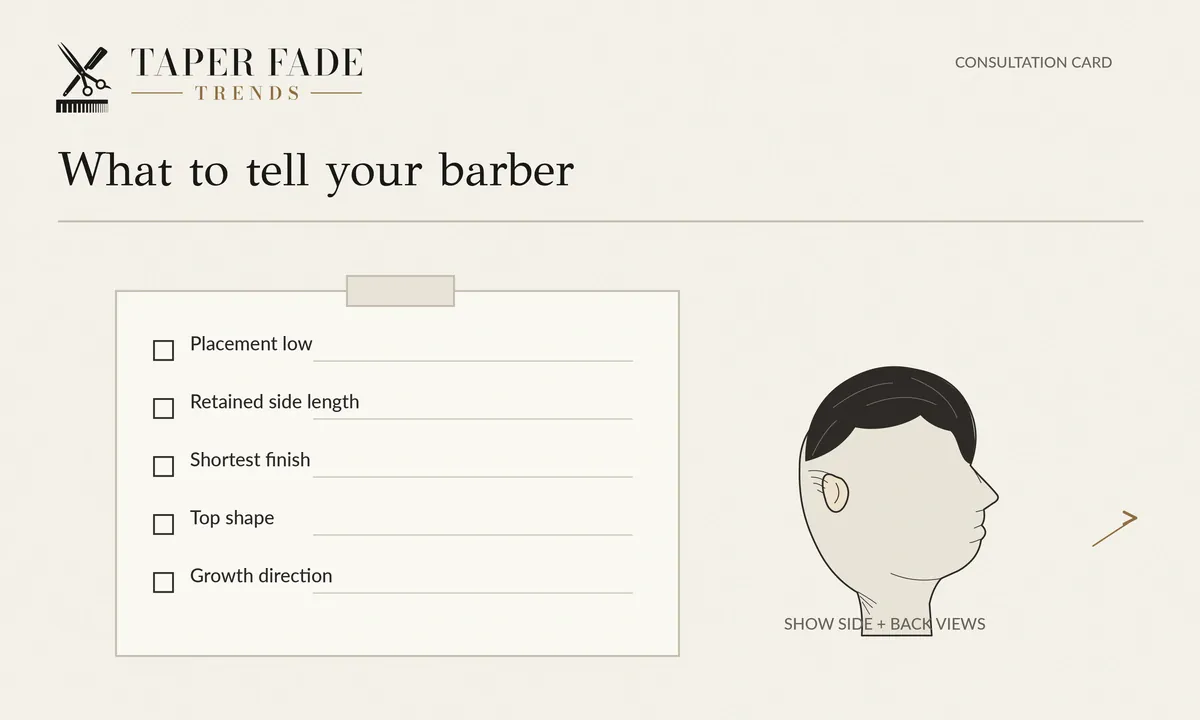
Ask for an Asian low taper fade in four parts: keep the taper low at the sideburns and nape, say how much retained side length stays, name the shortest finish, and describe the top. Then add one detail about your own hair: whether your sides lie flat or grow outward once they lengthen.
- Placement: “Keep the taper low, at the sideburns and nape. Don’t let it climb the side.”
- Retained side length: “Leave the sides about as full as in this photo.”
- Shortest finish: “Take the bottom down to skin,” or “a zero,” or “a one, no skin.”
- Top: “Leave the top as it is,” or “shape it like this photo.”
- Your hair: “My sides lie flat,” or “my sides push out here once they grow in.”
These lines describe outcomes. The guard, blade and technique that reach them are the barber’s call. The general version of this brief is in how to ask for a taper fade.
A brief for outward-growing sides
Yes. You can keep a low taper fade and still shorten the retained side length, because placement and side length are separate settings. Ask for both in one sentence: keep the taper low at the sideburns and nape, and take the sides down to the length in your photo. Saying both stops the barber from treating side bulk by raising the taper.
Shorter is not automatically flatter. Ouda warns that cutting at the wrong point can add width through the sides. So add: “These photos show my sides after they grow in. Where would you take weight out?” That question asks for selective weight removal instead of an all-over thin-out.
Reference photos for a low taper
Bring front, side and back photos of the cut you want, ideally on hair with a density close to yours. Add photos of your own sides after they have grown in. A front photo hides where the taper ends, and only your own photos show your growth direction.
- Side views show how low the taper sits and how much retained side length stays.
- The back view shows the nape and the neckline.
- Your own grown-in sides show whether they lie flat or push out.
Ouda also asks clients what their sides do after washing or a day under a hat. That is worth telling your barber unprompted.
A photo cannot show the guard, blade or lever used. Ask for the look, not a number read off a picture.
A cut card to save after the cut
When a cut works, ask the barber what they used and save it on your phone. Next time you can repeat the cut instead of describing it from scratch.
| Field | What to write down |
|---|---|
| Date | The day of the cut |
| Placement and shortest finish | Where the taper sat; skin, zero or guard |
| Retained side length | Guard number or “scissors” |
| Weight removal | Where, if any, and with what |
| Top | Length and shape |
| Sides after one to two weeks | Lay flat, pushed out, or both |
Leave a field blank if you do not know it. A guess from a photo is worse than no entry.
Styling flat tops and outward sides
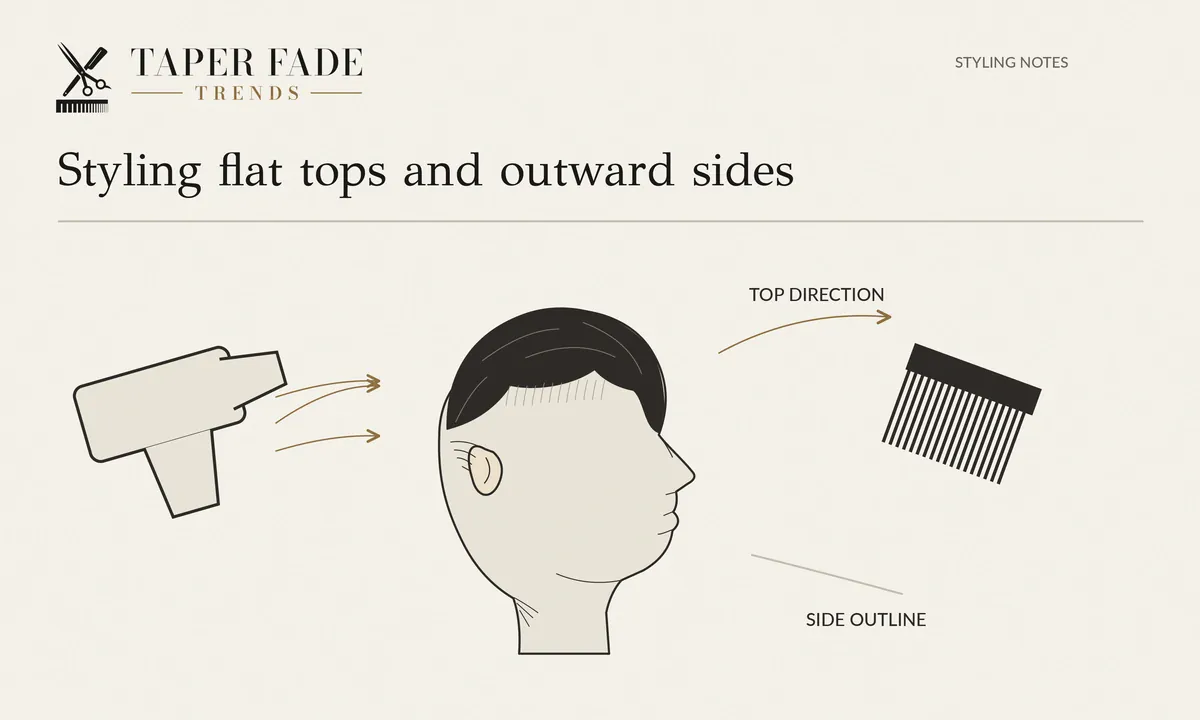
Styling the top and handling the sides are separate jobs, and a low taper fade decides neither. The taper sets the perimeter. The top and the retained side length stay open choices. This guide names no product or amount, because none was tested on a recorded cut.
If the sides spring out
First work out where the width comes from. Width that is there on the day of the cut points to retained side length you may want shorter. Width that appears only as the hair grows points to the length stage and your growth direction.
Growth direction does not change after any cut. A cut can change the length the hair sits at, but not the angle it leaves the scalp. Bring both observations to the barber as photos, not as a diagnosis.
If the top stays flat
A low taper fade changes the perimeter, not the volume on top. If the top stays flat, check the cut first: does the top have the length and internal shape your style needs? If not, that is a barber fix. If it does, change the direction you blow-dry it before reaching for more product.
Grow-out, limits and alternatives
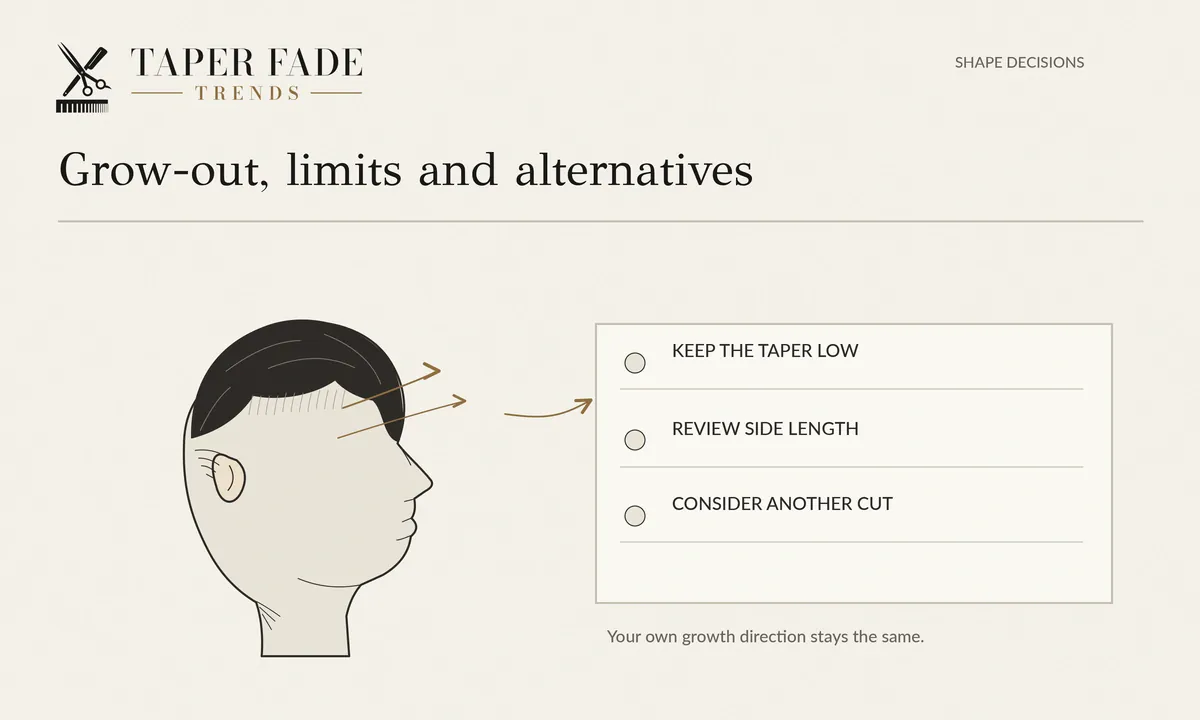
An Asian low taper fade has no universal refresh interval. DIDA Hair Studio suggests about two weeks for skin-close finishes, three for most low fades and four to five for softer tapers. That is one shop’s guidance. Rebook when the edge at the sideburns and nape, or the side outline, stops matching what you asked for.
The closer the shortest finish is to skin, the sooner regrowth shows against the edge. The how long does a taper fade last guide covers what changes week by week, and how to maintain a taper fade covers the upkeep between cuts.
When a low taper is not enough
A low taper fade may not fix outward-growing sides when the bulk sits above its small short zone. Keep the taper low if you like the outline, and ask the barber to judge the retained side length separately. If shortening it widens or changes the shape too much, longer sides with styling may be the better trade.
| If you want to change | Does the low taper set it? | What sets it |
|---|---|---|
| The hair above the taper zone | No | Retained side length and weight removal |
| How short the bottom goes | Not by being “low” | The shortest finish you name |
| Volume on top | No | Top length, internal shape and styling |
| The angle your hair grows | No | Your own growth direction |
When longer sides or another cut may fit
Other cuts fit when the low taper cannot give you the shape you want:
- Longer sides with styling fit when you like a fuller outline and will work with your growth direction.
- A scissor-led cut may preserve a classic, flexible shape on thick, straight hair if you want no visible short zone at all, according to Ouda.
- A [mid taper fade](/guides/mid-taper-fade/) moves the short work higher on the side. The low taper vs mid taper comparison covers the trade.
- A [low taper fade buzz cut](/guides/low-taper-fade-buzz-cut/) suits you if you would rather give up length on top altogether.
How this low taper guide was checked
Taper Fade Trends Editorial prepared this guide on October 21, 2026, from the sources below. The hair-science claims come from peer-reviewed papers and are stated only as population averages. The cutting advice is attributed to the named barber and shop, and the terminology follows this site’s own guides.
This page contains no real haircut photographs, no recorded cut settings and no follow-up photos. No barber has reviewed it. Every image is a labeled Taper Fade Trends illustration, not a haircut result.
Sources cited:
- Leerunyakul and Suchonwanit, “Asian Hair: A Review of Structures, Properties, and Distinctive Disorders,” Clinical, Cosmetic and Investigational Dermatology, 2020
- Daniels, Fraser and Westgate, “How different is human hair? A critical appraisal…,” International Journal of Cosmetic Science, 2022
- Koch, Shriver and Jablonski, “Variation in human hair ultrastructure among three biogeographic populations,” Journal of Structural Biology, 2019
- Youssef Ouda, men’s haircut for Asian, thick or straight hair (updated September 10, 2026)
- DIDA Hair Studio, low fade haircut for thick Asian hair (updated April 29, 2026)
Where to go next with your low taper
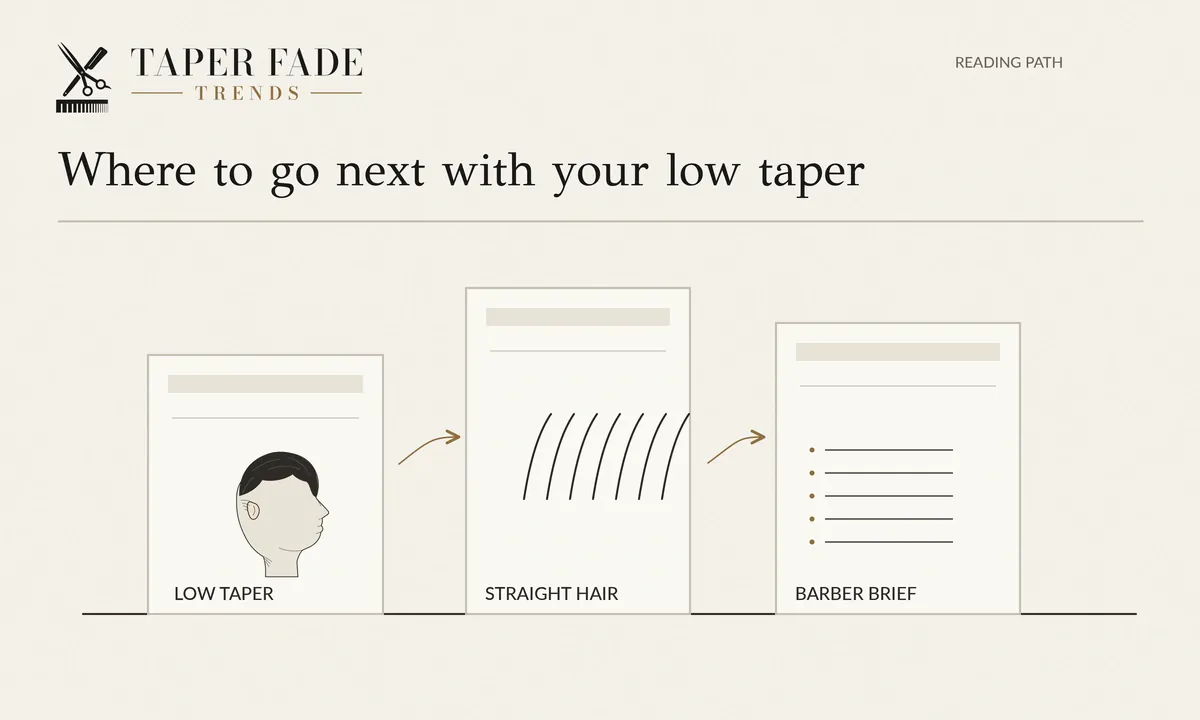
If you are still choosing the settings, start with the low taper fade guide. If your sides are the main problem, the low taper fade for straight hair guide goes deeper on density and grow-out. Once you have picked placement and retained side length, use how to ask for a taper fade to turn those choices into a brief.
Keep reading
All guides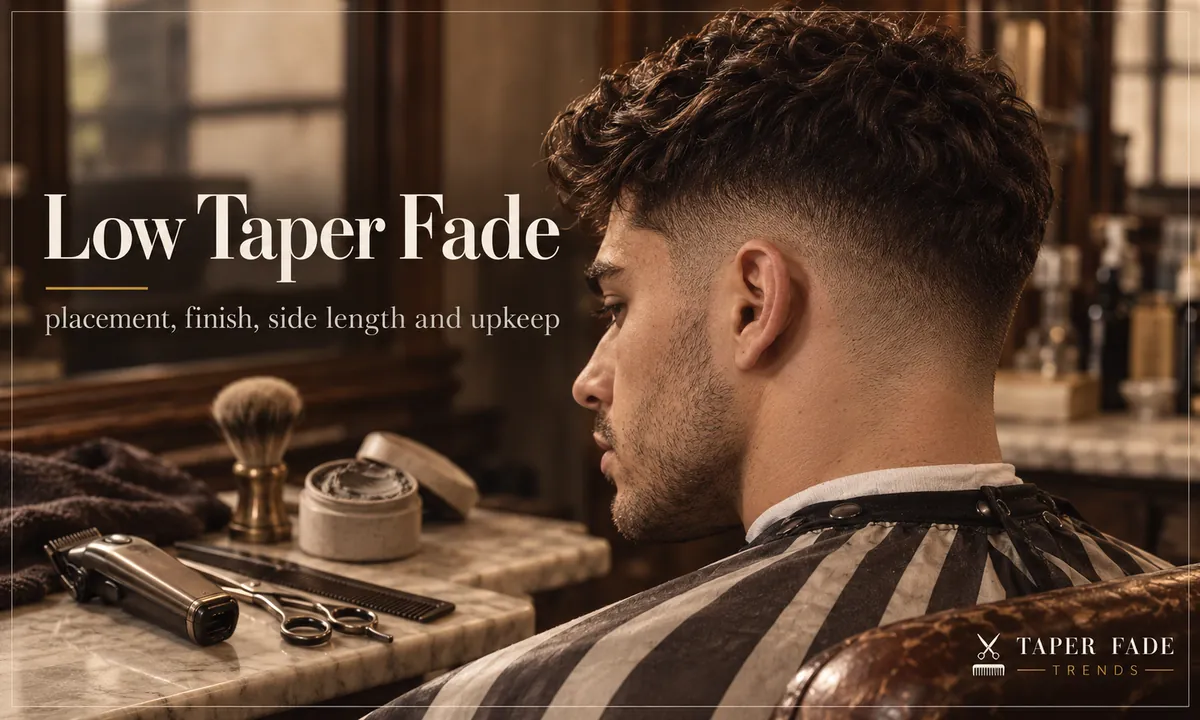
Low taper fade: placement, finish, side length and upkeep
A low taper fade shortens the sideburns and nape and keeps the sides full. See the four choices to make, whether it can go to skin, and what to say.
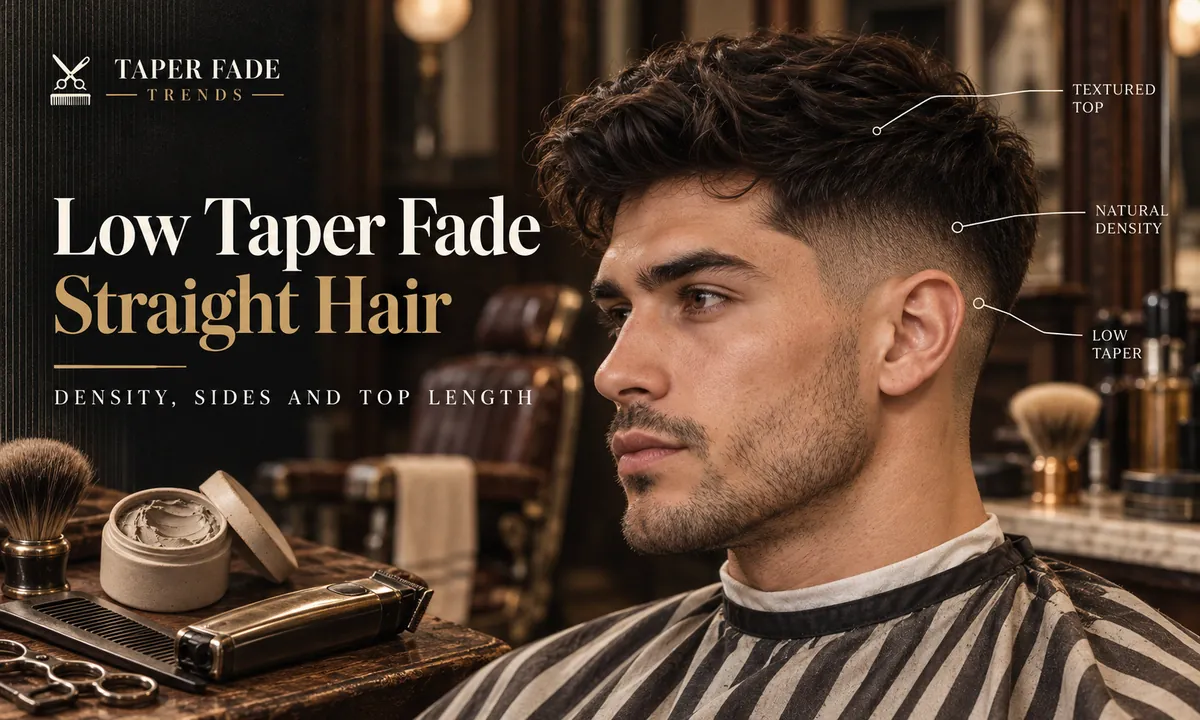
Low taper fade straight hair: density, sides and top length
Low taper fade straight hair guide: how much side weight to keep for your density and growth direction, why sides stick out, and what to ask your barber.
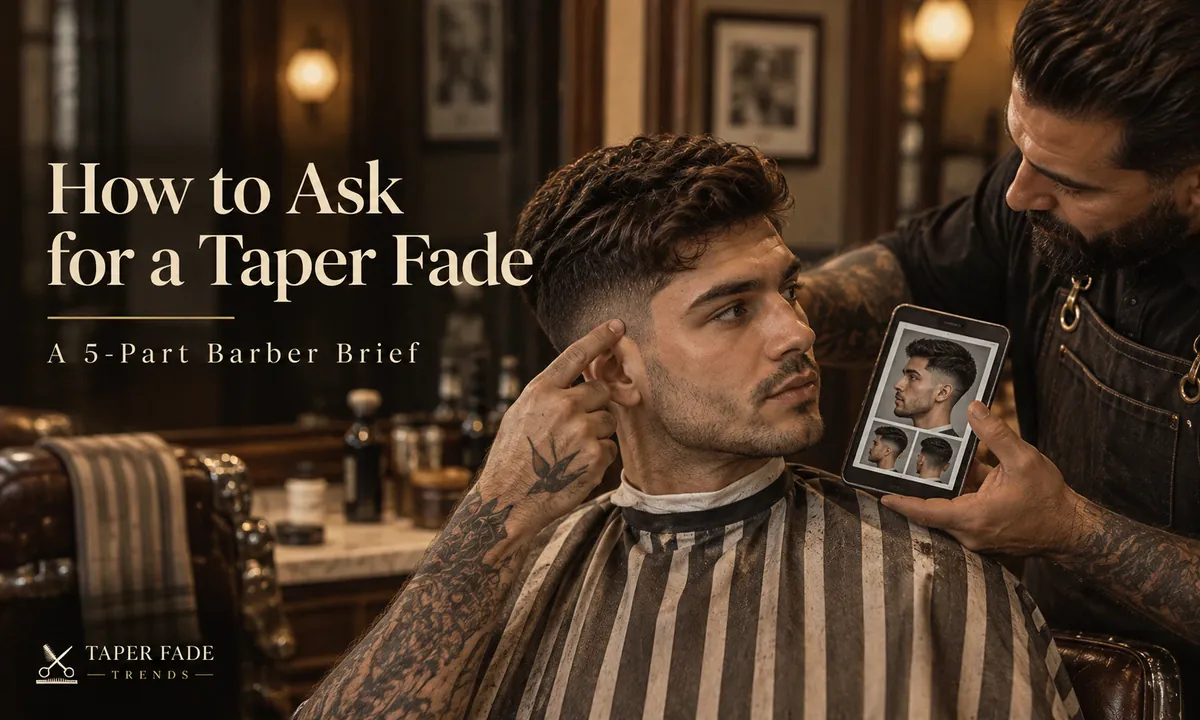
How to ask for a taper fade: a five-part barber brief
How to ask for a taper fade: say where it may reach, how short the base goes, how much side weight stays and what to do on top, then check the plan first.
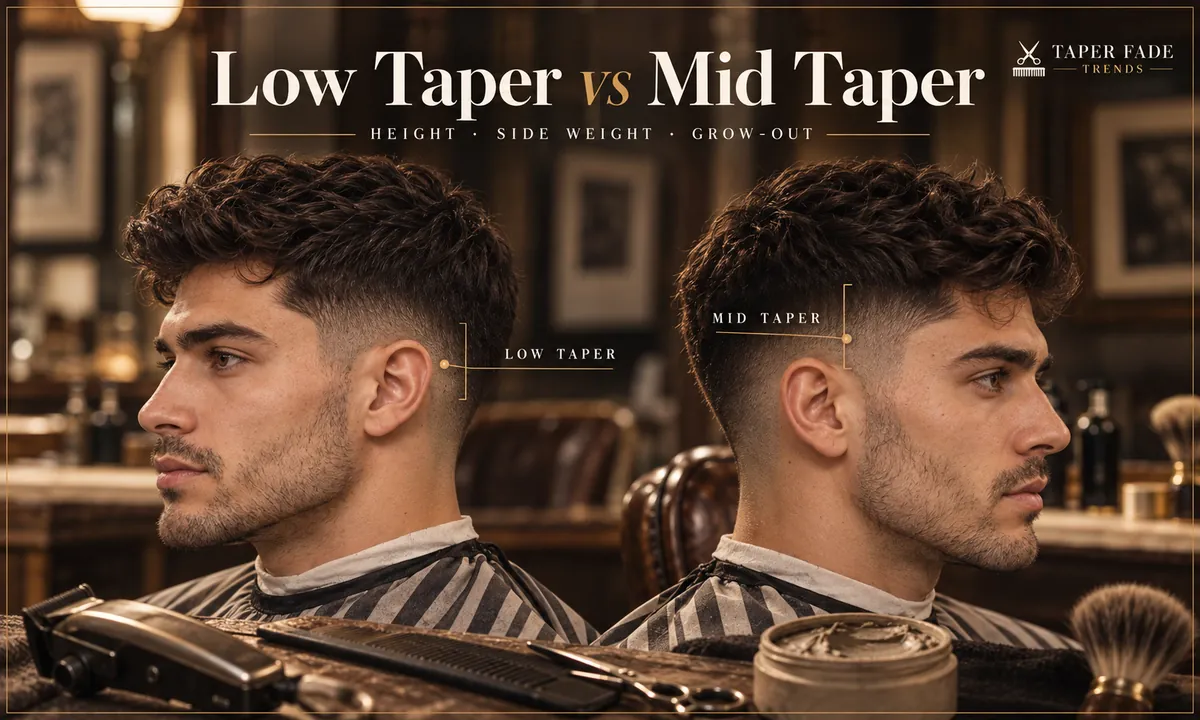
Low taper vs mid taper: what changes when only the height moves
Low taper vs mid taper compared on height, side weight, shortest finish and grow-out, why switching mid to low takes time, and what to tell your barber.
More in low taper fades
Low taper fades: all 14- Low taper fade: placement, finish, side length and upkeep12 min
- Low taper fade straight hair: density, sides and top length11 min
- Low taper fade Black male guide: choose the top, hairline and nape10 min
- Curly low taper fade: keep curl width above the ears10 min
- Low taper fade buzz cut: compare top length and finish12 min
- Textured fringe low taper: cut, style and barber brief12 min
- Blowout low taper fade curly hair: keep volume, keep definition11 min
- Low taper fade wavy hair: what to ask for13 min
- Asian low taper fade: choose by how your sides growYou are here
- Middle part low taper fade: keep the curtains connected8 min
- Low taper fade with dreads: protect the loc boundary12 min
- Low taper mullet: keep length behind the ears13 min
- Low taper vs mid taper: what changes when only the height moves10 min
- Low taper vs low fade: compare coverage and side weight11 min