Middle part low taper fade: keep the curtains connected
A middle part low taper fade is a longer, center-parted top over a taper kept low around the sideburns, ears and nape. Whether the curtains look connected depends on the upper sides. Leave weight there and the top blends in; cut it away and the top hangs over. No guard number guarantees either.
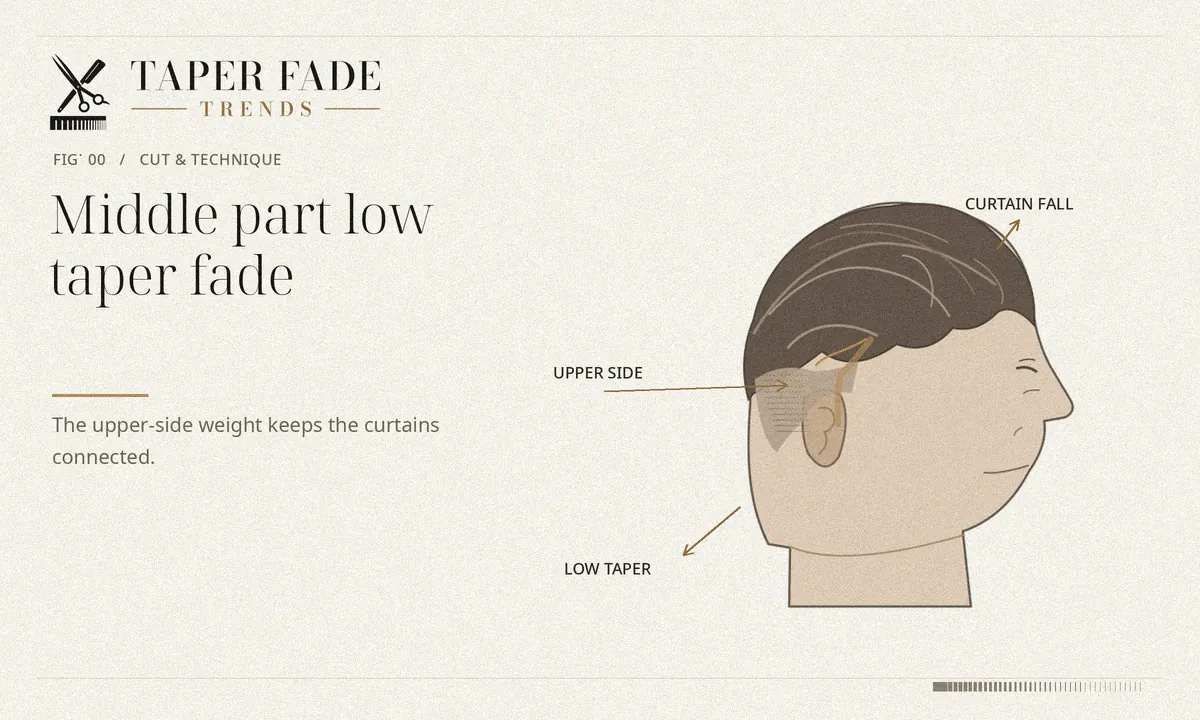
What a middle part low taper fade changes
A middle part low taper fade is a haircut with a longer top that splits near the center and a taper kept low around the sideburns, ears and nape. The part sets where the top divides, the low taper sets where the sides get shorter, and the upper sides decide whether the two read as one shape.
Working barbers describe the low taper the same way. Cutters Yard, a London barbershop, puts the shortest sections around the sideburns, ears and neckline and says more weight stays on the sides. Former barber Nick Hall, writing for Man of Many, describes a taper as a gradual change concentrated at the sideburns and neckline. Where “low” ends still varies from barber to barber, so no inch measurement defines it. The low taper fade guide covers the taper without the part.
| Spec | What it means for this cut | How settled it is |
|---|---|---|
| Top shape | Longer top that splits near the center and falls to each side | Consistent across guides |
| Taper height | Low: around the sideburns, ears and nape | Exact boundary varies by barber |
| Upper sides | Weight kept (connected) or removed on purpose (disconnected) | Your choice |
| Top length | Guides suggest roughly 3 to 5 inches for a basic version | Guides disagree; test it dry |
| Shortest finish | Shadow, a guarded length or skin | Chosen separately from height |
| Taper coverage | Around the edges, not the whole side | What keeps it a taper, not a fade |
| Upkeep | Taper refreshed sooner than the top | Rule of thumb, not a standard |
| Measured example | None on this page yet | No real cut recorded |
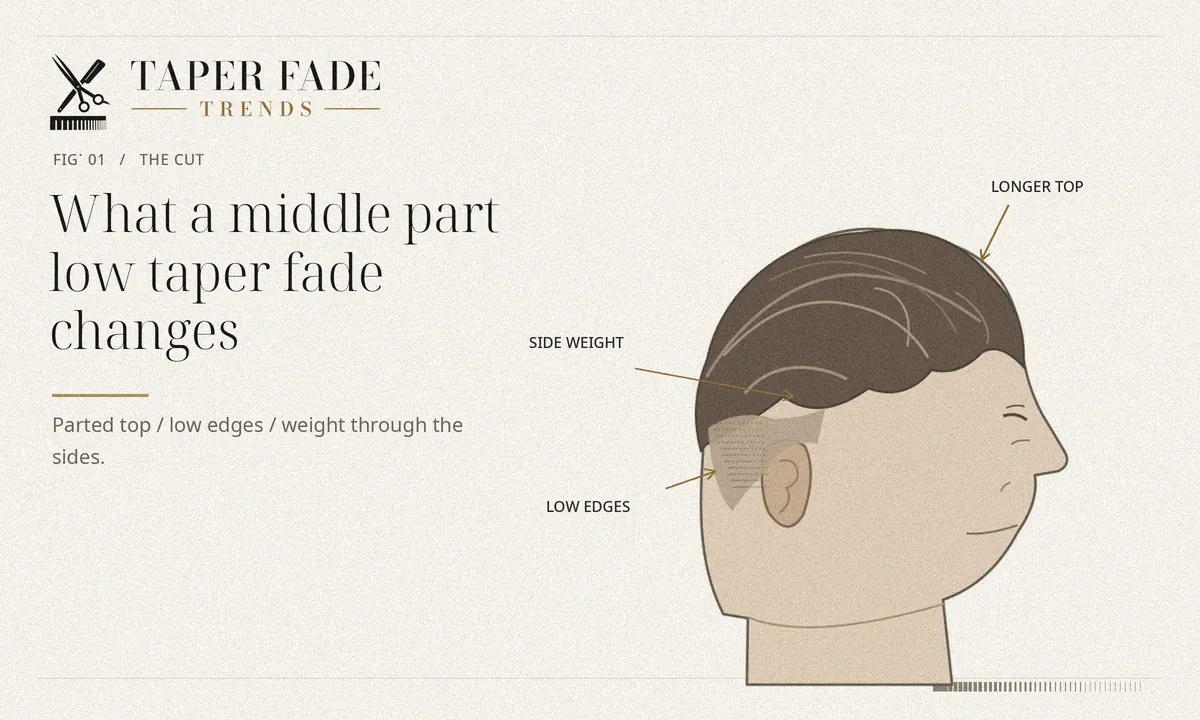
The connection that makes curtain flow work
A middle part low taper fade keeps the curtains connected when the barber leaves enough upper-side weight for the falling top to land on. Take the taper higher, or take too much length off the upper sides, and the top starts to hang over a shorter section instead of blending into it.
Connection is the transition where the longer top and curtain layers blend into the length kept on the sides. Two guides give the same warning from different angles. OnPointFresh says a high fade can disconnect the top too much and advises keeping it low or mid. Taper Haircut Guide lists tapering too high as a mistake because it strips the side weight a curtain needs.
The exact point where a low taper starts to break the connection is not fixed. It moves with your density, your head shape and how far the curtains drop. A side-profile photo showing the transition you want tells a barber more than a guard number does.
Connected sides vs a disconnected overhang
Connected sides blend the top into the sides as one silhouette. A disconnected overhang lets the top hang over a deliberately shorter section, and some guides list it as a style of its own. Neither one is a mistake. The problem is getting one when you wanted the other.
| In profile | Connected sides | Disconnected overhang |
|---|---|---|
| Where the top meets the sides | Blends into the kept side length | Hangs over a shorter section |
| Upper-side weight | Kept | Removed on purpose |
| Taper height that fits | Low | Low or mid |
| How it goes wrong | The taper goes too high, or the upper sides are cut too short | Nobody asked for it |
How much side length to keep
None of the guides we checked gives a side length that guarantees curtain flow, and this page has no measured example yet. The working test is visual. On dry hair, the upper sides should be long and full enough that the falling top meets them without a visible step.
A guard number in a gallery caption describes the cut in that photo, not yours.
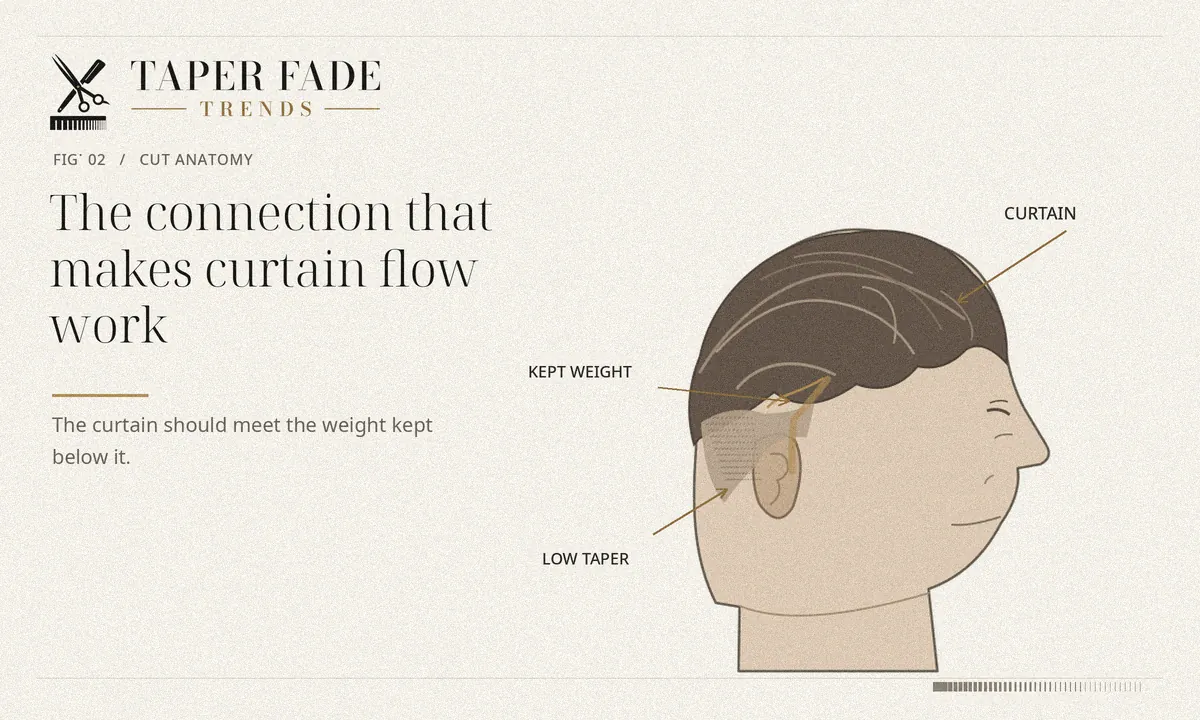
Is your hair long enough yet?
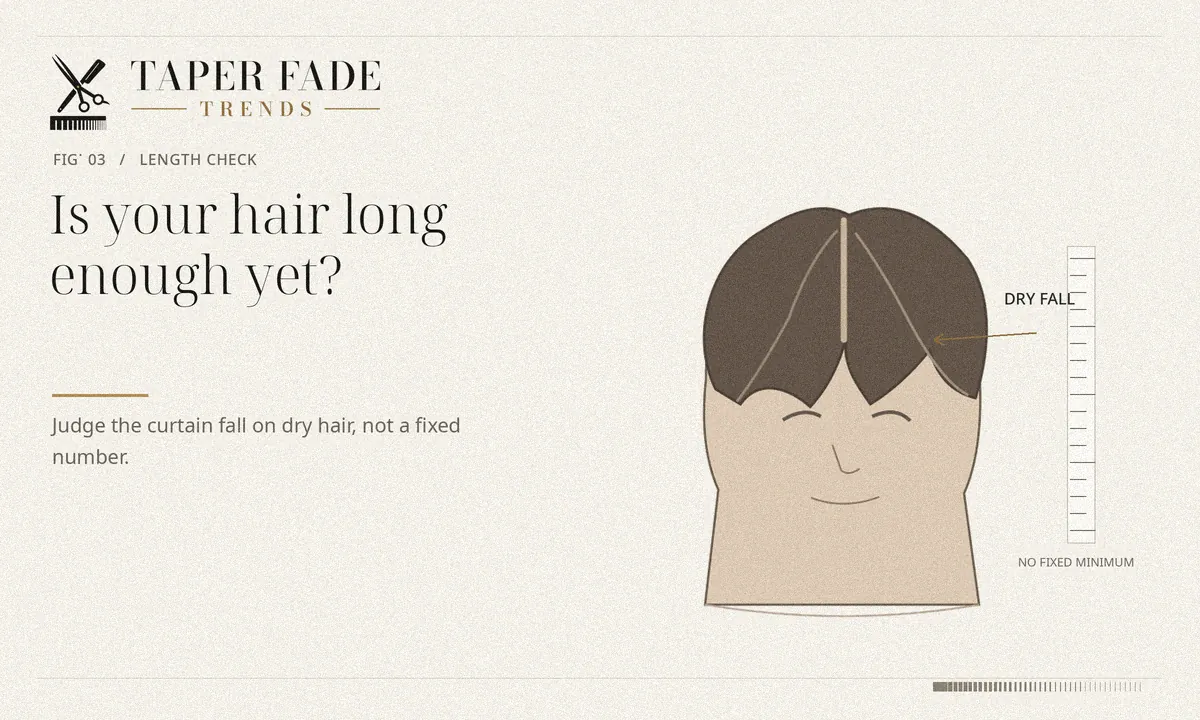
There is no single minimum top length for a middle part low taper fade. Published guides land between roughly 3 and 5 inches for a basic version and ask for more for fuller curtains, and texture changes the result. The practical test is dry: if the front bends and falls to both sides, it is long enough.
| Guide | Top length it suggests | Its note |
|---|---|---|
| Taper Trends | 3 to 4 inches as the common pick; 4 inches plus for a full curtain | 2 to 3 inches gives only a subtle part |
| OnPointFresh | At least 4 to 5 inches for a basic version; 5 to 7 for longer curtains | Front reaching the eyebrows, eyes or nose |
| Taper Haircut Guide | At least 3 to 5 inches | Enough for the front to reach eyebrow level |
The ranges overlap but don’t agree, which is why the dry test matters more than any of them. If the front springs up or falls to one side only, either the top needs more time or a cowlick is pushing the part off center.
How texture changes the fall
Straight, wavy and curly hair can all wear a middle part low taper fade, and current guides show all three, but the same length falls differently on each. Judge the part on dry hair, because shrinkage, density and growth direction decide where the curtains land more than the inch count does.
| Hair behavior | What it changes | Check on dry hair |
|---|---|---|
| Shrinkage | Curls and waves pull up shorter as they dry | Measure dry, never wet or stretched |
| Density | How full the upper sides look under the falling top | Does the top land on weight or on a gap? |
| Growth direction | A cowlick or whorl can push the part off center | Does the part hold without product? |
| Texture | Straight hair lies flatter; waves and curls add lift | Does the front split where you want it? |
Once the top can part, the next choice is how much contrast you want at the sides.
Choose the version before you sit down
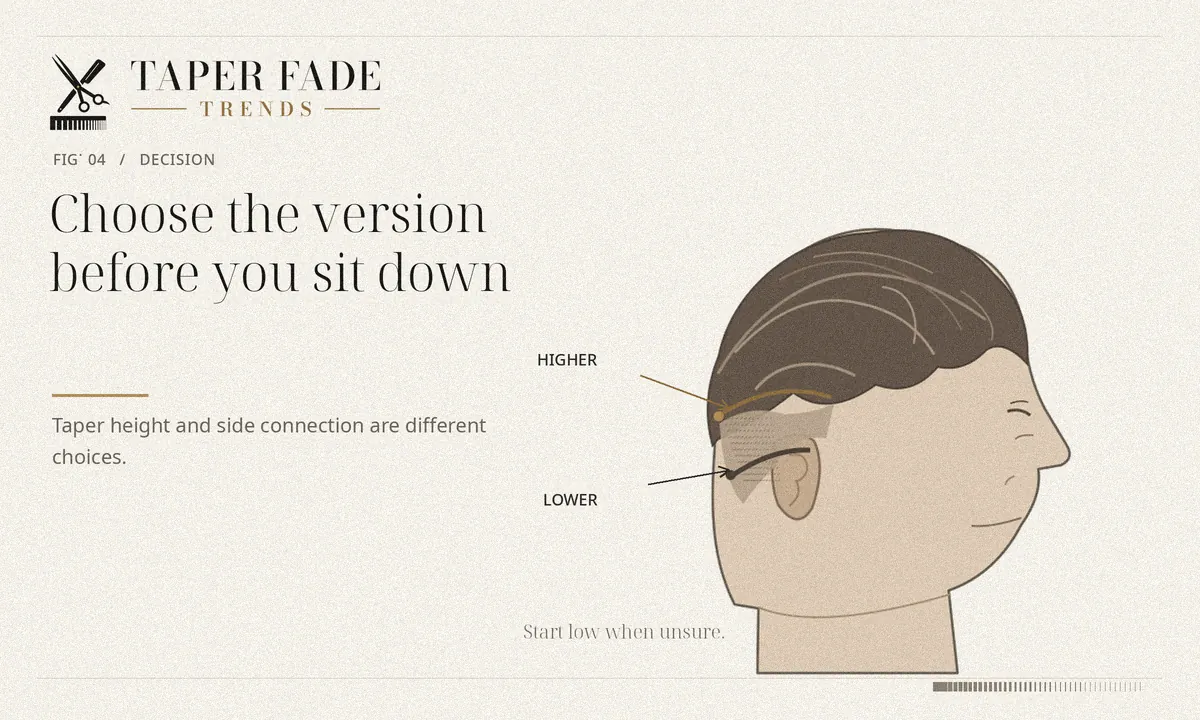
Choose a low taper if you want the curtains to fall onto full sides, and a mid taper if you want the sides to read sharper. Cutters Yard describes the low taper as keeping more weight on the sides and the mid taper as adding definition. Connection is a separate choice, though a low taper leaves more weight to connect with.
| Version | Choose it if | Say to the barber |
|---|---|---|
| Low taper, connected | You want the curtains to fall onto full sides | “Keep the upper sides; check with me before taking weight off.” |
| Low taper, disconnected | You want contrast but a low perimeter | “Take the upper sides shorter on purpose.” |
| Mid taper | You want sharper sides and accept less side weight | “Mid taper, and tell me how much side weight is left.” |
| Not sure yet | You can’t picture either | “Start low.” |
Starting low is the reversible choice. Man of Many’s Nick Hall makes the point that a barber can always take a taper higher at the next visit, while going back down means waiting for the hair to grow. The low taper vs mid taper guide compares the two heights in detail.
What to tell your barber
Tell your barber four things about a middle part low taper fade, in this order: where the taper sits, how long the top stays, whether the upper sides keep weight for the curtains, and how short the bottom of the taper goes. Show a side profile with it. Describe outcomes and let the barber choose the clipper settings.
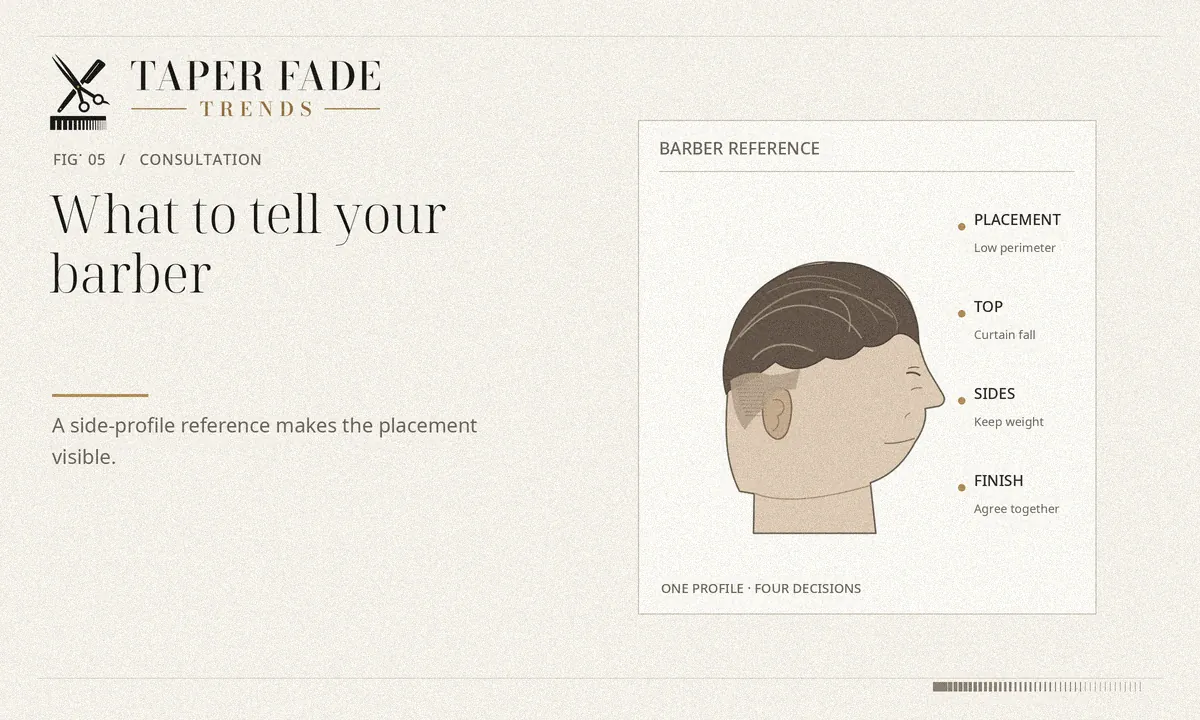
- Placement: a low taper around the sideburns, ears and nape, no higher than your reference photo.
- Top: long enough to split near the center and fall to both sides.
- Connection: keep upper-side weight for connected curtains, or remove it on purpose for an overhang.
- Shortest finish: point to it in your photo and ask what setting gets there.
Our guide on how to ask for a taper fade covers the consultation for any taper.
A copyable barber brief
Say or show something close to this:
“I want a middle part with a low taper around the sideburns, ears and nape, no higher than this profile photo. Leave the top long enough to split in the center and fall to both sides. Keep enough weight in the upper sides for the curtains to connect, and check with me before you take weight off them. I’d like the shortest finish to match the photo.”
For a disconnected overhang, swap the connection sentence for: “Take the upper sides shorter on purpose so the top hangs over them.”
If your sides puff out as they grow, add: “Can you reduce the bulk there without cutting the upper sides so short that the top hangs over them?”
Bring photos that let the barber check the same four things:
- A front reference, which shows how the top splits.
- Left and right profiles, which show where the taper stops and whether the top lands on side weight. If you bring only one photo, make it a profile.
- A back reference, which shows the nape and how far the taper wraps.
- A photo of your own dry hair from the side, without product, so the barber sees how your top falls today.
What not to specify unless you know it
Leave guard numbers, lever settings, inch heights and rebooking intervals out of the request unless you know them from your own past cut. Some guides publish guard recipes for each style, but those describe their example cuts. Guard sizes also aren’t consistent across clipper brands, as our clipper guard chart explains, and “low” is not an inch measurement.
What to trim while you grow it out
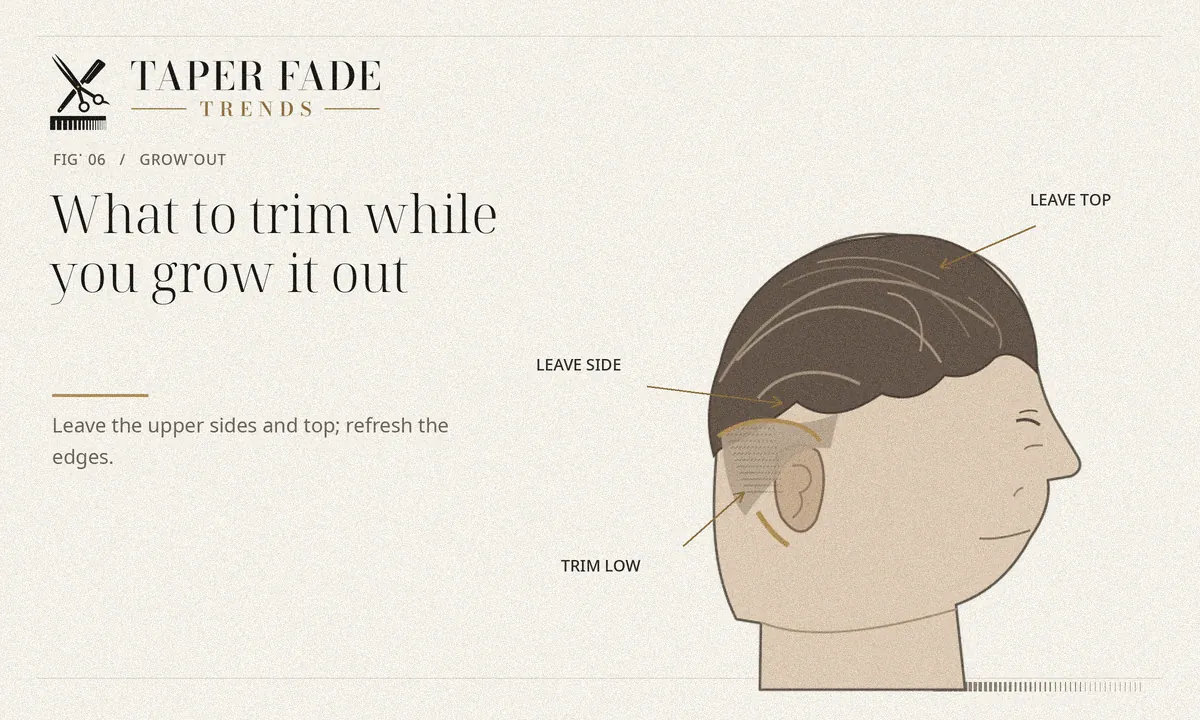
While you grow a middle part low taper fade toward longer curtains, trim the low perimeter and leave the upper sides and top alone. Ready Sleek gives the same advice for the taper fringe: refresh the taper but let the top grow, since trimming both at every visit keeps the cut stuck where it started.
| Zone | Grow-out move | Why |
|---|---|---|
| Low perimeter | Trim | Keeps the outline clean without shortening anything above it |
| Bulk above the ears | Ask before removing | Only worth it if the upper sides keep their length |
| Upper sides | Leave | They carry the weight the connection needs |
| Top | Leave | Its length is what the curtains need to fall |
Your starting cut sets the limits. If the upper sides were taken short before you began growing, an overhang can show until they catch up, and no trim speeds that along. Photograph your dry side profile before each visit so you and the barber can see what changed.
How to style the middle part without flattening the sides
Style a middle part low taper fade on damp hair: find the split your hair already falls into, dry each side away from the part, and keep some lift instead of pressing the top flat. Styling changes how the top falls, but it can’t put back upper-side weight the cut removed.
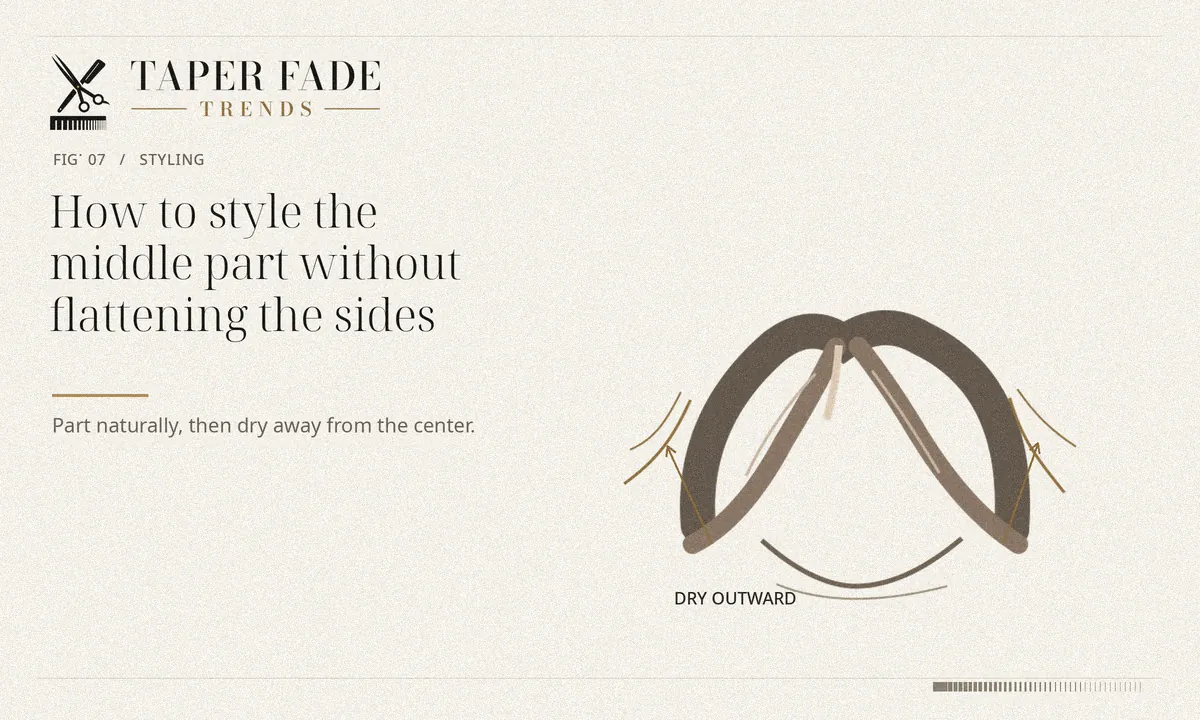
- Towel-dry until damp, then find the split the hair falls into on its own.
- Part it there with your fingers. OnPointFresh and Ready Sleek both warn against forcing a razor-straight center line; a slightly off-center part usually looks more natural.
- Blow-dry each side away from the part, keeping some lift at the root.
- Add product only if your texture needs it.
Taper Trends suggests a light cream or sea salt spray for wavy hair, a matte clay or water-based pomade for straight hair, a curl cream for curls and mousse for fine hair. No single product is required, and this guide gives no amounts.
Upkeep: refresh the perimeter, reshape the top separately
A middle part low taper fade has no fixed rebooking interval, but the low perimeter usually needs attention before the top does. Taper Trends suggests refreshing the taper every 2 to 4 weeks and trimming the top every 6 to 8; Taper Haircut Guide gives 2 to 3 and 6 to 8. Treat those as rules of thumb, not a schedule.
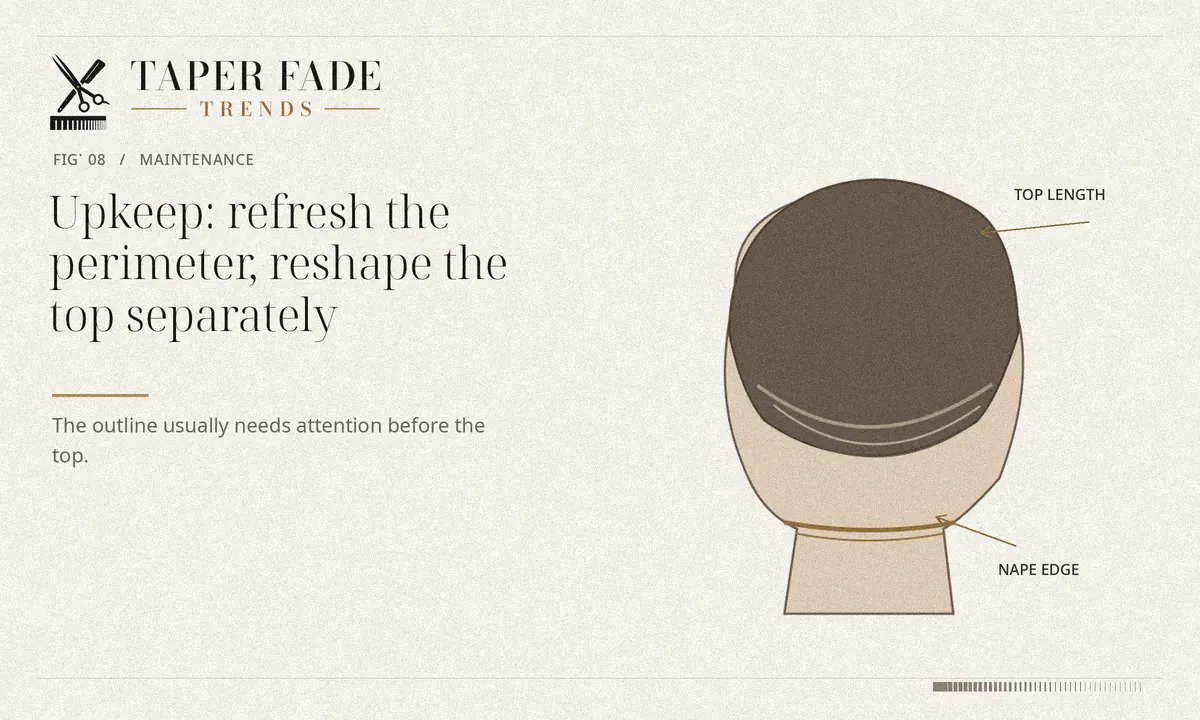
Cutters Yard names what moves your own timing. A shorter, sharper finish shows regrowth sooner, faster-growing hair shortens the gap, and the crisper you like the edges, the sooner they look due. Our guide to how long a taper fade lasts covers those variables week by week.
| What to watch | Sign it needs work | What to ask for |
|---|---|---|
| Low perimeter | The outline at the sideburns, ears and nape no longer matches what you chose | A refresh, with the upper sides left alone |
| Top | The front no longer falls to both sides, or bulk builds | The top reshaped, with the perimeter left as it is |
| Connection | An overhang appears that you didn’t choose | A profile photo and a clear statement of which version you want |
When another cut makes more sense
Pick a different cut when your top can’t part yet or when you don’t want a center split at all.
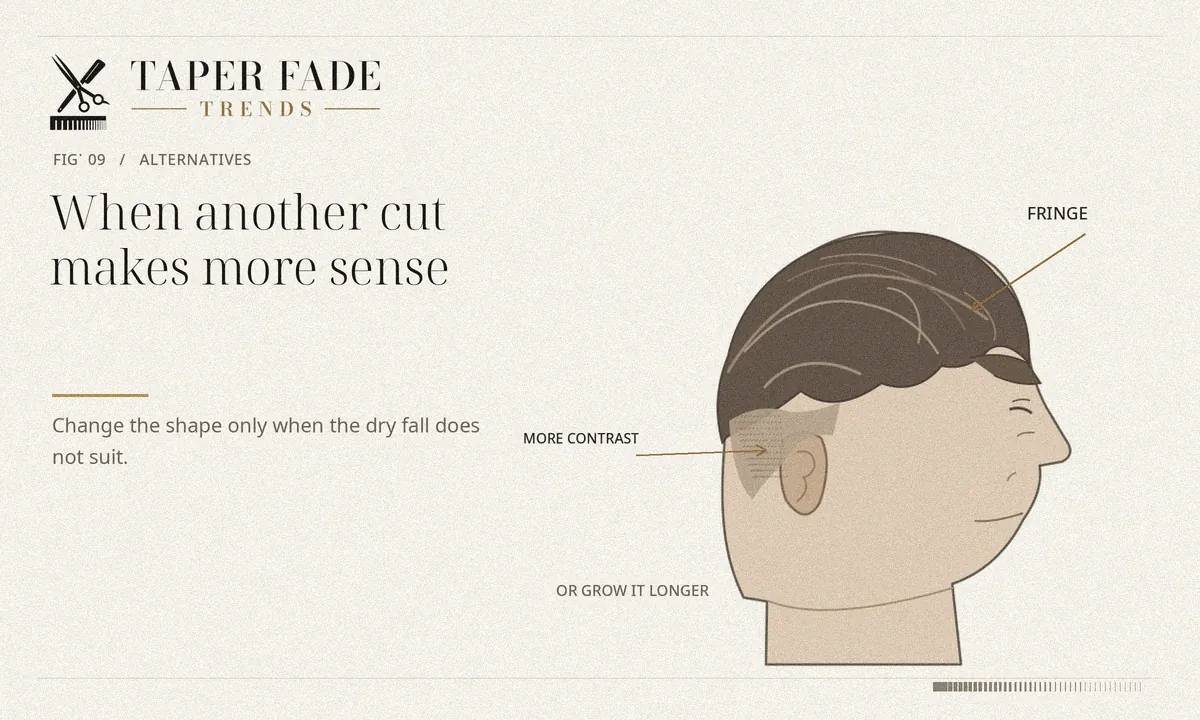
- If the top won’t fall to both sides on dry hair, wait for more length or wear it forward. A fringe sweeps the front onto the forehead instead of splitting it; the textured fringe low taper guide covers that cut.
- If you want stronger contrast at the sides, a mid taper fade or a deliberately disconnected overhang fits better than connected sides.
- If you want a pattern or line work in the sides, that is a design rather than this cut.
Many guides also match this cut to face shapes. Those are preferences, not rules, and this guide leaves them out. A reference photo shows a shape, but it can’t tell you the shortest finish behind it or how the model’s hair falls compared with yours.
How this middle part guide was researched
Taper Fade Trends Editorial wrote this guide to help readers choose and describe a middle part low taper fade before a barber visit. We compared current haircut guides with barbershop references, separated connection from taper height, and left out claims we could not support, including guard recipes and face-shape rules. Sources were checked on October 21, 2026.
No barber has reviewed this page yet. The page contains no photos of real haircuts: every image is a labeled illustration, and no measurement here comes from a recorded cut. Haircut terms are not standardized, so “taper,” “fade” and “taper fade” are used loosely across shops, and “middle part” and “curtains” overlap without meaning exactly the same thing.
Sources: Cutters Yard on low and mid taper weight and regrowth; Man of Many (Nick Hall) on taper placement and starting low; OnPointFresh, Taper Trends and Taper Haircut Guide on top length, disconnection and upkeep; Ready Sleek on grow-out and finger parting.
If something here is wrong, contact us and we will fix it, date the change and leave the original claim visible, as our editorial policy describes.
If taper height is still the open question, the low taper vs mid taper comparison is the next read. If the shape is decided, take the barber brief above to your appointment.
Keep reading
All guides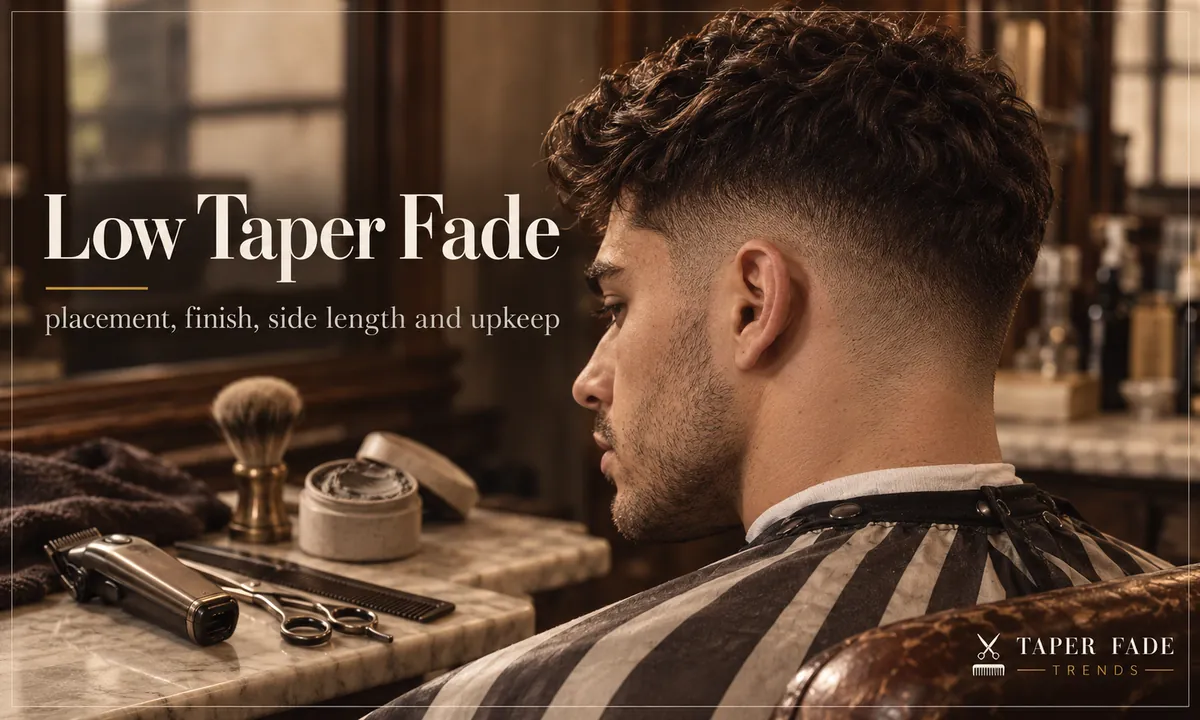
Low taper fade: placement, finish, side length and upkeep
A low taper fade shortens the sideburns and nape and keeps the sides full. See the four choices to make, whether it can go to skin, and what to say.
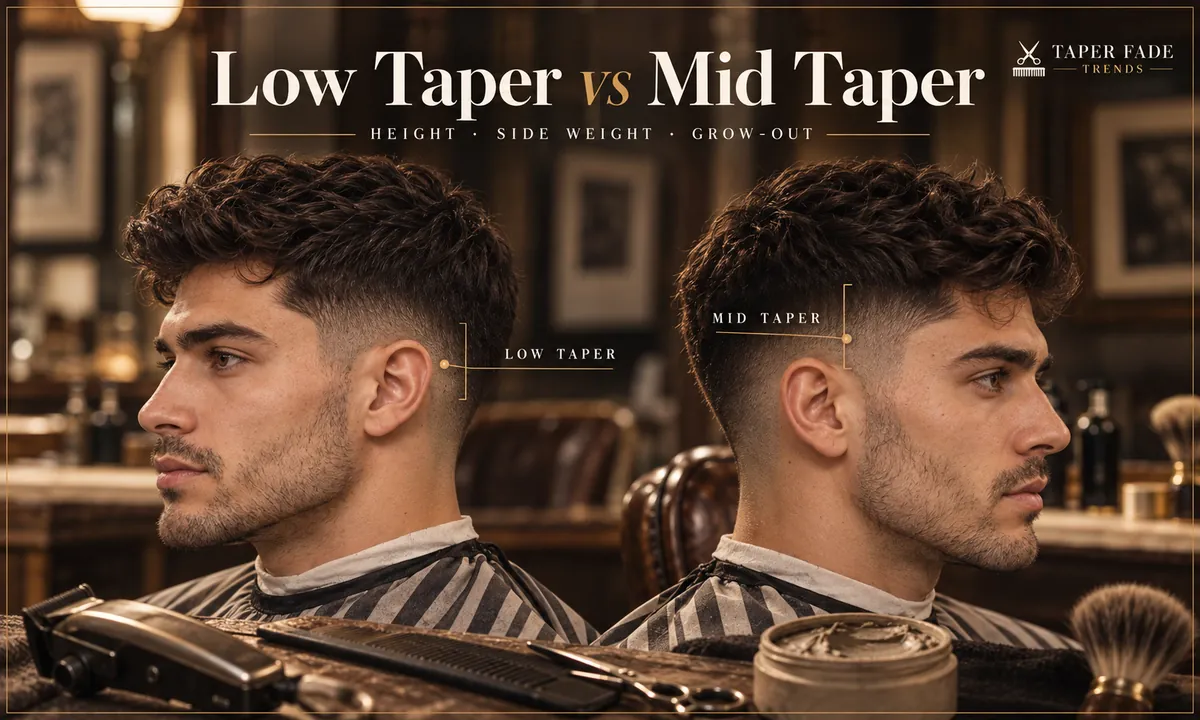
Low taper vs mid taper: what changes when only the height moves
Low taper vs mid taper compared on height, side weight, shortest finish and grow-out, why switching mid to low takes time, and what to tell your barber.
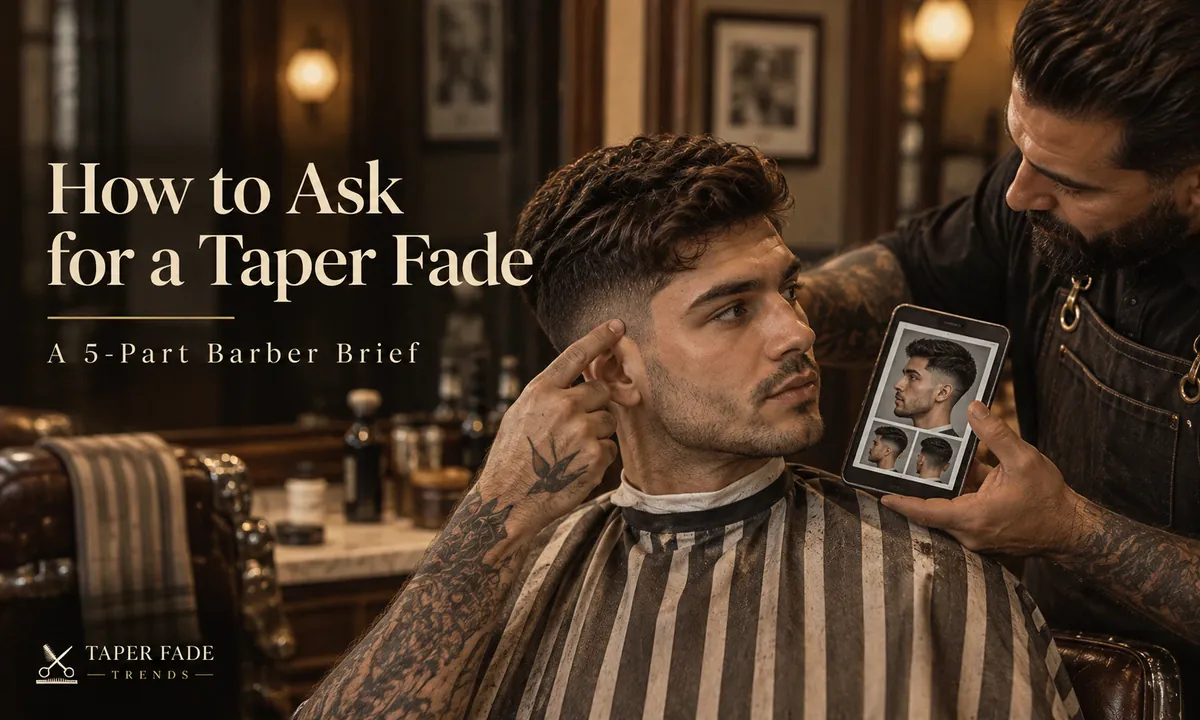
How to ask for a taper fade: a five-part barber brief
How to ask for a taper fade: say where it may reach, how short the base goes, how much side weight stays and what to do on top, then check the plan first.
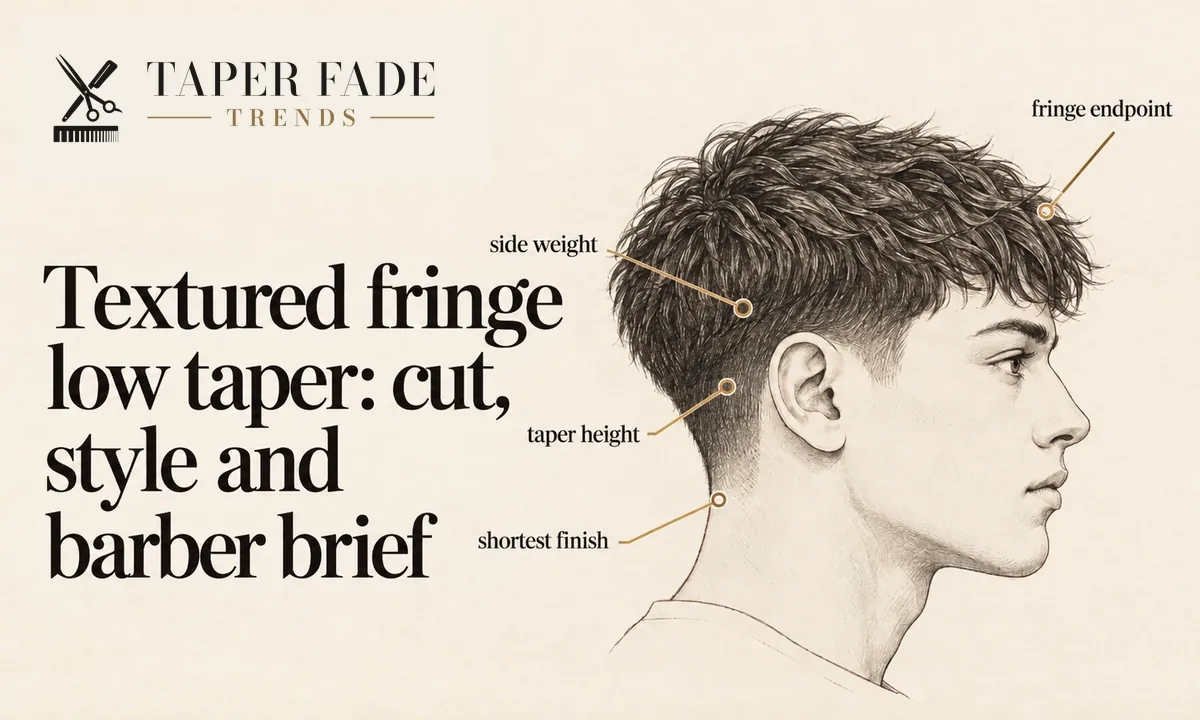
Textured fringe low taper: cut, style and barber brief
A textured fringe low taper explained: four choices to settle, whether straight hair needs a perm, what to tell your barber, and fixes for a flat fringe.
More in low taper fades
Low taper fades: all 14- Low taper fade: placement, finish, side length and upkeep12 min
- Low taper fade straight hair: density, sides and top length11 min
- Low taper fade Black male guide: choose the top, hairline and nape10 min
- Curly low taper fade: keep curl width above the ears10 min
- Low taper fade buzz cut: compare top length and finish12 min
- Textured fringe low taper: cut, style and barber brief12 min
- Blowout low taper fade curly hair: keep volume, keep definition11 min
- Low taper fade wavy hair: what to ask for13 min
- Asian low taper fade: choose by how your sides grow7 min
- Middle part low taper fade: keep the curtains connectedYou are here
- Low taper fade with dreads: protect the loc boundary12 min
- Low taper mullet: keep length behind the ears13 min
- Low taper vs mid taper: what changes when only the height moves10 min
- Low taper vs low fade: compare coverage and side weight11 min