Low taper fade straight hair: density, sides and top length
A low taper fade on straight hair keeps the shortest blending low, around the sideburns, ears and nape, and leaves more length through the rest of the sides. The real decisions are how much side weight to keep for your density and growth direction, and how much top length your chosen shape needs.
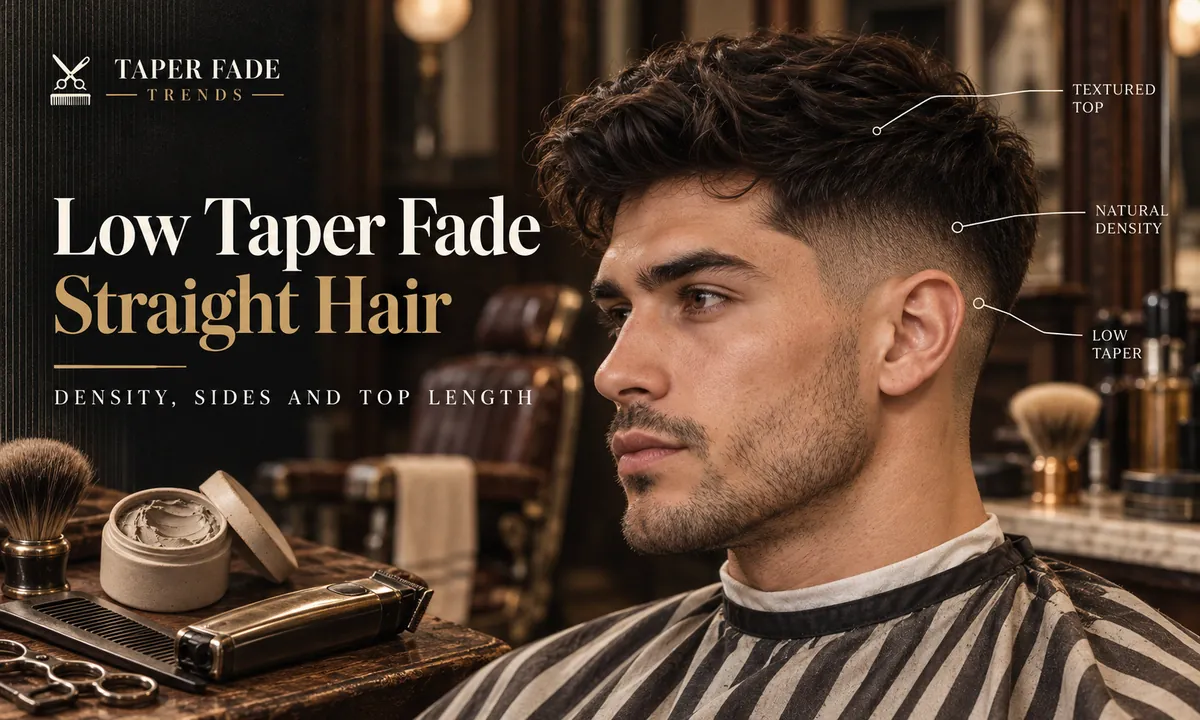
What a low taper fade changes on straight hair
A low taper fade on straight hair concentrates the shortest blend at the sideburns, around the ears and at the nape, while the mid and upper sides keep more length and density. Density and growth direction, not straightness alone, decide whether the side weight it keeps lies flat against the head or pushes out.
Montreal barber Youssef Ouda describes the low taper as a blend placed only around the temples and neckline, and Cadmen Academy’s taper guide places it near the ears and neckline with more length left on the sides overall.
“Low” describes where the blend sits. It does not set how short the bottom goes. Some barbers will take a low taper down to skin; Cadmen Academy defines a taper as a cut that never shows skin and calls anything with skin a fade. The labels shift from shop to shop, so describe the result instead: where the blend sits, how short it gets at the bottom and how much side is left above it.
A few terms used throughout. The blend is the zone where one length melts into the next. The nape is the back of the neck at the hairline. A guard is the clipper attachment that sets cutting length, and a guard number alone does not define how high a taper sits.
Straight hair is hair whose visible shaft does not form a persistent wave or curl, but its density, strand thickness and growth direction still vary from head to head. Straight does not mean fine, flat or downward-growing. Youssef Ouda’s guide to thick, straight hair makes the same point: strand thickness, density, stiffness and growth direction decide how the hair behaves, and a background label does not. The Asian low taper fade guide applies that to choosing side length.
Side weight is the length and density kept in the side panel, and it controls how close the hair sits to the head. Because a low taper keeps its short zone small, it leaves more side weight than a low fade, which runs a continuous short band around the head.
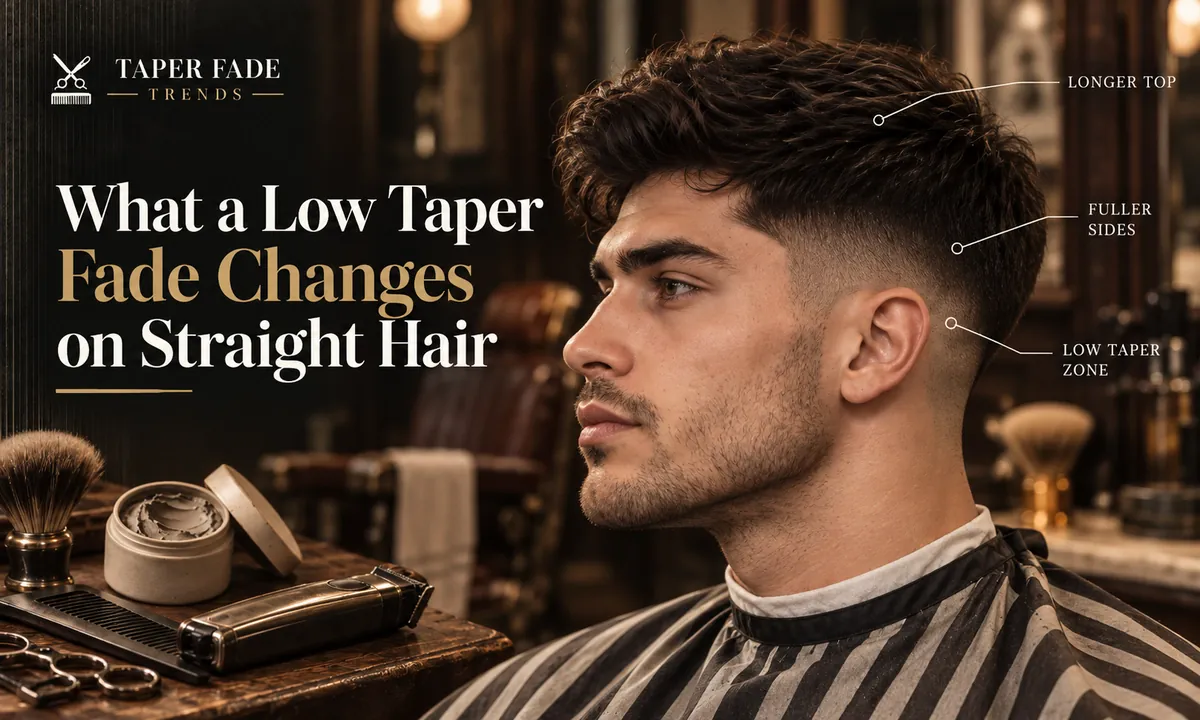
Quick specifications to decide before the cut
Before you book, decide placement, side weight and top length, and note your density and growth direction. Treat the shortest finish and any guard number as unknown until your barber confirms them for your cut.
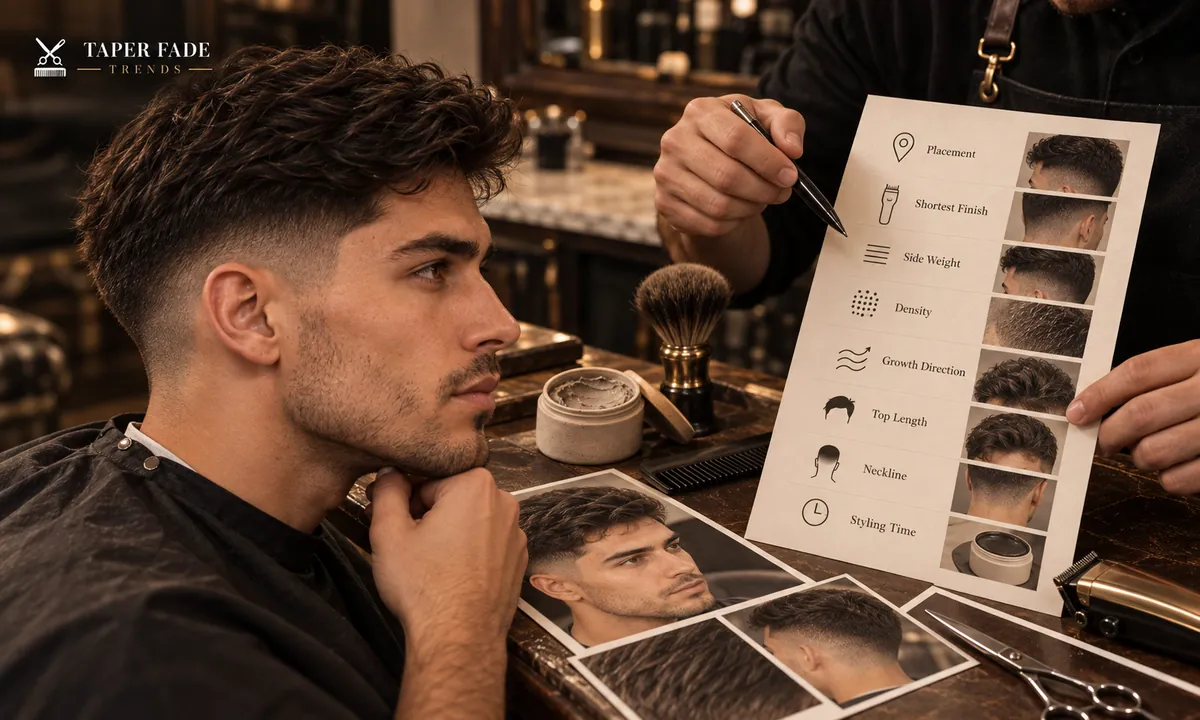
| Specification | What it means | How to settle it |
|---|---|---|
| Placement | Where the blend sits at the sideburn, ear and nape | Show a side and back reference |
| Shortest finish | The shortest length at the bottom, skin or not | Ask the barber; unknown until cut |
| Side weight | Length and density kept in the side panel | Choose by density and growth direction |
| Density | How much hair there is, separate from strand thickness | The barber assesses it on dry hair |
| Growth direction | Whether side hair falls down or pushes out | Watch your sides as they grow; straightness does not settle it |
| Top length and shape | Length for a fringe, crop, part or longer top | Set by the shape; no universal number |
| Neckline | The shape of the lower edge at the back | Natural, rounded or squared; your choice |
| Styling time | How much daily work the shape needs | Match it to your routine |
| Tidy-up trigger | The visual sign the cut needs work | See the grow-out table below |
Choose by density, growth direction and top length
Set side weight by how your hair behaves, then set top length by the shape you want. Here is how each pattern changes the decision.
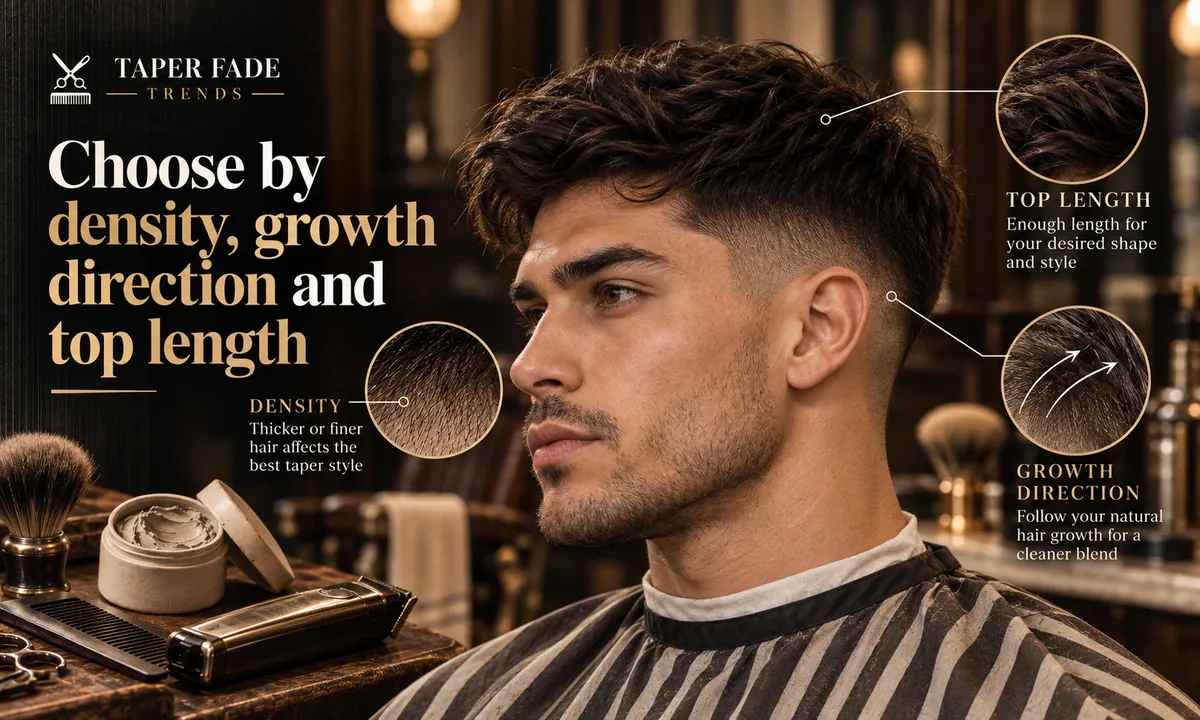
| Hair behavior | What it changes | Decision to discuss |
|---|---|---|
| Fine or flat straight hair | A high-contrast taper can expose a light, see-through zone | Keep some shadow in the taper; keep side weight and top length |
| Dense straight hair that falls down | Side length usually lies flat | How much internal bulk, if any, to remove |
| Dense straight hair that grows outward | Some lengths push away from the head | Keep enough length to lie down, or go short in a chosen zone |
| Any density, with a fringe or longer top | The top must connect to the sides without a step | The length the shape needs, with no fixed inch range |
Density is how much hair grows on the head; strand thickness is how wide each hair is. Fine strands can be dense, and thick strands can be sparse, so describe both to your barber.
Fine or flat straight hair
Fine or flat straight hair does not need more taken off to suit a low taper. Youssef Ouda’s advice for fine hair is to keep some shadow in the taper and limit contrast, so a lighter area does not open up above the ear. Decide how much side weight and top length carry your shape before anything comes off.
Dense straight hair that grows outward
Dense straight hair that grows outward needs a side-shape decision, not just a shorter guard. Youssef Ouda’s approach is to keep enough length for the hair to lie down, or go short on purpose within a chosen zone, and to remove weight by section rather than thinning the whole side evenly.
On the low taper itself, he advises reducing weight gradually so the sides do not project or form a step above the short zone. Some style guides suggest thinning the sides so thick hair sits flat. His guide to thick, straight hair warns that thinning shears used everywhere can create short strands that push out as they grow, so ask for selective weight removal, not an all-over thin-out.
Fringe, crop and longer top shapes
No single top length works for every fringe, crop or brushed-back top, and published guides give ranges that disagree with each other. Pick the shape first, then let the barber set the length that shape needs on your hair, and ask for the number afterward if you want to repeat it.
| Top shape | What the length has to do |
|---|---|
| Fringe | Reach the forehead line the fringe needs and fall without splitting |
| Crop or short top | Hold the shape at the chosen length without standing up |
| Longer brushed-back or parted top | Move as intended and connect to the sides without a step |
Why the sides can stick out after a week
Straight sides usually stick out after a cut because growth direction, density and length interact as the hair grows. With stiff strands, Youssef Ouda notes that some middle lengths stand up more than hair that is either very short or long enough to settle. A side can sit flat right after the cut and then flare as it grows into that in-between range.
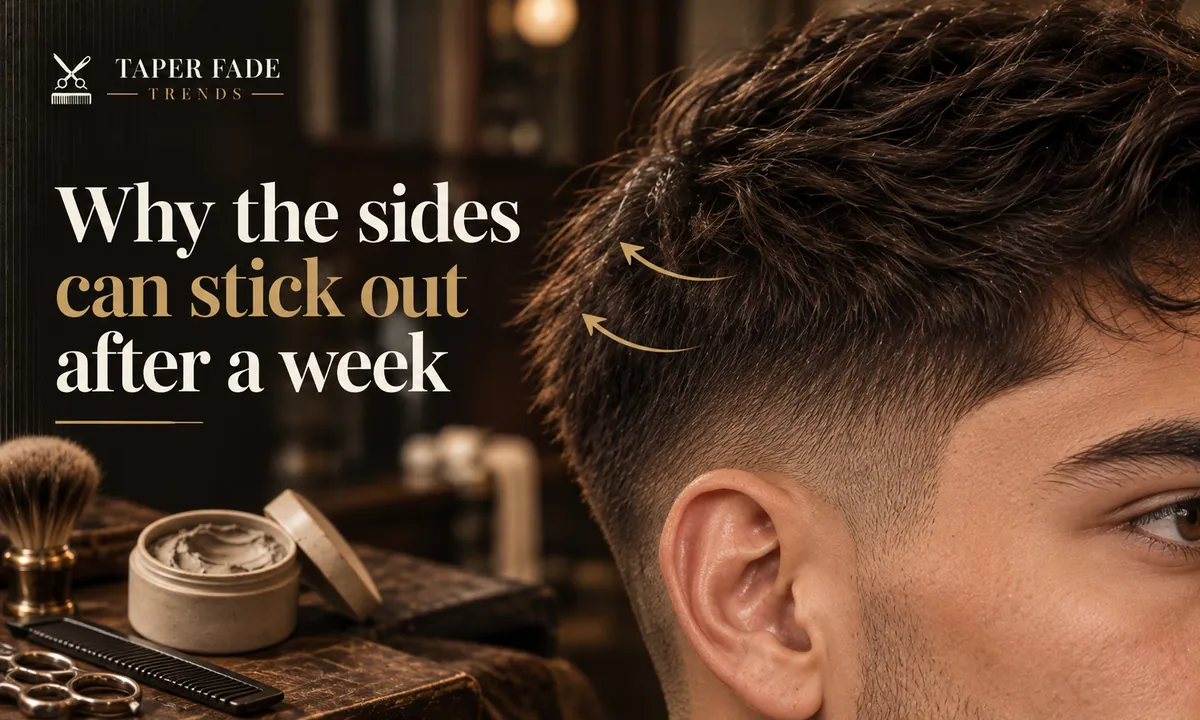
That in-between length is different on every head, so this guide gives no day count or millimeter figure. The evidence is practitioner observation, not controlled study.
| What you see | Likely variable | What to do |
|---|---|---|
| The side flares at one length, then settles as it grows | Length stage | Decide with your barber whether to keep more length or cut that zone shorter |
| The side stands out at every length | Growth direction and density | Ask the barber to check growth direction before any weight comes off |
| The side looks heavier than the shape you asked for | Retained side weight | Ask for selective weight removal by section |
Cutting shorter is not an automatic fix. Youssef Ouda warns that cutting at the wrong point can add width through the sides instead of removing it.
What to ask your barber
Ask for results, not tool settings. Cover these five points in your own words:
- Placement: keep the taper low at the sideburns and nape.
- Side weight: keep the mid and upper sides full, or say how much shorter you want them.
- Shortest finish: ask how short the bottom will go, and whether you want skin.
- Top: the shape you want, and how the fringe or part should fall.
- Neckline: natural, rounded or squared, as in your back reference.
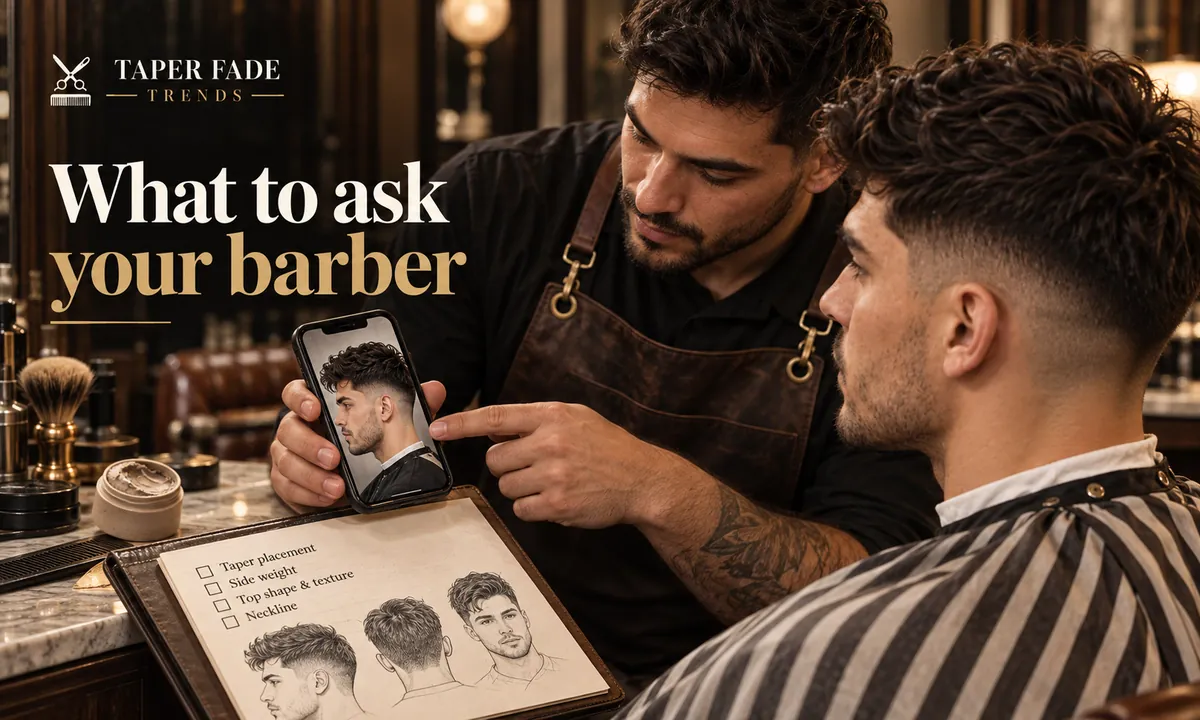
Bring front, left, right and back photos, ideally of hair with a density close to yours, because a side profile on very different hair will mislead you both. Also tell the barber what your sides do after washing or a day under a hat. Ask for the guard or length used afterward and write it down for next time.
Keep the taper low and preserve side fullness
To keep the taper low and the sides full, make two separate requests: a low taper at the sideburns and nape, and full mid and upper sides. Name placement and side weight separately, show a side reference with that silhouette, and let the barber check density and growth direction before removing any weight.
Keep the taper low but shorten the whole side
Yes, you can keep the taper low and still shorten the whole side. Taper placement and side length are separate controls, so the short zone can stay at the sideburns and nape while the panel above it comes down. Ask for both in one sentence so the barber does not raise the taper instead.
| Request | Taper placement | Side panel above the taper |
|---|---|---|
| Low taper, keep side weight | Low, at the sideburns and nape | Keeps its length and density |
| Low taper, shorter side | Low, at the sideburns and nape | Shorter, to the length you describe |
Say which one you mean. A side photo shows the silhouette more clearly than a guard number.
Low taper vs low fade on straight hair
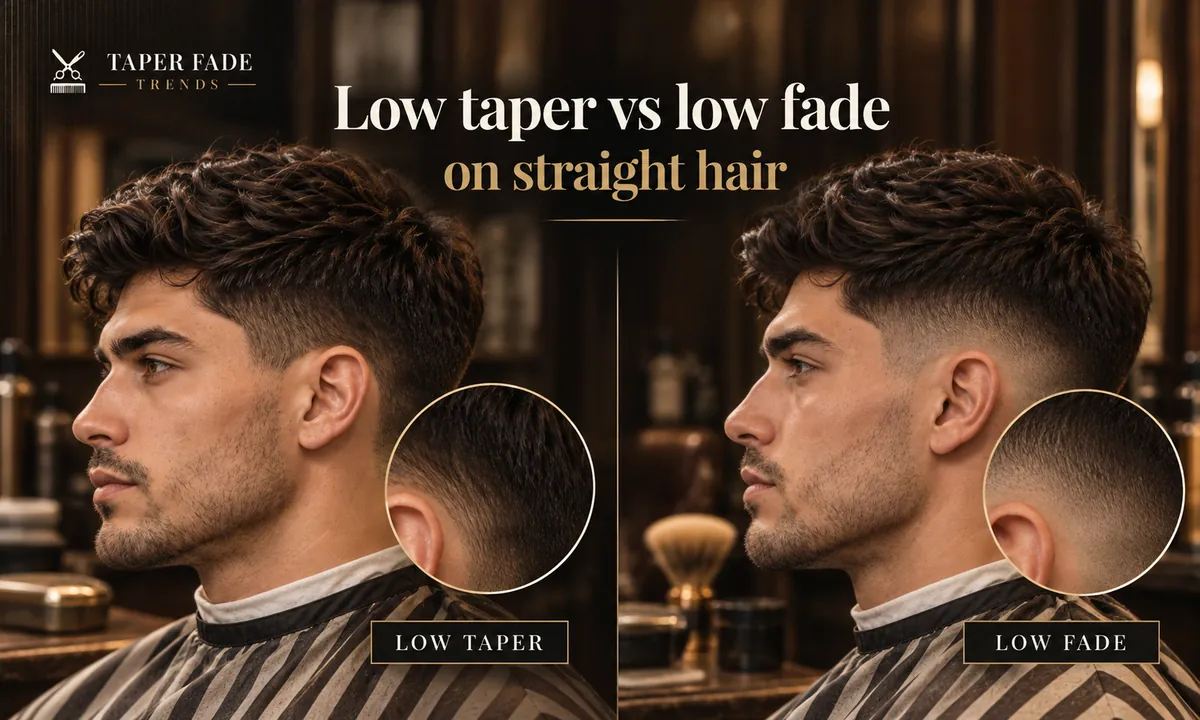
A low taper and a low fade both sit low, but they cover different ground. Youssef Ouda distinguishes them by shape: the low taper blends only around the temples and neckline, while a low fade runs one continuous low transition around the whole head. Other shops draw the line at skin instead, so confirm the end state.
Styling when the top stays flat
A flat top is either a cut problem or a styling problem, and the cut comes first. Check whether the top has the length and internal shape your style needs; if it does not, that is a job for the barber. Only then experiment with how you style it.
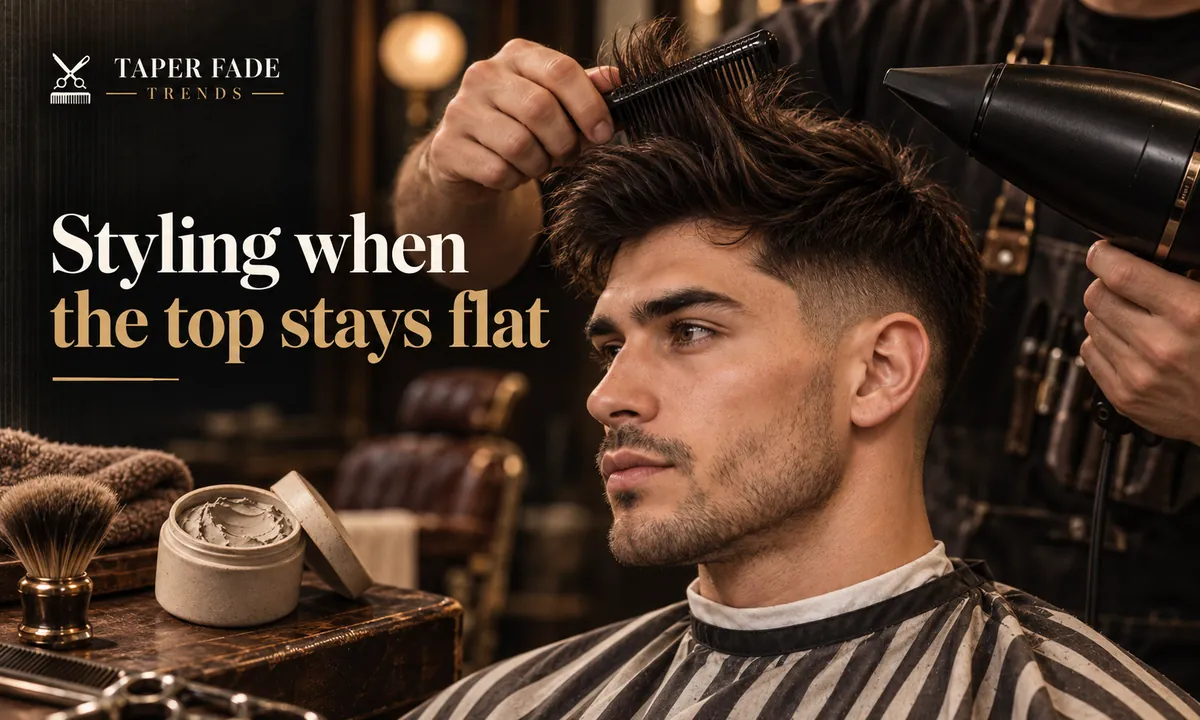
- Compare the top with the shape you asked for, dry and at rest. Short or blunt means the cut needs work.
- If the cut matches, change the direction you blow-dry the top and check whether the shape holds at rest. Keep what works on your hair.
- Add a small amount of light product only if the hair needs it, and note what you used.
How to judge grow-out and when to tidy it
No single tidy-up interval fits every low taper fade. Barber sources range from about two weeks, for clients who want the outline very fresh, to five or six weeks for men who prefer a classic taper. How short the bottom was cut changes it: Cadmen Academy notes that a taper stopping short of skin shows regrowth more slowly.
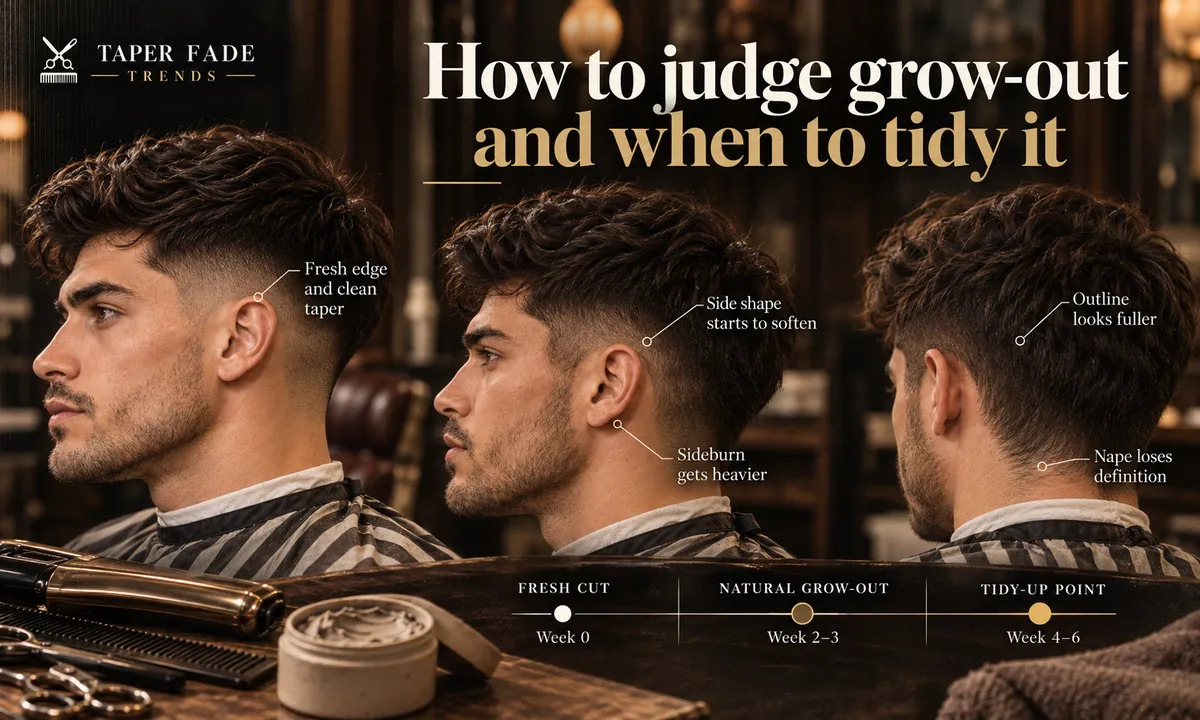
| What you notice | What is behind it | Usual fix |
|---|---|---|
| The edge at the sideburns and nape has gone soft | Shortest finish and growth rate | Outline clean-up at the barber |
| The neckline looks fuzzy or uneven | Neckline shape and growth | Neckline tidy; leave the blend alone |
| The sides flare again | Growth direction and side weight | Barber checks length stage before cutting |
| The top has lost its shape | Top length, then styling | Check the cut first |
Resist cleaning up the line yourself. Youssef Ouda points out that edging without reliable reference points can enlarge the short zone and slowly turn a low taper into a higher fade.
Limits, alternatives and what a photo cannot tell you
A reference photo can show taper placement, side weight, top silhouette and neckline shape. It cannot reliably show the guard or blade setting, the subject’s density, natural growth direction, the product used or how many days have passed since the cut. Treat those as unknown unless the photo comes with a real cut record.
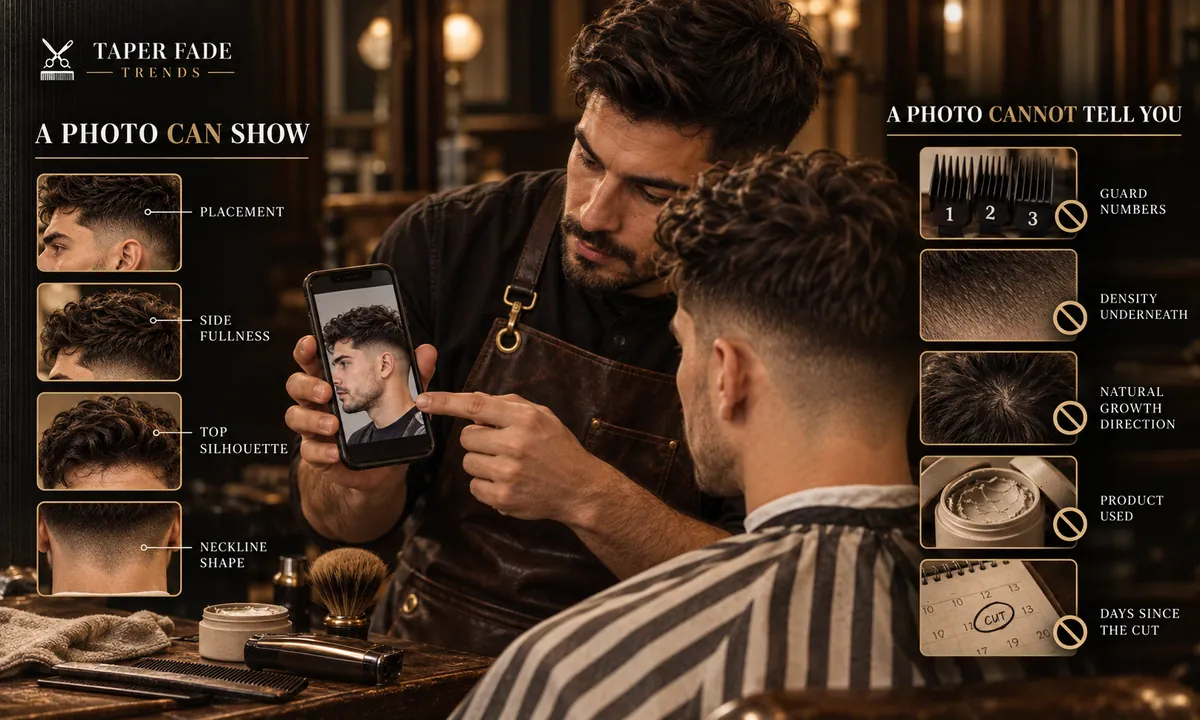
| A photo can show | A photo cannot reliably show |
|---|---|
| Where the taper sits at the sideburn, ear and nape | The guard, blade or lever setting |
| How full the sides look | The density underneath |
| Top silhouette and fringe shape | Natural growth direction |
| Neckline shape | Product used or days since the cut |
If you want no visible short zone at all, or sides that move freely, a scissor cut may suit you better; Youssef Ouda notes that a scissor-led cut can preserve a classic, flexible shape on thick straight hair. For more contrast with side weight still kept above the blend, a mid taper fade on straight hair starts it around the temple. Face-shape rules are preferences, not anatomy. Barber Dave Broderick, quoted by Latest-Hairstyles, argues that how a client feels in the cut matters more than face-shape rules. School and age rules are a separate question this guide does not cover.
Method, image credits and sources
Taper Fade Trends prepared this guide from published barber and barber-school sources, read on October 6, 2026. It contains no real cut photographs and no measured cut records, so it gives no guard numbers or top lengths. Every image is a labeled Taper Fade Trends illustration, not a haircut result. No barber reviewed this page.
- Youssef Ouda, low taper fade guide: placement, fine and thick straight hair, low taper vs low fade, grow-out.
- Youssef Ouda, thick and straight hair guide: sides that stick out, selective weight removal, reference photos.
- Cadmen Academy, taper haircut technique and taper terminology: low taper placement and the taper-versus-fade skin line.
- Cadmen Academy, taper and fade explained: how a non-skin taper grows out.
Next step: bring the brief and reference photos
Save front, left, right and back references of hair close to your density, then copy this brief into your phone:
Keep reading
All guides
Low taper fade: placement, finish, side length and upkeep
A low taper fade shortens the sideburns and nape and keeps the sides full. See the four choices to make, whether it can go to skin, and what to say.
Curly low taper fade: keep curl width above the ears
A curly low taper fade cleans the temples, sideburns and nape but keeps curl width above the ears. What to decide, check dry and tell your barber.
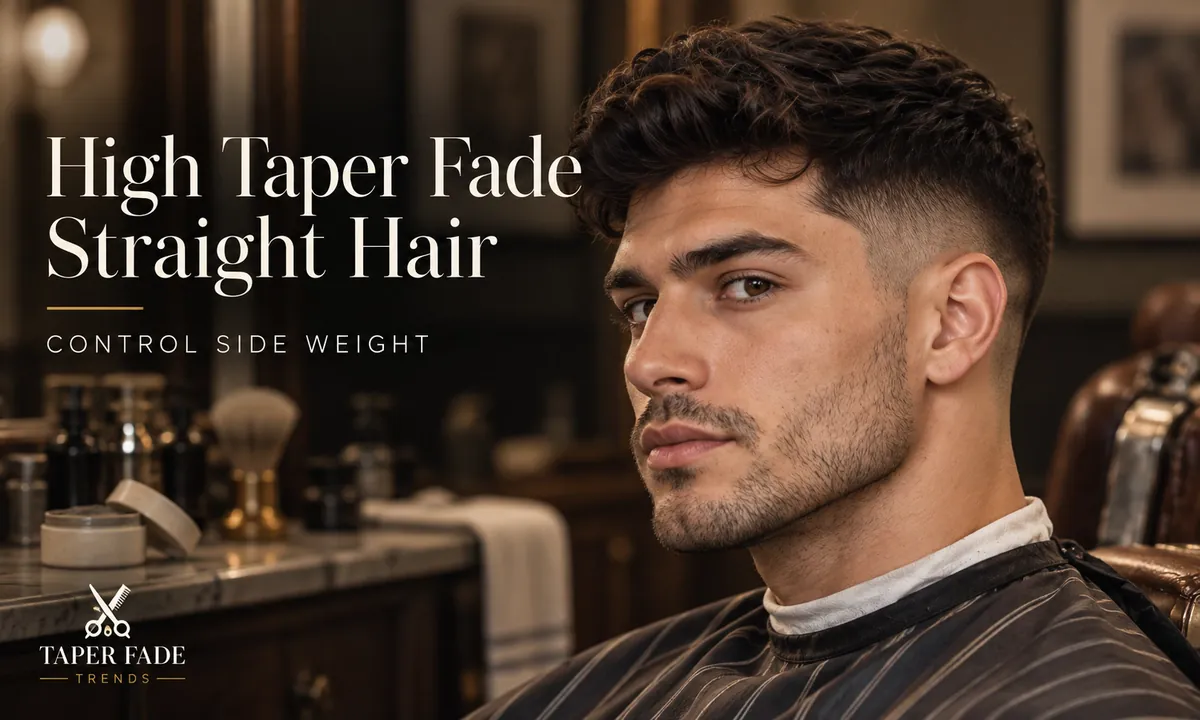
High taper fade straight hair: control side weight and avoid a shelf
High taper fade straight hair, explained by density, growth direction and side weight, with a barber script and why sides stick out as it grows.
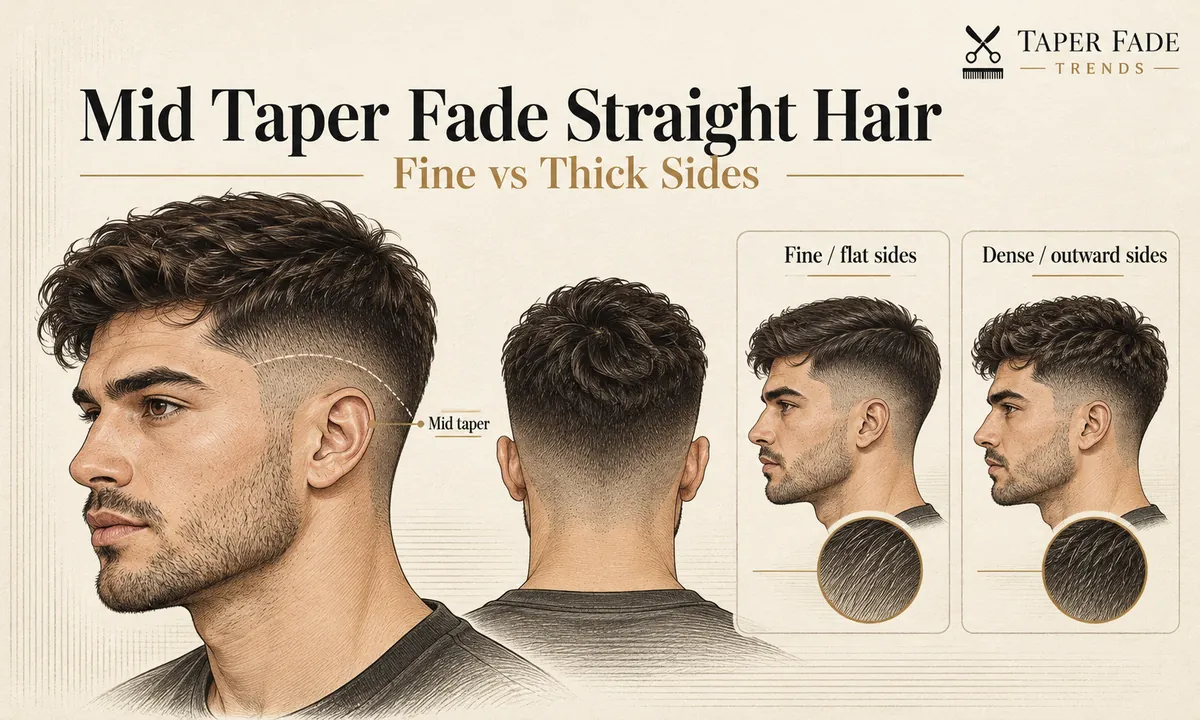
Mid taper fade straight hair: fine, flat and outward-growing sides
Mid taper fade straight hair guide: how much side weight to keep on fine or dense sides, why sides stick out after a cut, and what to tell your barber.
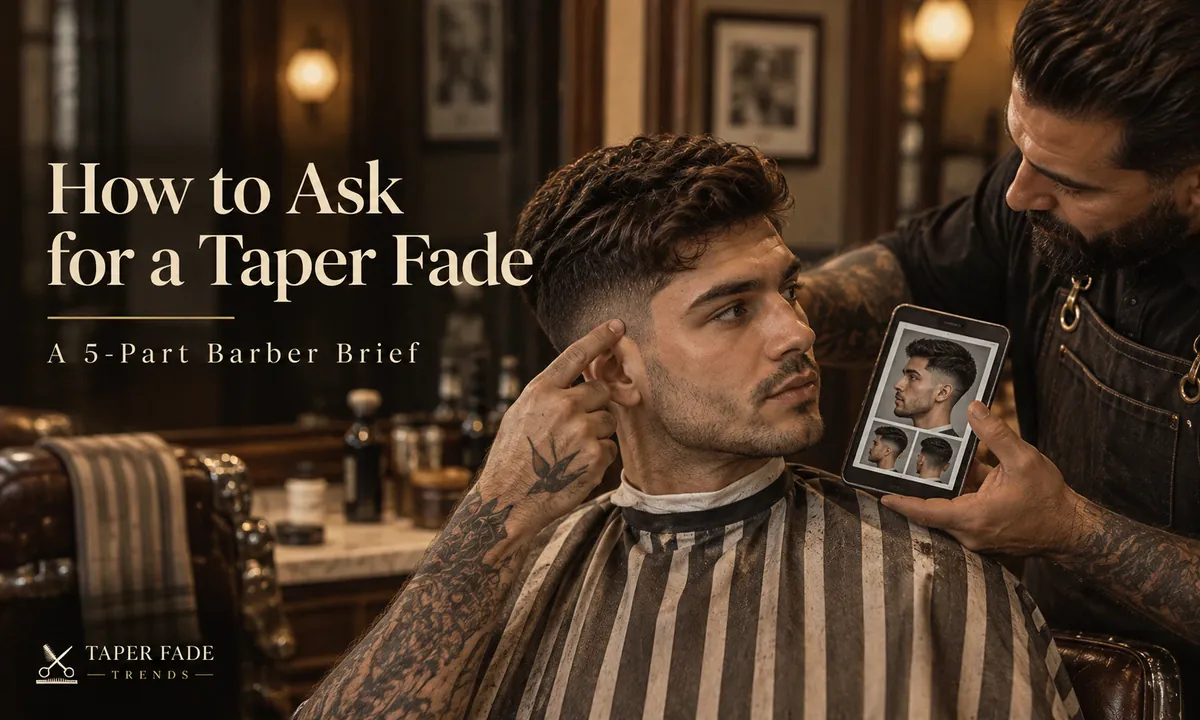
How to ask for a taper fade: a five-part barber brief
How to ask for a taper fade: say where it may reach, how short the base goes, how much side weight stays and what to do on top, then check the plan first.
More in low taper fades
Low taper fades: all 14- Low taper fade: placement, finish, side length and upkeep12 min
- Low taper fade straight hair: density, sides and top lengthYou are here
- Low taper fade Black male guide: choose the top, hairline and nape10 min
- Curly low taper fade: keep curl width above the ears10 min
- Low taper fade buzz cut: compare top length and finish12 min
- Textured fringe low taper: cut, style and barber brief12 min
- Blowout low taper fade curly hair: keep volume, keep definition11 min
- Low taper fade wavy hair: what to ask for13 min
- Asian low taper fade: choose by how your sides grow7 min
- Middle part low taper fade: keep the curtains connected8 min
- Low taper fade with dreads: protect the loc boundary12 min
- Low taper mullet: keep length behind the ears13 min
- Low taper vs mid taper: what changes when only the height moves10 min
- Low taper vs low fade: compare coverage and side weight11 min