Low taper French crop: set the fringe length and edge
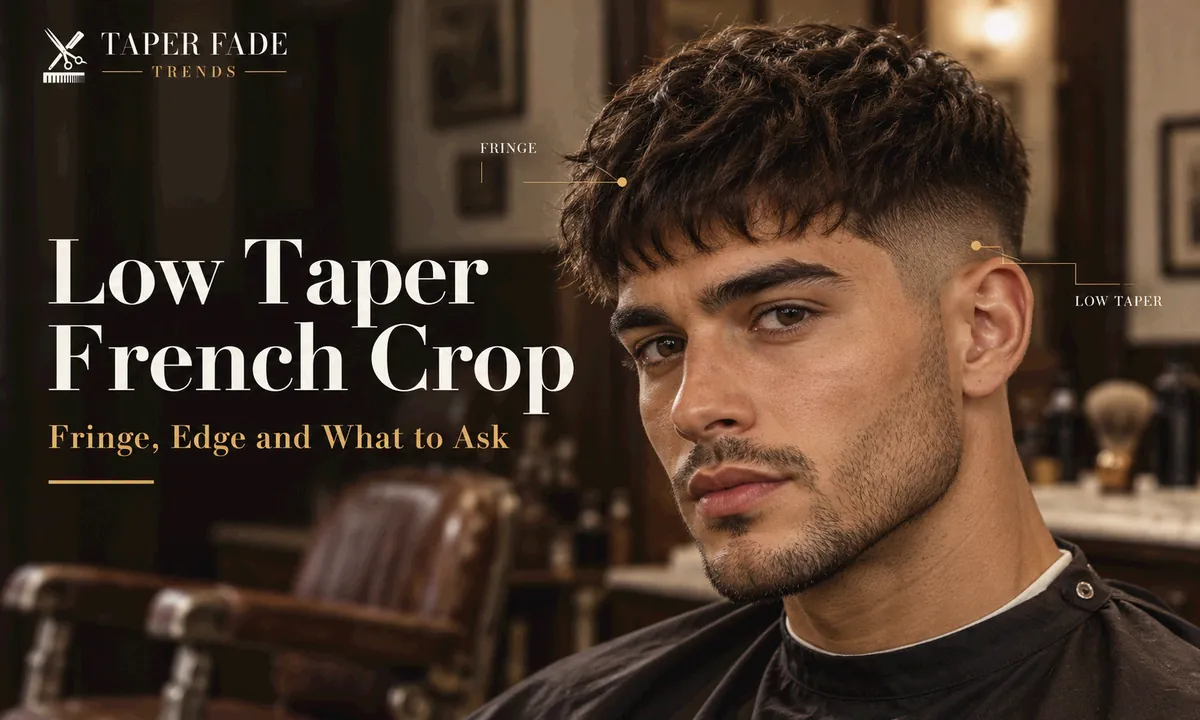
A low taper French crop is a short haircut with the top directed forward into a visible fringe while the shortest work stays at the sideburns and nape. A low taper usually leaves more side weight than a low fade. The front comes down to two choices: where the dry fringe lands and whether its edge is blunt or broken.
What is a low taper French crop?
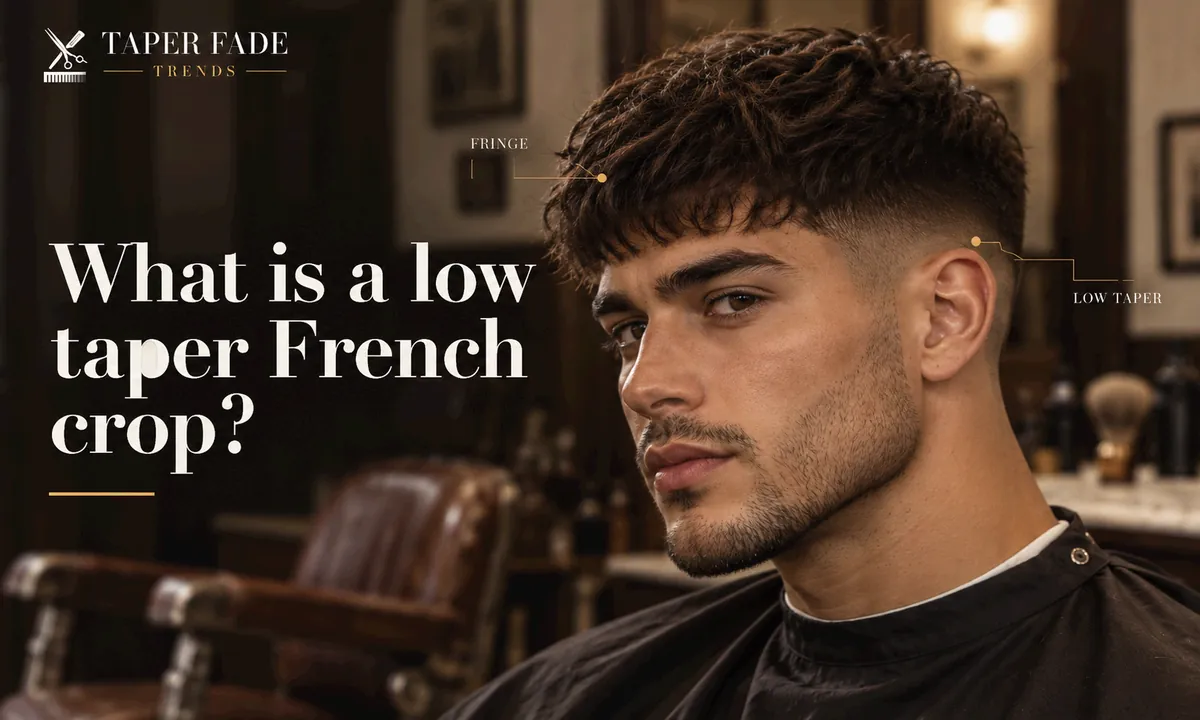
A low taper French crop is a forward-fringe crop paired with a low perimeter taper that preserves side weight above the shortest areas. The top is directed forward into a visible fringe, the short work stays at the sideburns, around the ears and at the nape, and most of the side panel keeps its length.
The two halves are separate decisions. The French crop sets the top: hair travels forward from the crown and finishes in a fringe, and licensed barber James Goodman’s French crop guide notes the sides can be scissor-cut, tapered or faded. The low taper sets the sides. In Goodman’s low taper version, the shortest work stays around the sideburns and neckline instead of spreading across the side of the head. A Sydney barbershop, Fresh By Prince, describes one textured French crop where the taper was kept around the temple and ear so the sides stayed dark enough to connect to the heavier top.
Plenty of people search for a “low taper fade French crop.” This guide uses “low taper” because barbers use “taper” and “fade” for different amounts of side coverage, and the difference shows up as side weight. For the taper on its own, see the low taper fade guide.
Use this spec sheet with any reference photo. Each row is a separate choice, and none of them is set by the haircut’s name.
| Choice | What it controls | How to set it |
|---|---|---|
| Fringe landing | Where the finished dry front edge rests on the forehead | Point to the spot on your own forehead |
| Fringe edge | One blunt line, or a front broken into pieces | Name it, then point to it in the photo |
| Top length | Whether the top can travel forward from the crown without splitting | Show the photo and have the length judged dry |
| Taper placement | Where the shortest work sits | “Sideburns and nape, below the temple” |
| Side weight | How full the sides stay above the taper | “Keep the sides full above it” |
| Shortest finish | What is left at the bottom of the taper | Say skin, a zero or a guard number |
| Neckline | How the back outline is finished | Natural, rounded or squared; show a back photo |
Set the fringe before you choose the taper
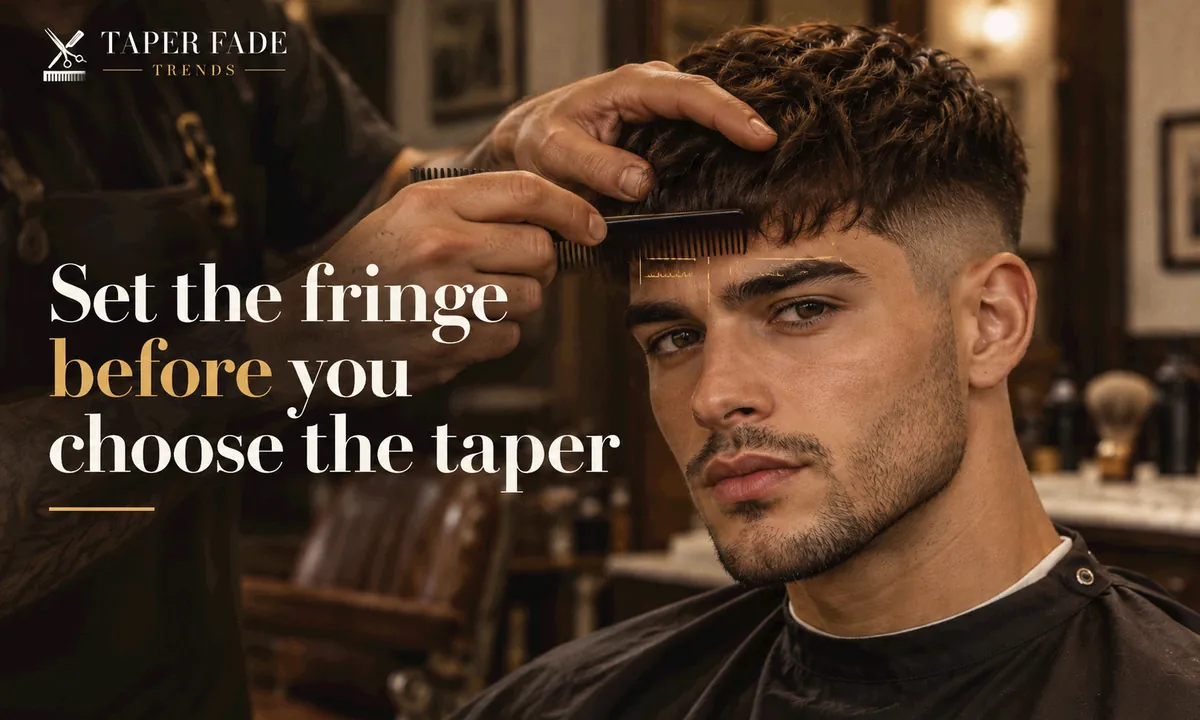
No single fringe length suits every French crop, so decide the landing point first: the spot on your forehead where the finished dry edge should rest. Then choose whether that edge reads as one blunt line or breaks into pieces. The taper changes the sides, not the front, so it can be settled after.
Published numbers show why a universal length doesn’t work. Hairnee prints a fringe of 1 to 2 inches, London’s Golden Scissors places the fringe anywhere between the hairline and the middle of the forehead, and Goodman describes short versions with a fringe only a few millimeters deep. All three describe real French crops. The same length simply lands in a different place on a different hairline.
Choose where the fringe lands
The fringe landing point is the point on the forehead where the finished dry front edge rests. Set it by touch, not by inches. Golden Scissors asks clients to put a finger on the forehead where the fringe should stop, because “short fringe” means different lengths to different men.
Judge it dry. Goodman’s guide says the fringe should be checked once dry so its final position is clear, and that soaking-wet hair can hide where it will sit. For a blunt fringe, Golden Scissors adds a practical margin: one cut too short looks wrong for about ten days, so it suggests aiming roughly a centimeter (about 3/8 inch) longer than the spot you want.
Blunt edge or broken edge?
A blunt fringe reads as one continuous front line. A broken edge is a fringe line intentionally separated into visible pieces rather than reading as one continuous straight line. Neither is more correct, but the choice changes what some barbers call the cut, so name the edge instead of relying on the label.
Golden Scissors treats the blunt line as what makes the cut a French crop and calls the broken version a textured crop. Goodman lists both blunt and choppy fringes as French crops. Henkey’s French crop guide splits the difference: once the front breaks into many different-length pieces, the cut is moving toward a textured crop.
| Edge | How the front reads | Tends to work for | Watch for |
|---|---|---|---|
| Blunt | One continuous, defined line | Straight, dense hair, which Goodman says holds the line best; fine hair, which Golden Scissors says reads denser with a blunt end | A line cut too short, and how much an uneven hairline shows |
| Broken | Separate pieces with movement | An irregular hairline or mild temple recession, per Goodman | Heavy thinning, which Goodman warns can leave a fine fringe weak and wispy |
Low taper vs low fade on a French crop
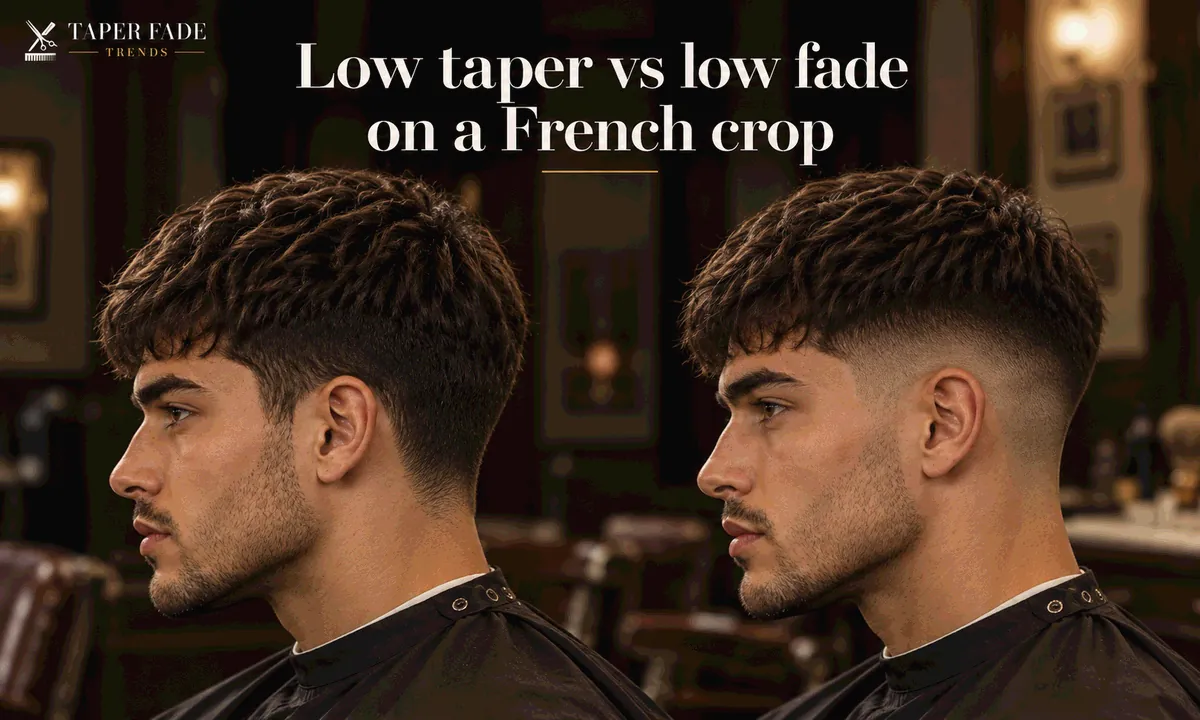
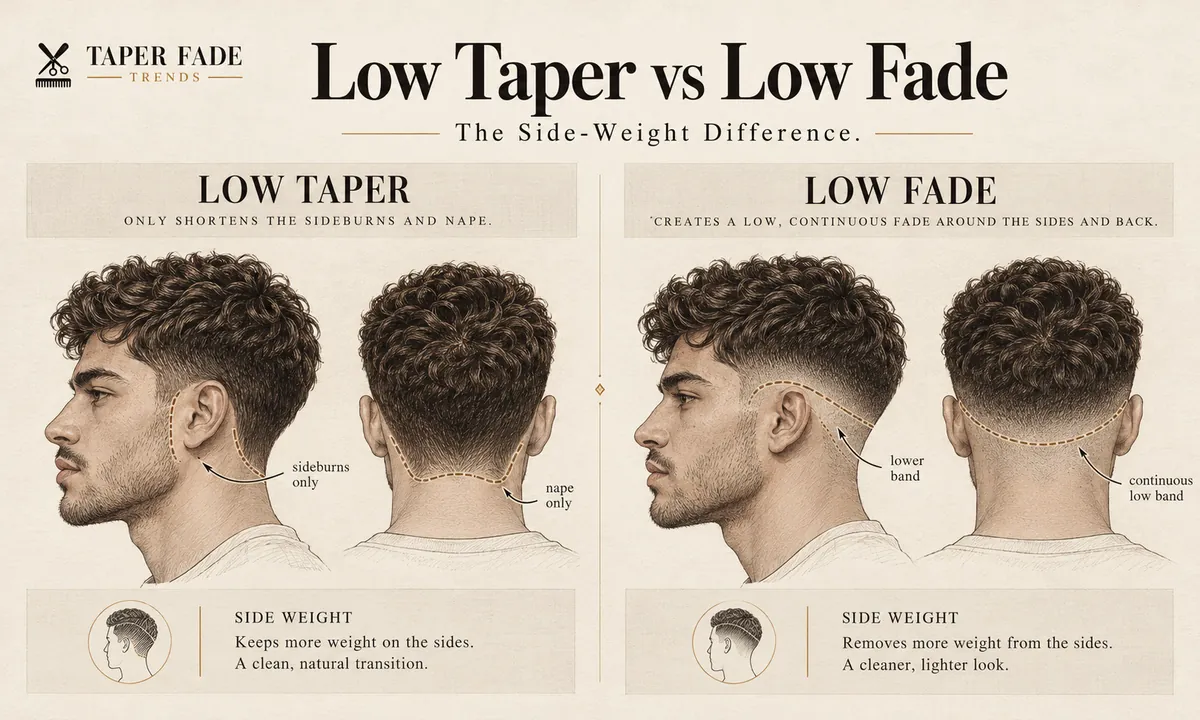
On a French crop, a low taper keeps the shortest work at the sideburns, around the ears and at the nape, so most of the side panel stays full. A low fade usually carries a shorter band farther around the sides and back. Shops draw this line differently, so point to where the short work should stop.
Goodman calls the low taper the subtler of the two for that reason: the short work stays at the perimeter instead of spreading across the side. Not every shop separates them by area, though. Hairnee, for example, separates them by finish, describing a taper as never exposing skin and a fade as blending to skin or near it. Under that usage, the bottom length decides the name, not the coverage.
| Criterion | Low taper | Low fade | Check in a photo |
|---|---|---|---|
| Where the short work sits | Sideburns, around the ears, nape | A band that continues around the sides and back | Side and back views near the ear and neckline |
| Side weight above it | More stays | Less stays, because more of the side is shortened | The side panel in profile |
| What “low” fixes | Placement only | Placement only | Neither word sets the shortest finish; ask for it separately |
Show the barber a side photo and a back photo, and point to where the shortening should stop. The full four-criteria comparison is in taper vs fade.
Which hair characteristics change the result?
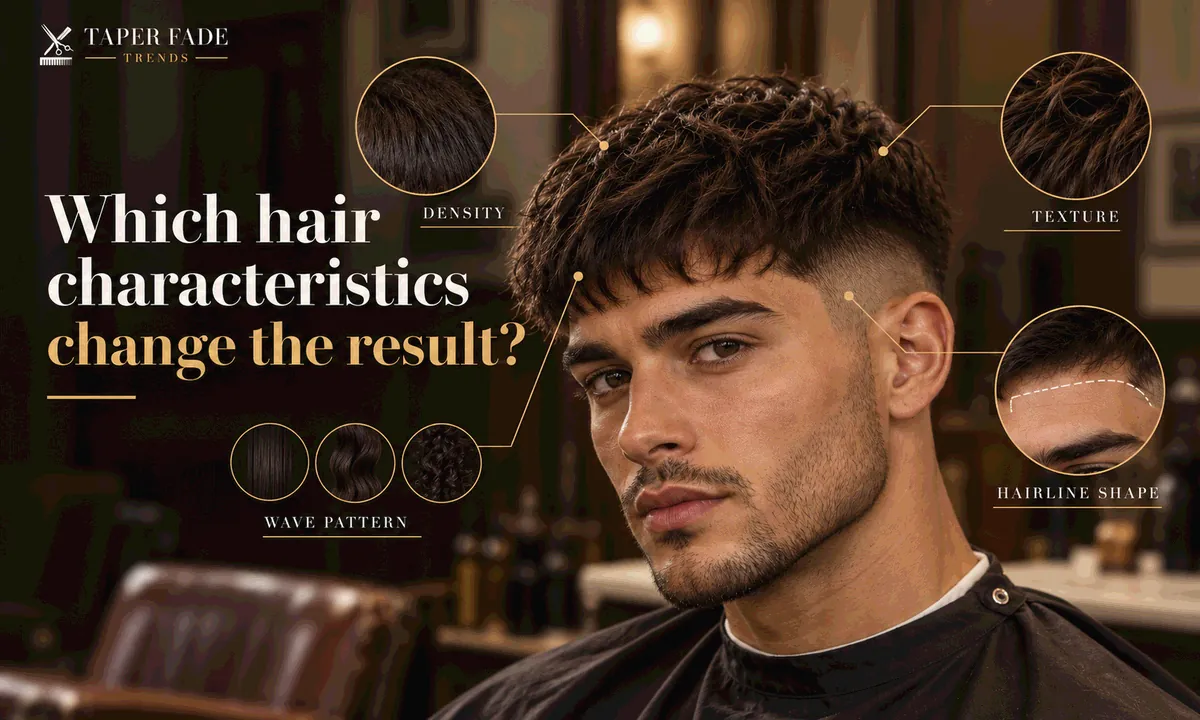
Density, strand texture, crown direction and front growth pattern all change how a low taper French crop sits, so the same reference photo can turn out differently on your head. Goodman’s guide says a good barber adjusts the cut around the crown, temples and density instead of copying the photo exactly.
| Hair variable | What it changes | What to tell the barber |
|---|---|---|
| Density | How full the fringe stays once weight comes out | How much weight you want taken off the top |
| Texture | How the top holds its direction and front edge | How your hair behaves when it dries on its own |
| Front growth pattern | Where the dry fringe actually settles | Where the front lifts or pulls sideways |
| Crown direction | Whether the top travels forward or splits | Which way your crown swirls |
Straight or fine hair
Straight hair is the easiest match for the clean shape, according to Henkey’s. Fine hair needs the opposite of heavy texturizing. Goodman says fine hair needs density preserved so the fringe doesn’t look see-through, and Golden Scissors says a blunt edge makes fine hair read thicker because every hair ends at the same line. Ask the barber to keep weight in the front rather than thin it.
Thick or wavy hair
Thick hair needs weight removed, or it sits heavy and the fringe lifts off the forehead in one piece, Golden Scissors warns. In Fresh By Prince’s cut, the client’s thick hair was kept as part of the shape instead of being stripped from the sides. Wavy hair often shortens as it dries, Goodman notes, so have the fringe checked in its natural state before the final length is set.
Cowlicks, crown and growth direction
A cowlick is a section of hair that grows in a different direction from the hair around it. At the front, it can change where the dry fringe lands. Barbers handle it differently: Goodman says a front cowlick may need more hair than the photo suggests, while Golden Scissors may cut the fringe shorter and blunter so the weight holds it down. Ask which approach your barber plans before the cut. A crown that splits is often reset with a dryer, covered in the styling section.
A receding hairline
A forward fringe can soften how much the temples show, and Goodman, Golden Scissors and Henkey’s all describe the French crop working for some receding hairlines. It depends on how much density is left at the front. Goodman adds that a broken edge usually looks more natural than a heavy straight line when recession is uneven.
How to read a reference photo
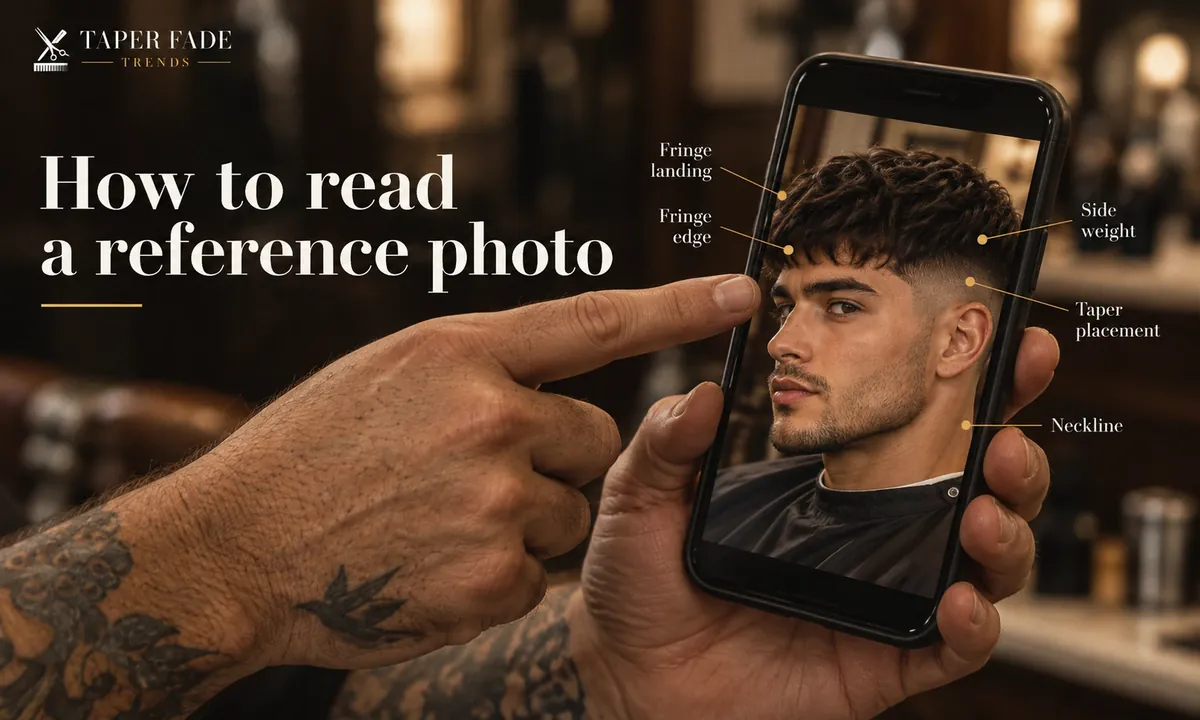
A reference photo shows placement, side weight, the fringe edge and roughly where the fringe lands. It cannot show the guard, blade or lever used, how dense the hair is, how it grows, or how many days have passed since the cut. Use it to agree on the visible result, not the settings.
| Frame | What it shows | What it cannot prove |
|---|---|---|
| Front, dry | The fringe landing point and edge | The exact length, unless it was measured |
| Left and right profiles | Side weight and how far up the taper goes | The guard, blade or lever setting |
| Back | Where the taper finishes at the nape, and the neckline | The tool or technique used |
| Unstyled next to styled | How much styling changes the front | Whether your hair will style the same way |
Bring dry-hair photos of one haircut from the front, both sides and the back. The two sides confirm they match, and the back shows the nape, which a profile hides. If you can find an unstyled shot of the same cut, add it so the barber sees the cut without product.
What to tell your barber
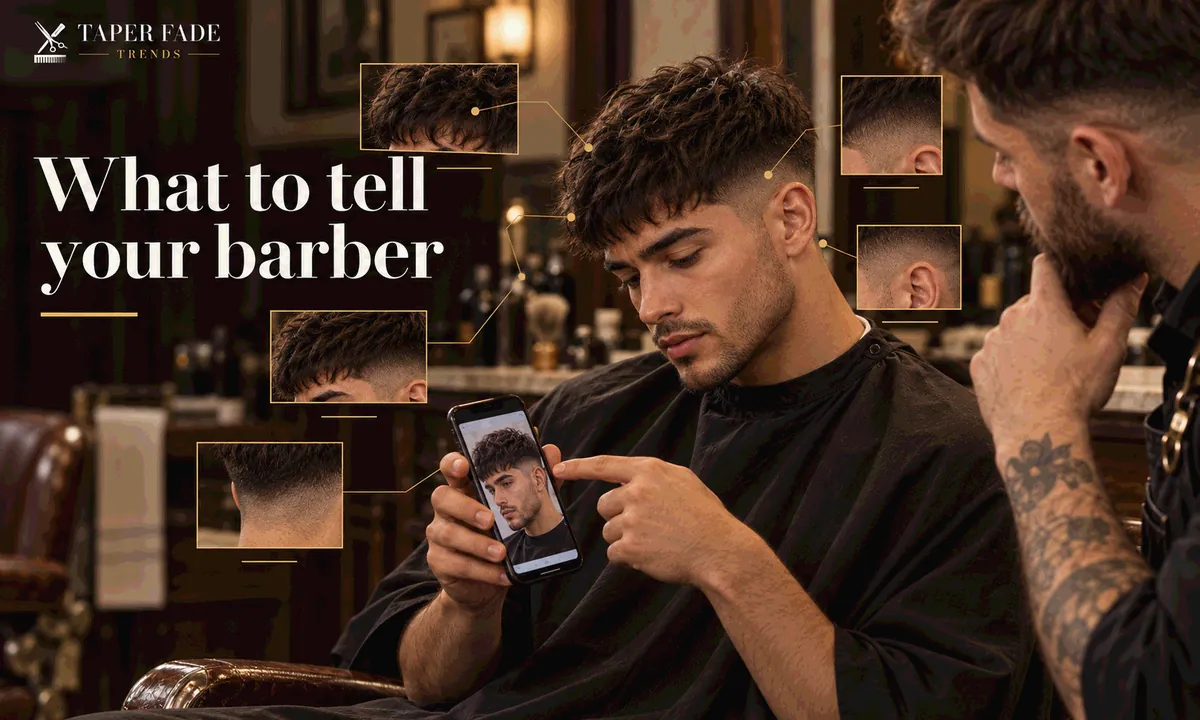
Show a front photo and a side photo, then state four things: where the dry fringe should land, whether the edge is blunt or broken, how much side weight stays above the taper, and what the shortest finish should be. Describe the visible result and let the barber choose the tools.
- Put a finger on your forehead where the dry fringe should land.
- Name the edge, blunt or broken, and point to it in the photo.
- Say how much side weight stays, for example “keep the sides full above the taper.”
- Point to where the taper should stop on the side and back photos, and say the shortest finish: skin, a zero or a guard number.
Fresh By Prince makes the same point about its own cut: say more than “French crop,” show the photo, and let the barber adjust it to your hair. Then ask the barber to repeat the plan back before the clippers start.
| You decide and show | The barber confirms |
|---|---|
| Where the dry fringe lands and which edge you want | Whether your front growth lets it sit there, and how to adapt |
| How much side weight stays | The guard, lever and blade that produce it |
| The shortest finish | Where the transition goes and how it is blended |
| The forward direction on top | How much weight to remove for your density |
Skip guard numbers unless they come from the exact cut you are copying. A number describes a guard, not a haircut: brands size their guards differently, and a taper lever can move the cut between sizes, as the haircut numbers chart explains. After a cut you like, ask which guard and lever were used and save them with your photos. For a script that works with any taper, see how to ask for a taper fade.
Style a French crop with or without a blow dryer
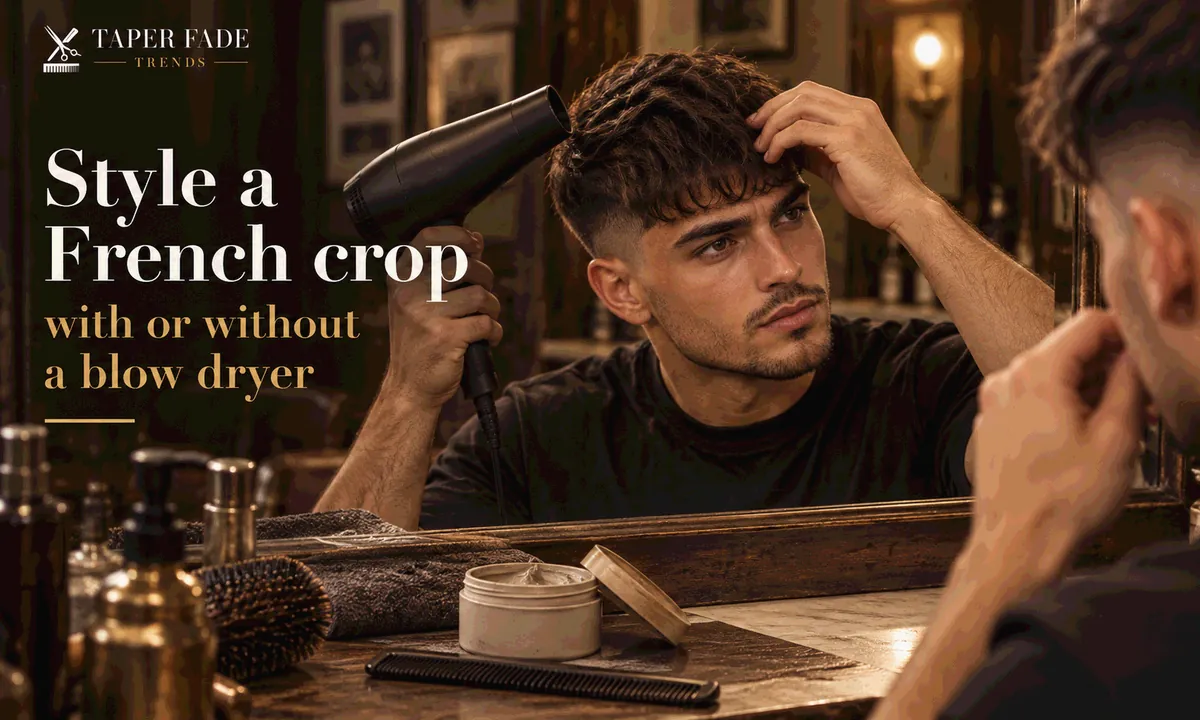
Yes, a low taper French crop can be air-dried when the cut and your growth direction already push the top forward. A blow dryer helps when the crown splits, the front lifts or fine hair lies too flat. Henkey’s says air-drying gives a slightly softer, less controlled result, so treat the dryer as a control tool.
| Route | Use it when | How | What to check |
|---|---|---|---|
| Air-dry | Hair falls forward on its own | Work a small amount of matte product through damp hair and direct it forward with your fingers | The fringe still lands on your chosen spot once dry |
| Blow dryer | The crown splits, the front lifts, or fine hair collapses | Dry forward and slightly down from the crown; reset a split crown by briefly drying it the other way first | The top stays flat enough to read as a crop, not a quiff |
Henkey’s French crop guide aims the airflow forward and a little down instead of lifting from underneath, and Goodman resets a split crown by drying it against its direction before bringing it forward. Finish with a small amount of matte cream, paste or clay worked from the back toward the front, then stop. Henkey’s warns that pinching the front into pieces turns a French crop into a textured crop. The taper doesn’t change with styling either way; it only changes as it grows.
Upkeep and grow-out
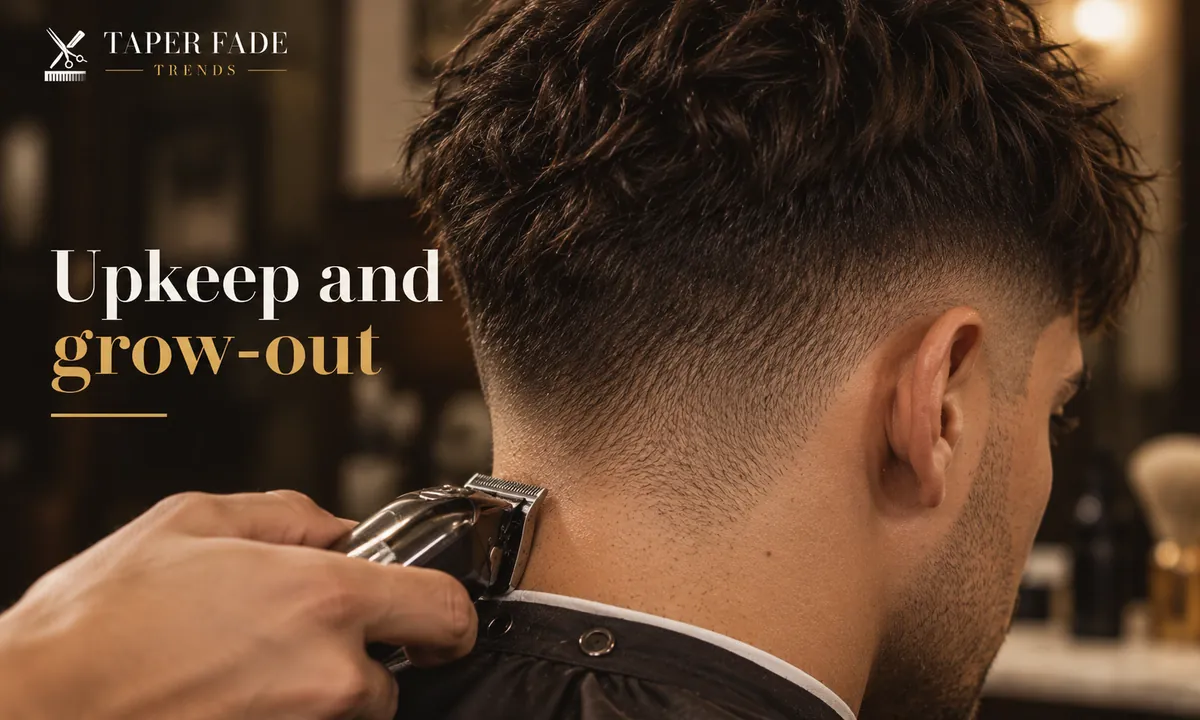
A low taper French crop needs attention in two places on two schedules. The taper softens first if you want it sharp, while the fringe drops lower on the forehead until it stops landing where you chose. Published guidance ranges from two to six weeks, depending on how crisp you like the edges.
Hair grows about half an inch a month, according to MedlinePlus, which is roughly 1/8 inch a week. On the sides, that blurs a close finish quickly. At the front, it moves the landing point down your forehead a little every week.
| Source | Sides and taper | Fringe |
|---|---|---|
| Fresh By Prince | About 2 to 3 weeks to stay sharp; up to 4 if you accept softer sides | Not stated separately |
| Golden Scissors | Edges soften at about 3 to 4 weeks | Usually what sends people back, around 5 to 6 weeks |
| Barber Goodman | Most French crops hold 3 to 5 weeks; a low taper stays presentable longer than a skin fade | Often the first part to need attention |
These are each source’s own published guidance, not measurements, and they don’t fully agree. Use them as a range. Rebook for the sides when the taper loses the edge you want, and for the fringe when it lands lower than your marked spot. For how any taper changes week by week, see how long a taper fade lasts.
French crop vs Caesar cut
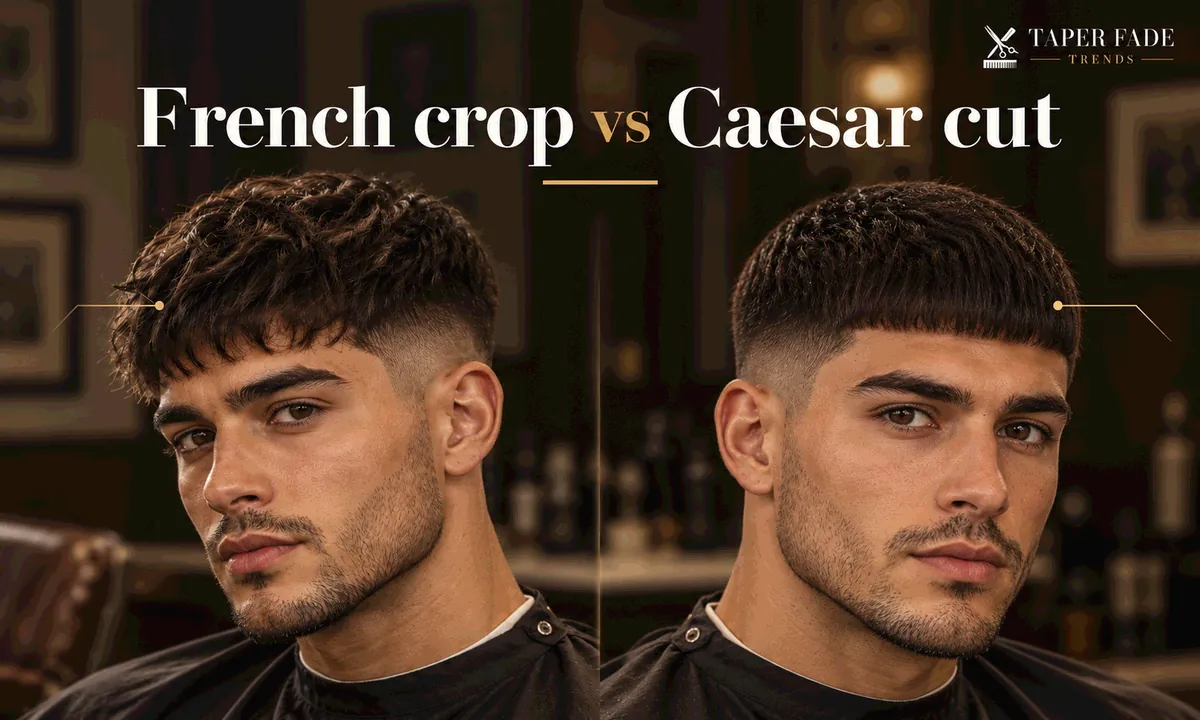
A French crop and a Caesar cut both direct the top forward into a short fringe, so the names overlap. A Caesar generally keeps the top shorter and more even, with a short straight fringe. A French crop allows more top length, texture and variation in the front. When the label is unclear, the photo decides.
| Criterion | French crop | Caesar cut |
|---|---|---|
| Top | Short to medium, with room for texture | Short and fairly even all over |
| Fringe | Visible fringe, blunt or broken | Short, straight fringe |
| Sides | Scissor-cut, tapered or faded | Not fixed by the name |
Goodman, Golden Scissors and Henkey’s all describe the two as close relatives rather than separate haircuts. A short, even top with a low taper could carry either name, so describe the fringe landing and edge instead.
When another cut makes more sense
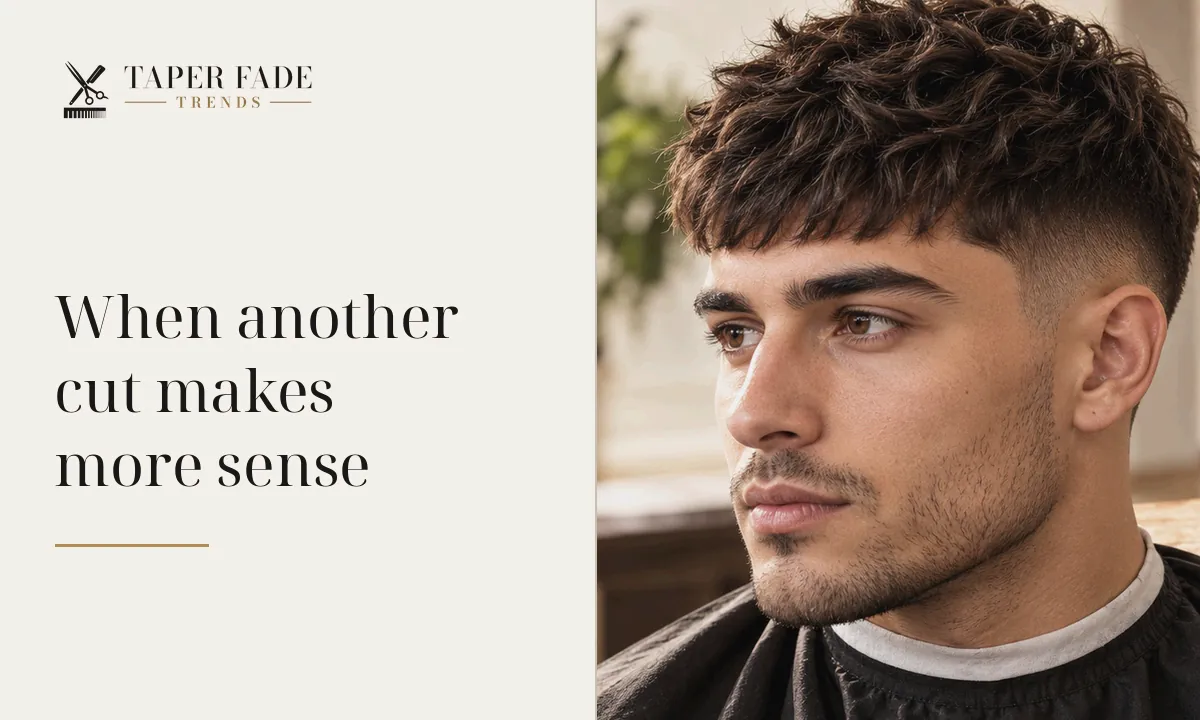
Choose a different cut when you want something a low taper French crop doesn’t give: more contrast on the sides, a longer front, a looser broken top or length at the back.
- More contrast on the sides: a low fade carries the short work farther around the head; see taper vs fade.
- A longer front worn forward: the textured fringe low taper keeps more length falling over the forehead.
- A clipper-short top with no real fringe: the low taper fade buzz cut.
- A choppy top with a less defined front: ask for a textured crop, and bring the photo, since the names overlap.
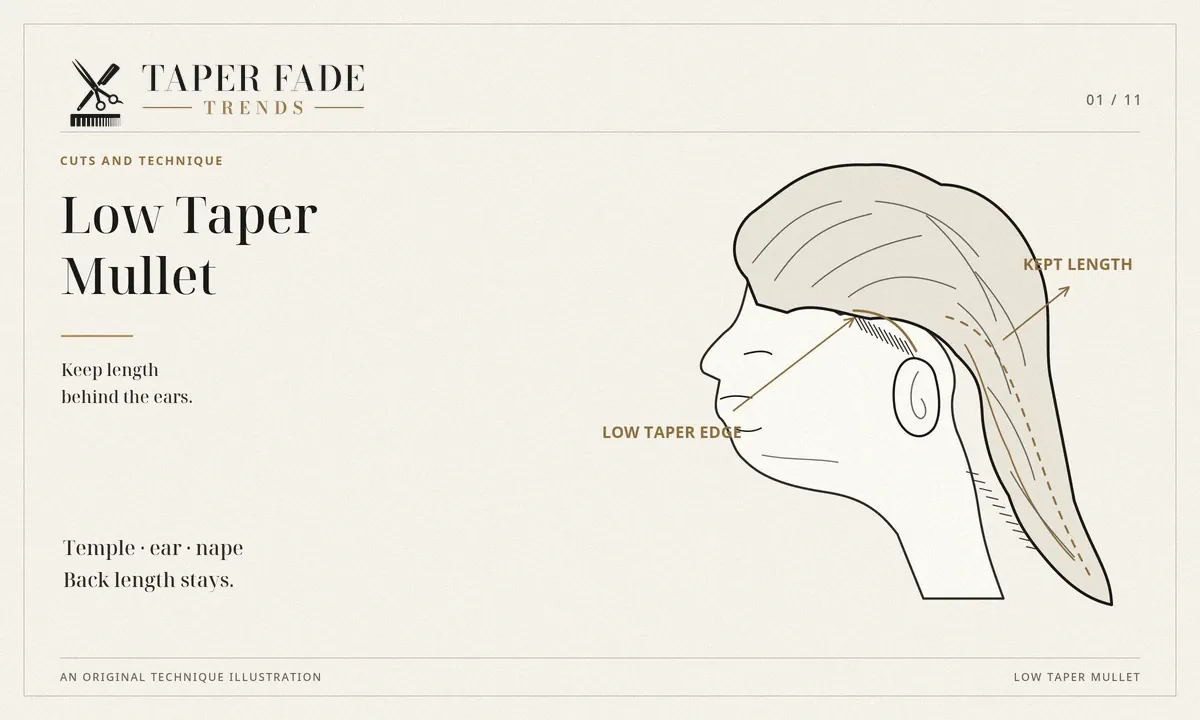
- Length kept at the back: a low taper mullet trades the short nape for a longer back.
How this French crop guide was researched
Taper Fade Trends Editorial built this guide on October 21, 2026, by reading how barbers, a grooming retailer and haircut publishers describe the low taper French crop, then separating the parts the name blurs: fringe landing, edge, top length, taper placement, side weight and shortest finish. Where sources disagree, on fringe length, on blunt versus broken edges, on taper versus fade and on upkeep, the page shows each view instead of picking one.
Every image on this page is a labeled illustration. None shows a documented haircut, and no measurements or guard settings are claimed for any image. No barber has reviewed this version of the page; when one does, their name, role and review date will be added here.
Sources cited:
- Barber Goodman: 21 best French crop haircuts for men, by James Goodman, licensed barber
- Fresh By Prince: the textured French crop with a low taper fade
- Golden Scissors: what is a French crop haircut?
- Henkey’s: how to get a French crop
- Hairnee: low taper fade French crop haircut
- MedlinePlus: hair problems
Found an error? Contact us or read our editorial policy.
If the real question is how much of the side to shorten, compare taper vs fade next.
Keep reading
All guides
Low taper fade: placement, finish, side length and upkeep
A low taper fade shortens the sideburns and nape and keeps the sides full. See the four choices to make, whether it can go to skin, and what to say.
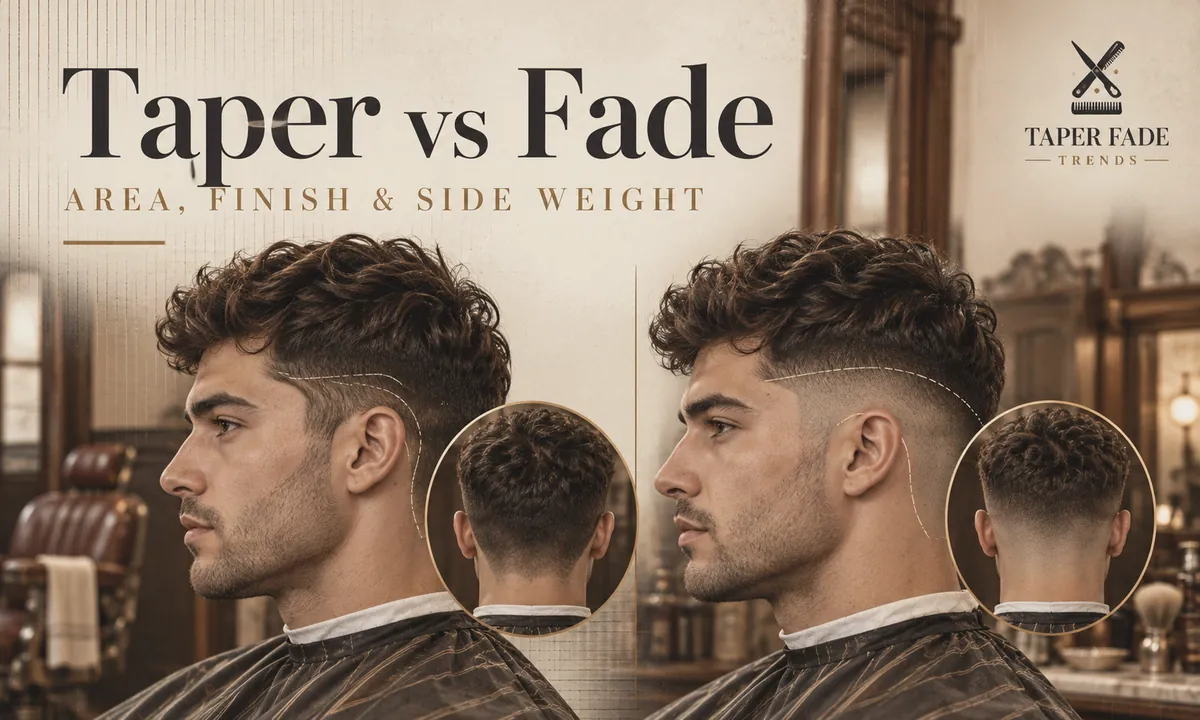
Taper vs fade: what changes in area, finish and side weight
Taper vs fade compared by coverage, height, shortest finish and side weight, with a back-view check and word-for-word barber scripts for either cut.
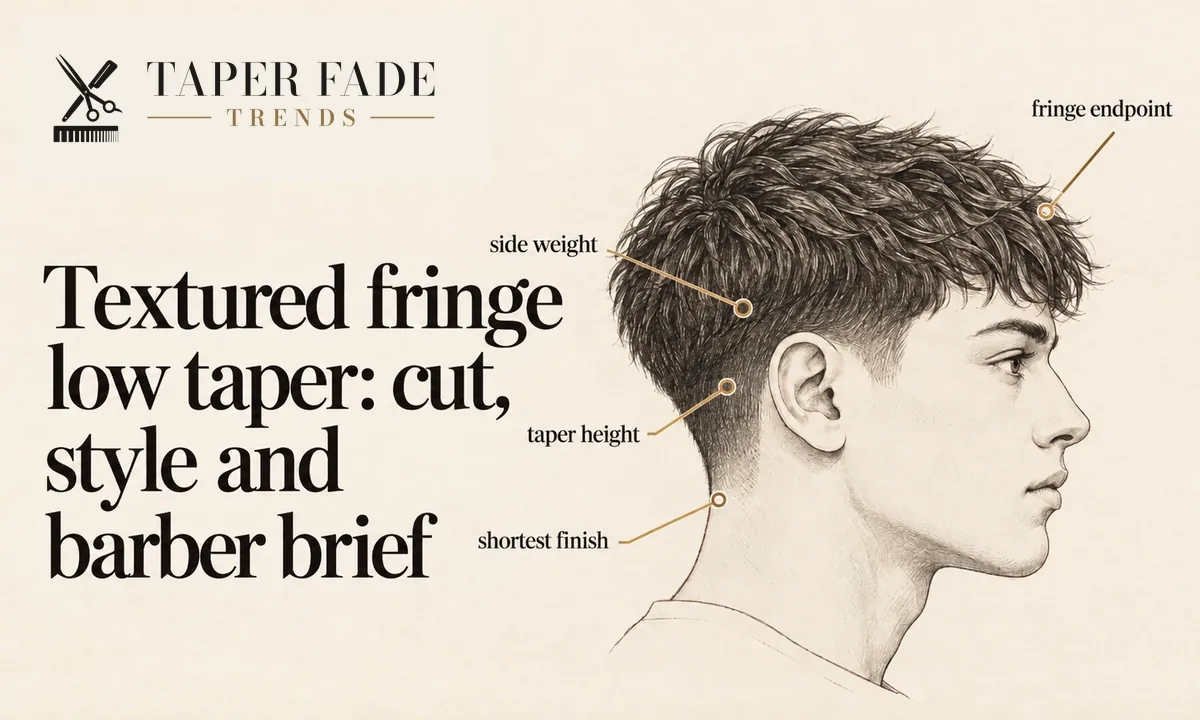
Textured fringe low taper: cut, style and barber brief
A textured fringe low taper explained: four choices to settle, whether straight hair needs a perm, what to tell your barber, and fixes for a flat fringe.
How to ask for a taper fade: a five-part barber brief
How to ask for a taper fade: say where it may reach, how short the base goes, how much side weight stays and what to do on top, then check the plan first.
Low taper vs low fade: compare coverage and side weight
Low taper vs low fade: a low taper shortens the sideburns and nape; a low fade shortens a band around the lower sides and back. Compare finish and upkeep.
Low taper mullet: keep length behind the ears
A low taper mullet keeps length behind the ears and through the back. See what to tell your barber, how texture changes it, and how to grow it out.
More in low taper fades
Low taper fades: all 15- Low taper fade: placement, finish, side length and upkeep12 min
- Low taper fade straight hair: density, sides and top length11 min
- Low taper fade Black male guide: choose the top, hairline and nape10 min
- Curly low taper fade: keep curl width above the ears10 min
- Low taper fade buzz cut: compare top length and finish12 min
- Textured fringe low taper: cut, style and barber brief12 min
- Blowout low taper fade curly hair: keep volume, keep definition11 min
- Low taper fade wavy hair: what to ask for13 min
- Asian low taper fade: choose by how your sides grow7 min
- Middle part low taper fade: keep the curtains connected8 min
- Low taper fade with dreads: protect the loc boundary12 min
- Low taper mullet: keep length behind the ears13 min
- Low taper French crop: set the fringe length and edgeYou are here
- Low taper vs mid taper: what changes when only the height moves10 min
- Low taper vs low fade: compare coverage and side weight11 min