Mid taper fade Afro: choose a rounded or squared top
A mid taper fade Afro blends the hair at the temples, sideburns and nape at a medium height and leaves a full Afro on top. Choose the top outline, rounded or squared, as its own request. Then tell the barber how much side weight to keep, how short the shortest finish goes and whether your hairline stays natural.
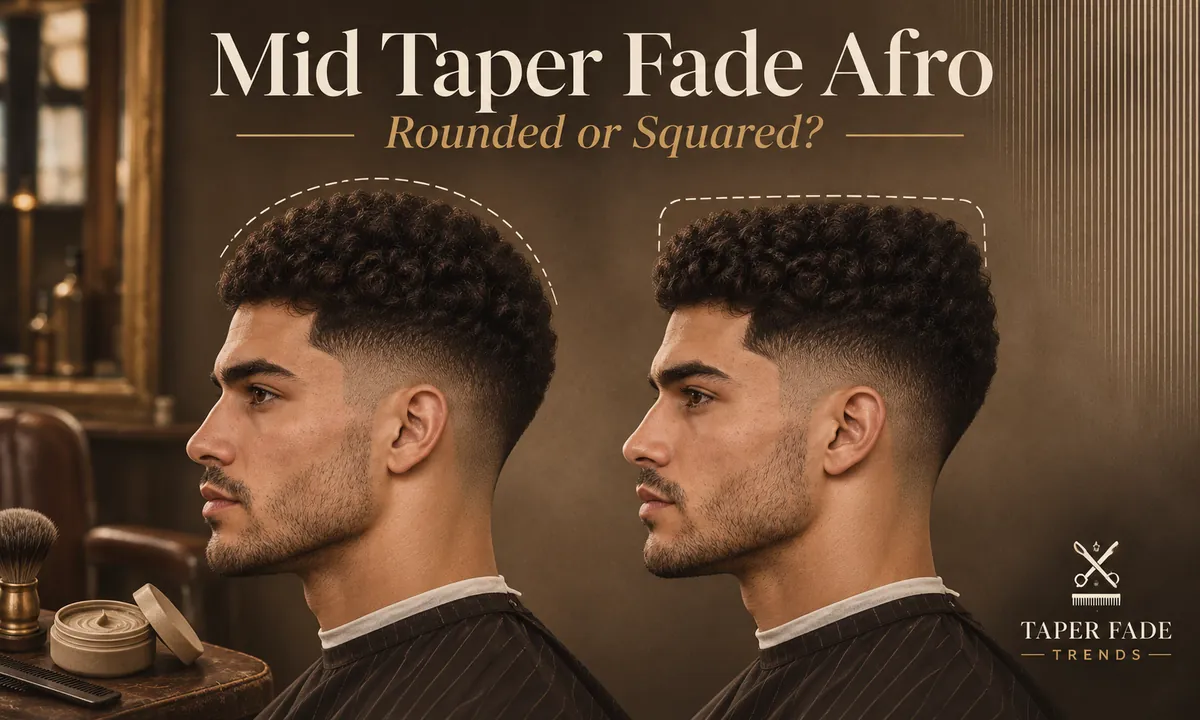
What a mid taper fade Afro changes
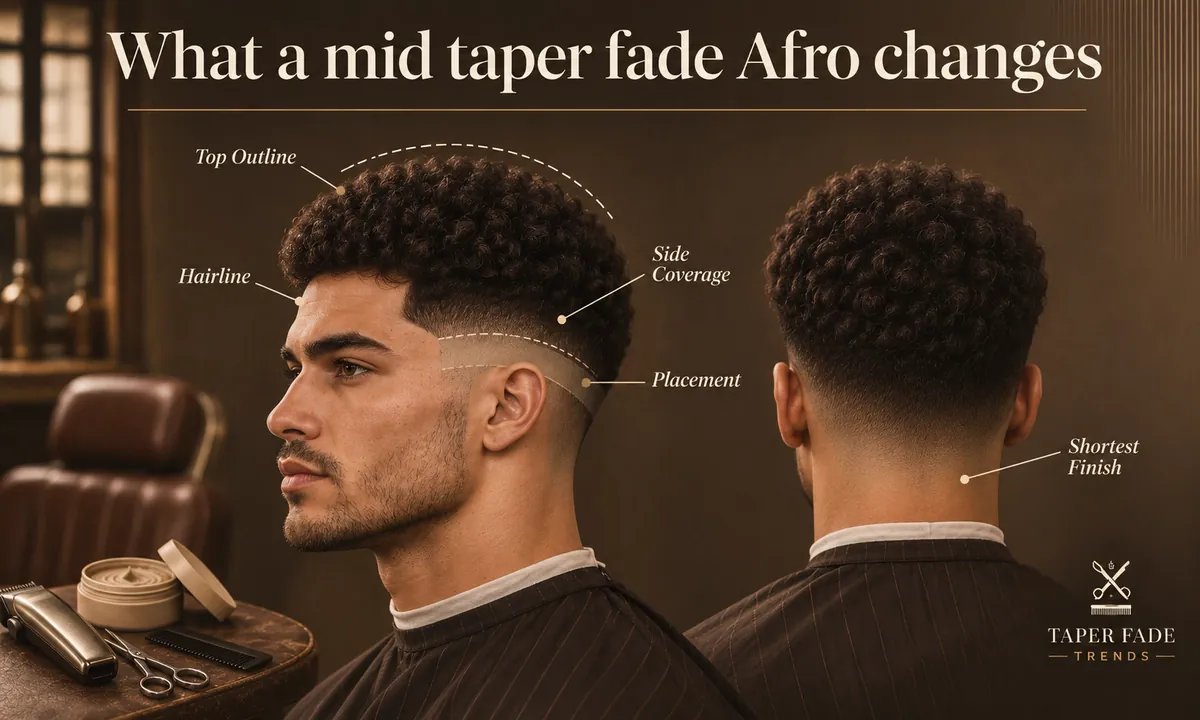
A mid taper fade Afro shortens and blends the hair around the temples, sideburns and nape, starting at about temple height, and keeps a full Afro above it. “Mid” names the height of the blend. It does not set the top length, the top shape or whether the shortest area reaches bare skin, so each of those needs its own sentence.
Treatwell’s taper fade guide puts the start of a mid taper at temple level, the same zone this site’s mid taper fade guide uses. Shops still draw the line in slightly different places, so point to it on your own head.
| Control | What you decide | Options |
|---|---|---|
| Placement | How high the blend starts | Around the temple for mid; lower or higher if you prefer |
| Side coverage | How much of the side panel the blend crosses | Narrow (edges only) or broad (most of the side) |
| Top outline | The Afro’s shape from the front and side | Rounded or squared, at full or compact size |
| Shortest finish | What’s left at the lowest point | Visible hair, a shadow or bare skin |
| Hairline | How the front edge is treated | Natural, cleaned up, or lined up |
Placement, coverage and finish are separate requests, but they meet the Afro at the same seam. The taper fade guide covers height and finish for every top; this page covers what changes when the top is an Afro.
Pick a rounded or squared top
A mid taper fade Afro can carry a rounded top or a squared top. A rounded top follows one continuous curve from the crown down into the sides. A squared top has a flatter upper plane and visible corners where the top turns down. Decide from front and side views of hair with density close to yours, then say the word out loud.
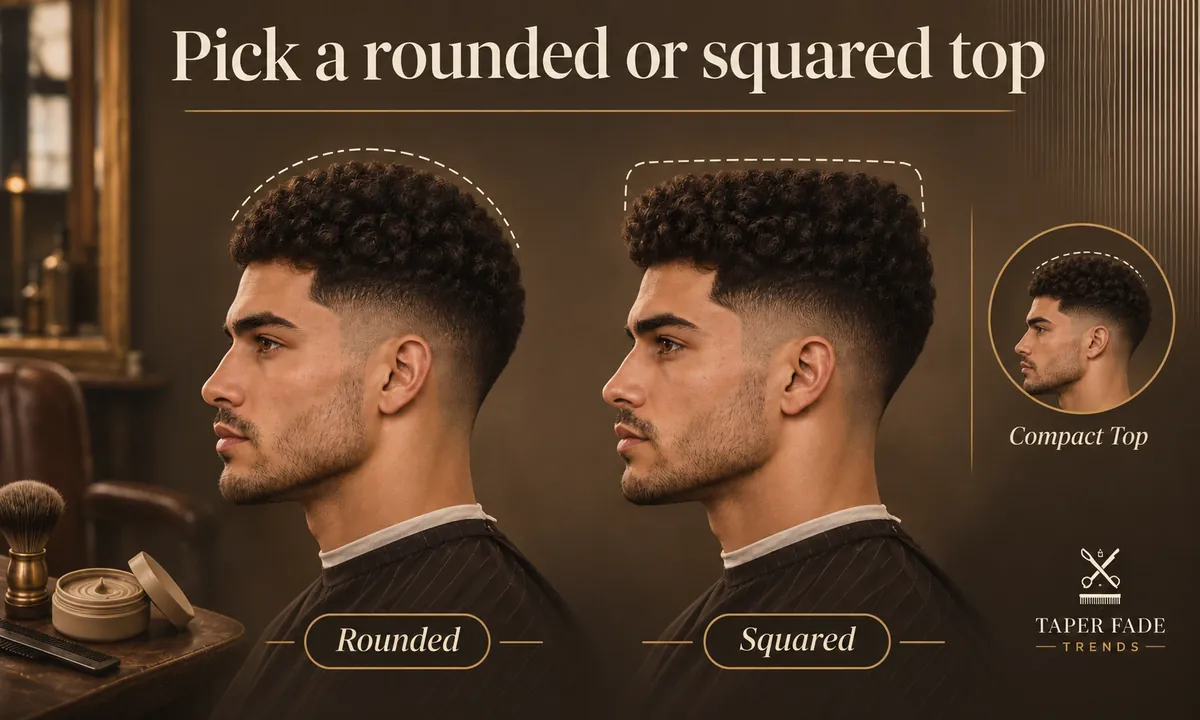
| Rounded top | Squared top | |
|---|---|---|
| From the front | One even curve, no corners | Flatter top, two visible corners |
| Where top meets sides | The curve keeps going down into the taper | A defined turn, then the sides |
| Taper height that fits | Low enough for the curve to reach the sides | Mid works; corners sit above the blend |
| Mirror check | The curve is even left to right | Both corners sit at the same height |
| Say it like this | “Round it off, one even curve.” | “Square the top, keep the corners.” |
The two shapes interact with the taper more than the labels suggest. Golden Scissors, a London barbershop that cuts a lot of Afro hair, keeps the taper low under a round top so the curve can run into the sides, and warns that a high taper cuts the circle off halfway. A mid placement works under a rounded top as long as the blend stays narrow.
A squared top does not require a sharp front hairline. A line-up, the deliberate shaping of the front edge, is a separate request, and taper height doesn’t imply one.
Rounded, squared and compact tops
Compact describes size, not shape. A compact Afro is either outline cut smaller and closer to the head, which puts more visual weight on the taper itself. Barber Exaucé Imbo, owner of EXSTUDIO, told Creative HEAD that a crisp, round shape reads clean and classic, while leaving more natural texture on top reads more relaxed.
Once the top shape is chosen, set the limit of the taper beneath it.
Set the taper boundary and side weight
To keep an Afro’s side fullness, ask for the close work to stay at the sideburns, around the ears and at the nape, and point to the highest spot you’ll accept on each side. Side weight is the hair kept above the shortest blend. If the blend crosses the whole side panel, the cut becomes a full mid fade, whatever the ticket says.
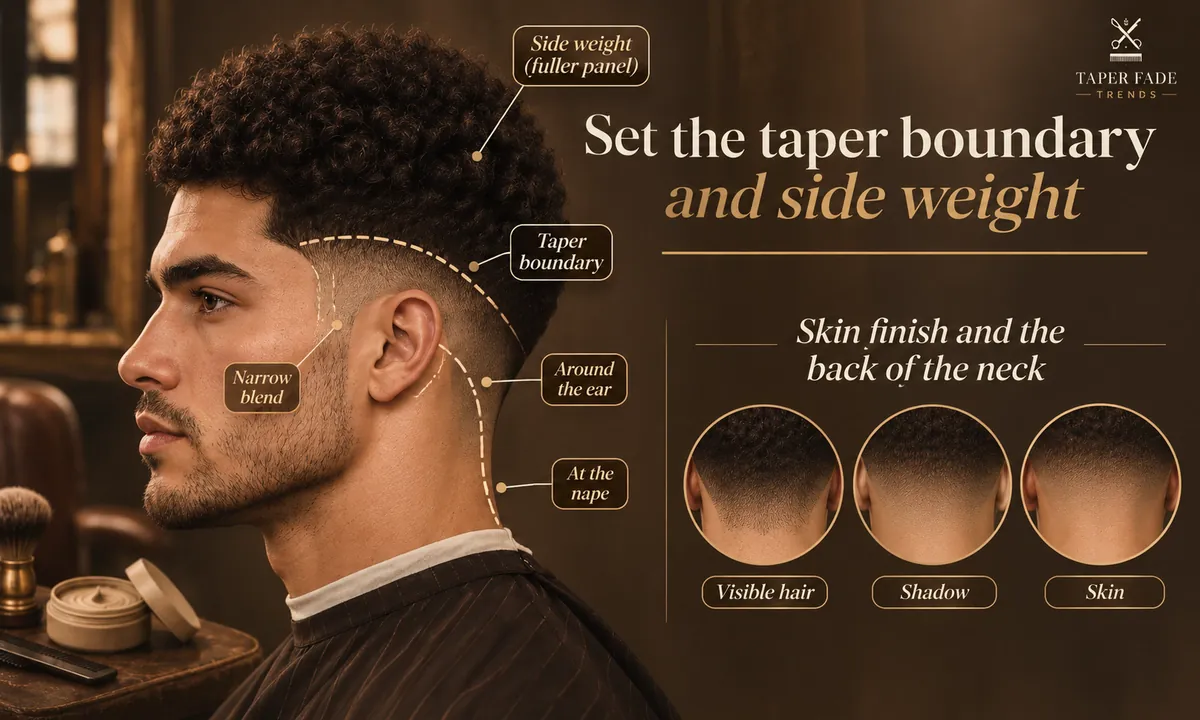
Placement sets how high the blend starts. Coverage sets how much of the side it crosses, and coverage is what removes side weight. Narrow coverage keeps the side panel full against the Afro. Broad coverage gives a cleaner, higher-contrast side and less fullness.
A mid taper fade Afro can end at visible hair, a shadow or skin. Shops disagree on the words: Golden Scissors and Treatwell both describe a taper as stopping above bare scalp, while other shops use “taper fade” for cuts that go to skin. Say the finish itself, then confirm it before the clippers start.
| Shortest finish | What you see | How regrowth shows |
|---|---|---|
| Visible hair | Short hair that still covers the scalp | Softly; it reads as slightly more hair |
| Shadow | Scalp faintly visible through very short hair | Gradually, as the shadow fills in |
| Skin | Bare scalp at the lowest point | Soonest, because growth shows against bare skin |
Skin finish and the back of the neck
A skin finish at the nape is a cosmetic choice, but it carries a skin trade-off for some people with coarse, curly hair. The American Academy of Dermatology explains that hair cut very short can curve back into the skin and cause razor bumps; that guidance is written for the beard. Separately, the AAD lists frequent close-shave haircuts among things that irritate the back of the neck in acne keloidalis nuchae, a condition often mistaken for acne or razor bumps there.
If bumps keep appearing at your nape, ask for a shadow or guarded finish at the back and see a board-certified dermatologist. The AAD’s self-care advice for that condition includes avoiding haircuts that shave the back of the neck. This is general information, not a diagnosis.
Choose the outline by your hair, not a type label
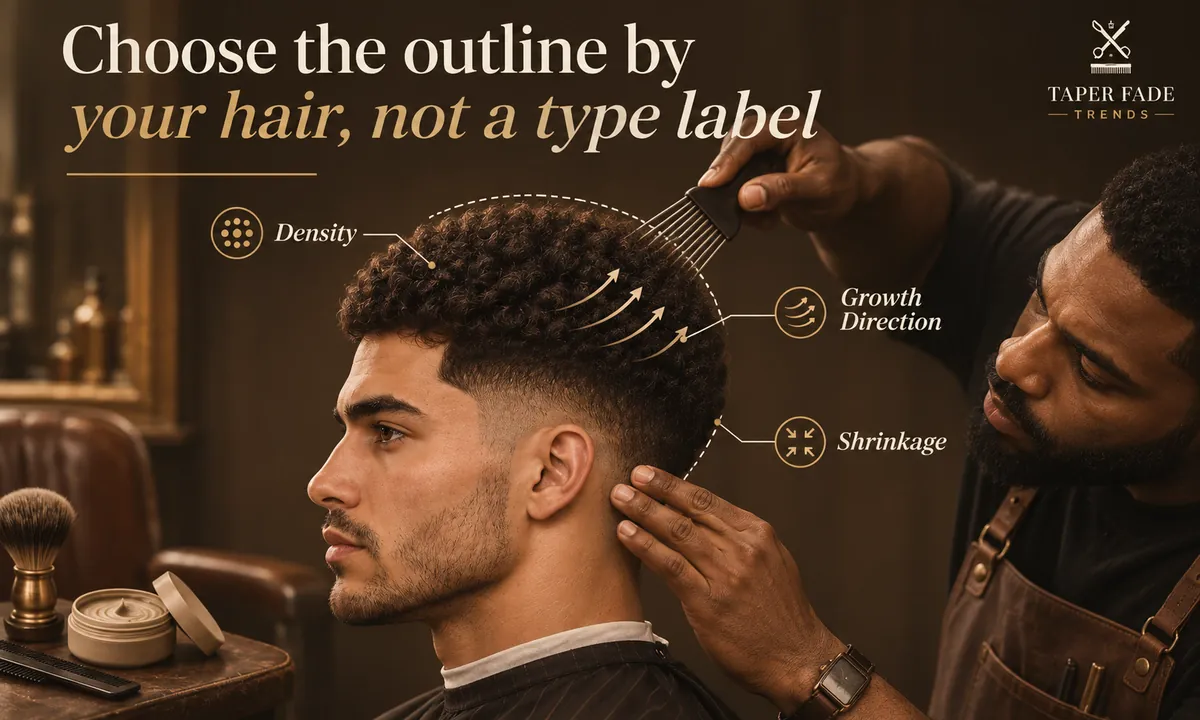
A coil label such as 4C doesn’t predict how round or square your Afro will sit. Top length, where your hair is denser or sparser, growth direction and shrinkage all change the outline. Judge it on your own hair, in the state you actually wear it, and pick reference photos whose texture and density look close to yours.
Shrinkage is the gap between how long coiled hair is stretched and how long it looks. Golden Scissors gives an example of hair measuring four inches stretched that sits at about an inch and a half on the head. That gap is why the shop picks the top out from the roots before setting where the taper stops. Ask for the same.
- Density: point to any sparse spots at the temples or crown, so the barber leaves length where the outline needs it.
- Growth direction: mention a crown whorl or a temple that grows sideways at the start of the consultation.
- Wear state: tell the barber whether you wear it picked out, sponged or pressed down, and ask them to judge the outline that way.
Treatwell adds that curly hair often needs a slightly longer guard than straight hair, because curls spring back shorter after cutting.
Tell the barber exactly what to keep
You can keep a natural front hairline with a mid taper fade Afro. The temple and nape blend works without a line-up across the forehead. Ask the barber to clean only the stray hairs below your hairline and leave its shape alone, then confirm in the mirror before any edging starts. Name the outcome; leave guard numbers to the barber.
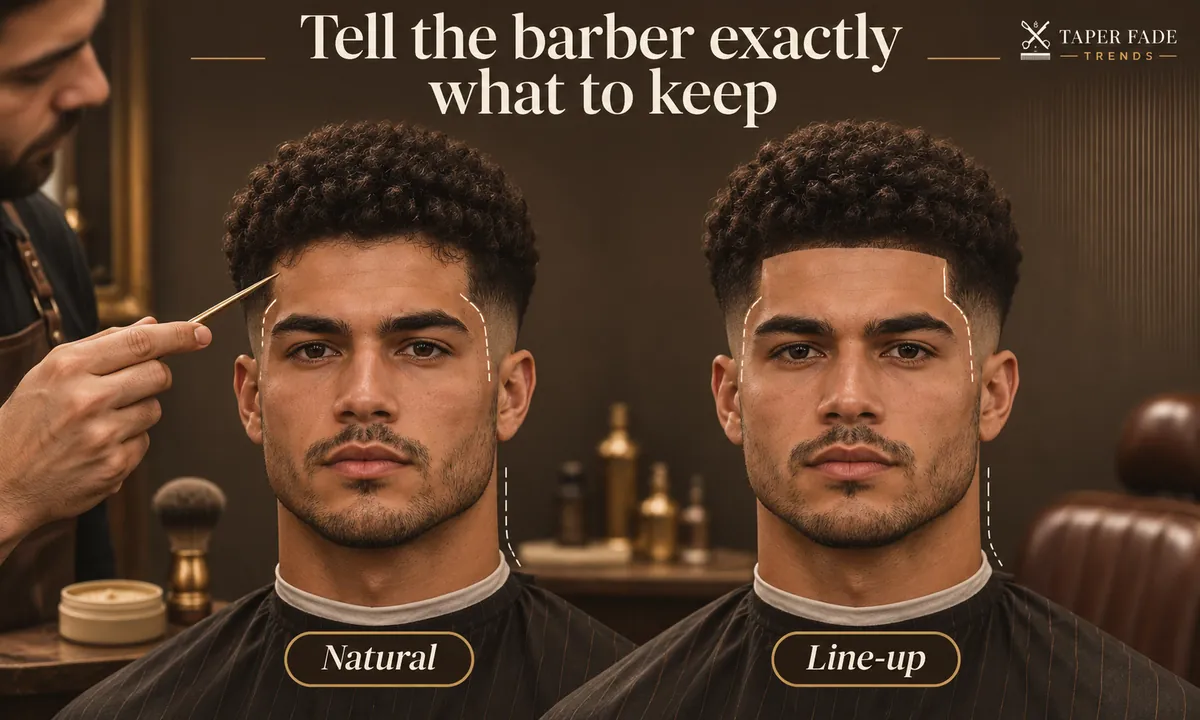
Golden Scissors makes the case for the cleaned-up version: redrawing an uneven hairline into a straight line takes off hair that was already there, and repeating it every visit can move the line back over time. Imbo, on the other hand, lines up the edges on most of his cuts for contrast. Either is a valid request. Just make it on purpose.
Swap in a rounded top or a different finish as needed. If you’ve got dense coils, it’s fair to ask whether the barber will blend the join between the taper and the Afro with scissors; Golden Scissors says clipper work pushed up into dense coils can leave a shelf. The how to ask for a taper fade guide has the general five-part brief this script builds on.
Bring four views of one reference cut and say what each one shows:
- Front: the rounded curve or the squared corners.
- Left profile: the highest point of the blend and the side weight above it.
- Right profile: the same two checks, since the two sides of a head don’t always match.
- Back: where the nape blend stops.
A photo can’t show the guard, lever setting or technique, so don’t try to read those from it. If you don’t know the clipper, describe the result; the haircut numbers guide explains why the same number cuts differently across brands.
Style the outline between visits
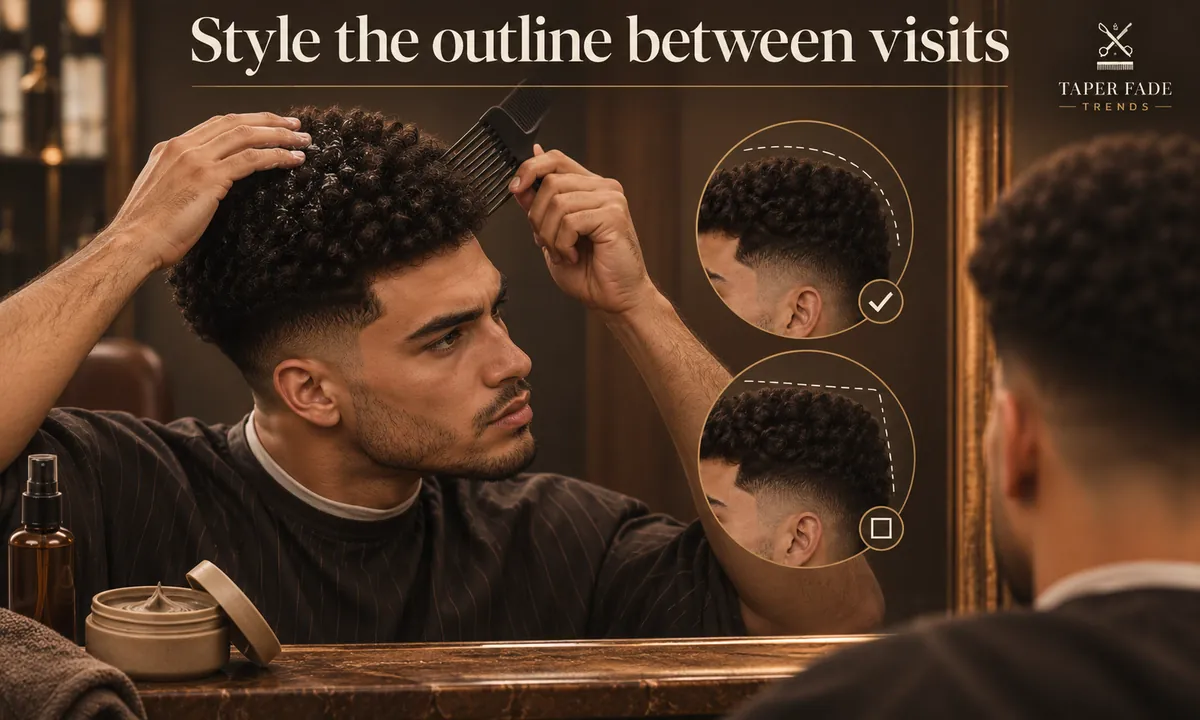
The Afro top is the part you shape between visits; the taper belongs to the barber. Moisturize, detangle and pick or sponge the top in the style you normally wear, then check it from the front and side against the shape you agreed. Look for an even curve on a rounded top and level corners on a squared one.
If you use a curl sponge, Imbo’s method is to moisturize first, comb the hair out fully, then work the sponge in small circles in one direction with light, even pressure, because pressing hard can break the hair. Keep any product routine your hair already responds to. Day-to-day care for the edges is in how to maintain a taper fade.
Keep the Afro shape as it grows
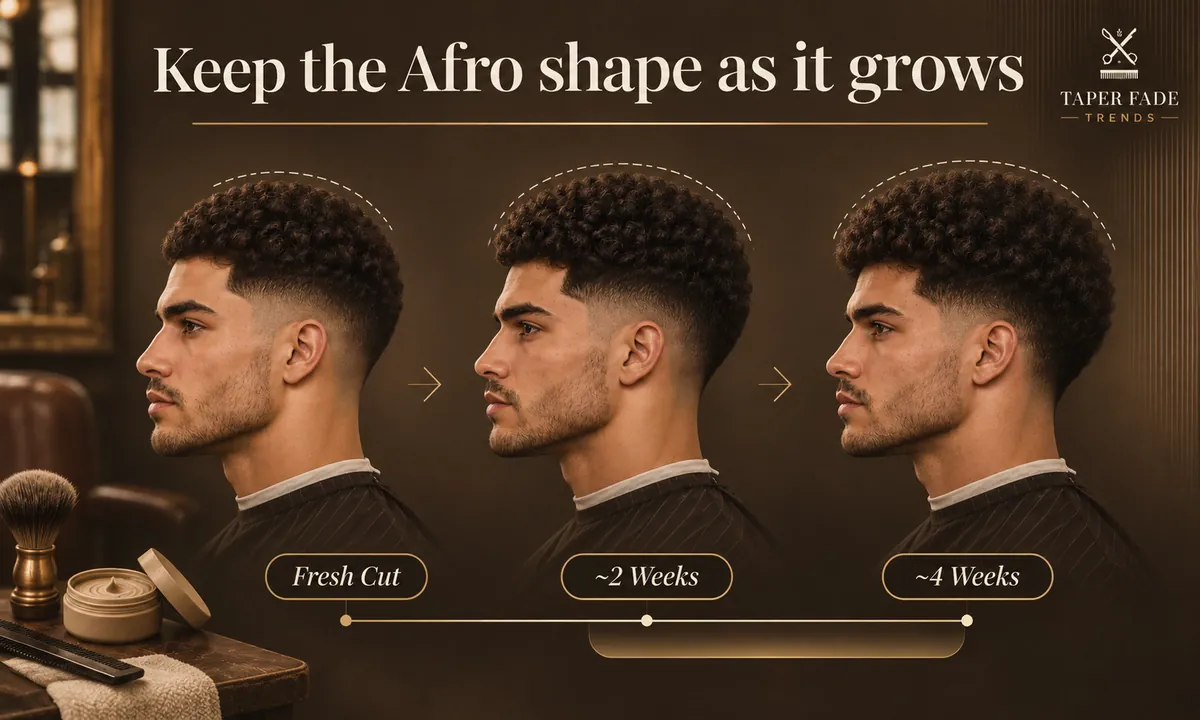
No single rebooking interval fits every mid taper fade Afro. Published guidance runs from about two to four weeks: Treatwell suggests two to three for a mid taper, and Golden Scissors says three to four for its tapers. Rebook when the taper at the temples and nape, or the top outline, no longer matches what you agreed.
Check the two separately, because they change at different speeds. A skin finish and a lined-up hairline show regrowth soonest. A shadow or visible-hair finish with a natural hairline softens more slowly. The top drifts on its own schedule as the Afro grows.
Photograph the front, both sides and the back on the day of the cut. Comparing against those photos is a better trigger than a calendar, and the same photos make your next brief easier. More on timing is in how long a taper fade lasts.
When to choose another cut
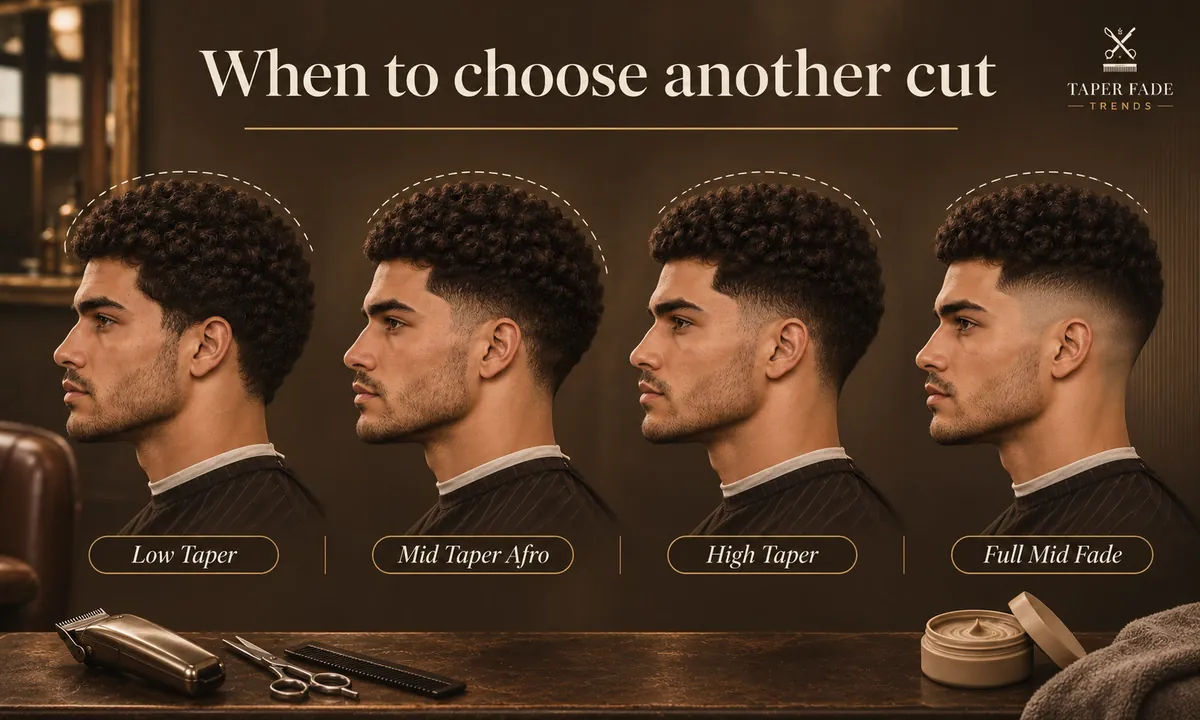
Choose a lower taper if keeping side fullness matters more than contrast, a higher taper if you want more short work near the temples, and a full mid fade if you want a cleaner side panel and accept less side weight. Compare matched side and back views of each, not the names alone.
| Cut | Where the blend sits | Side weight kept | Pick it if you want |
|---|---|---|---|
| Low taper | Near the sideburn and nape | Most | Fullness over contrast |
| Mid taper fade Afro | Around the temple, narrow coverage | High | A visible step that keeps the side panel |
| High taper | Above the temple | Less | Stronger contrast near the temples |
| Full mid fade | Around the temple, broad coverage | Least | A cleaner, higher-contrast side |
Height and coverage combine, so two cuts with the same name can look different. The low taper vs mid taper comparison covers the lower option and why moving back down takes regrowth. The high taper fade guide covers the higher one, and the mid taper fade guide explains where a mid taper ends and a mid fade begins. If the top is locs or brushed waves instead of an Afro, see mid taper with dreads or mid taper fade waves.
How this guide was checked
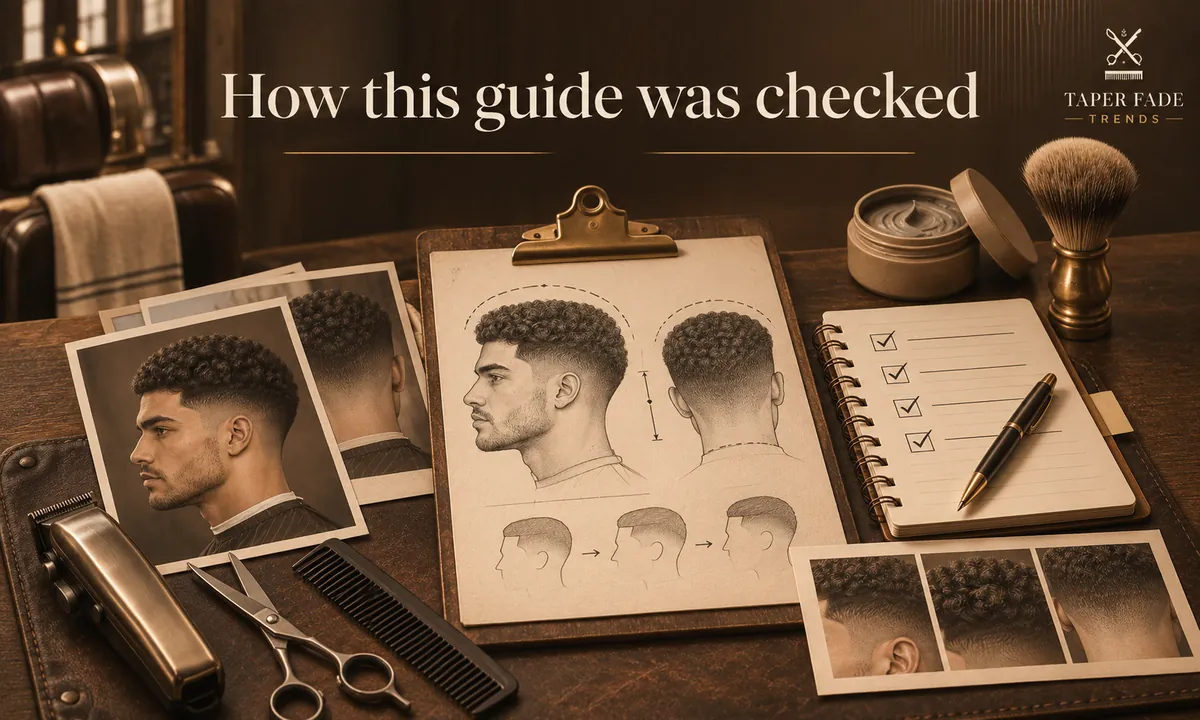
Taper Fade Trends Editorial compared barbershop explanations of Afro tapers, a barber’s technique notes and published taper guides, then separated placement, side coverage, top outline and shortest finish into distinct choices. Where shops disagree, mainly on whether a taper can reach skin, the page says so. The skin notes come from the American Academy of Dermatology.
The figures on this page are illustrations. They explain shape and zones; none is a photograph of a finished haircut, and this guide reports no tests or measurements of its own. No barber has reviewed this version. If one does, their name, role and review date will be added here.
Sources checked on October 22, 2026:
- Golden Scissors: Afro taper fade types and what to ask for
- Creative HEAD: Exaucé Imbo on an Afro mid taper fade
- Treatwell: Taper fade guide
- American Academy of Dermatology: Razor bump remedies
- American Academy of Dermatology: Acne keloidalis nuchae, causes
- American Academy of Dermatology: Acne keloidalis nuchae, self-care
Found an error? The editorial policy explains how corrections are made and dated.
Next: confirm your cut with the barber
Save your four reference views and the choices you made here: outline, coverage, finish and hairline. Then open the five-part barber brief, which turns those choices into a request you can say in about 20 seconds at the chair. Take the taper fade barber brief with you.
Keep reading
All guides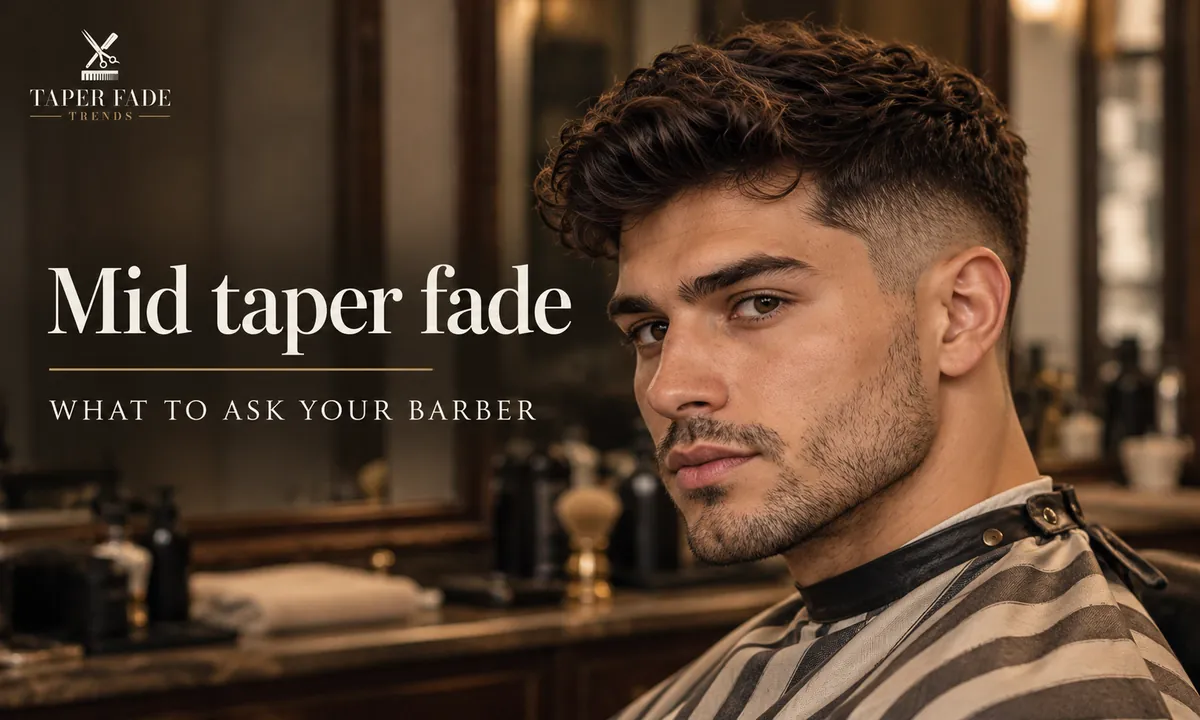
Mid taper fade: what it is and what to ask your barber
What a mid taper fade is, how it differs from a full mid fade, why skin is optional, and the four specs to give your barber before the cut starts.
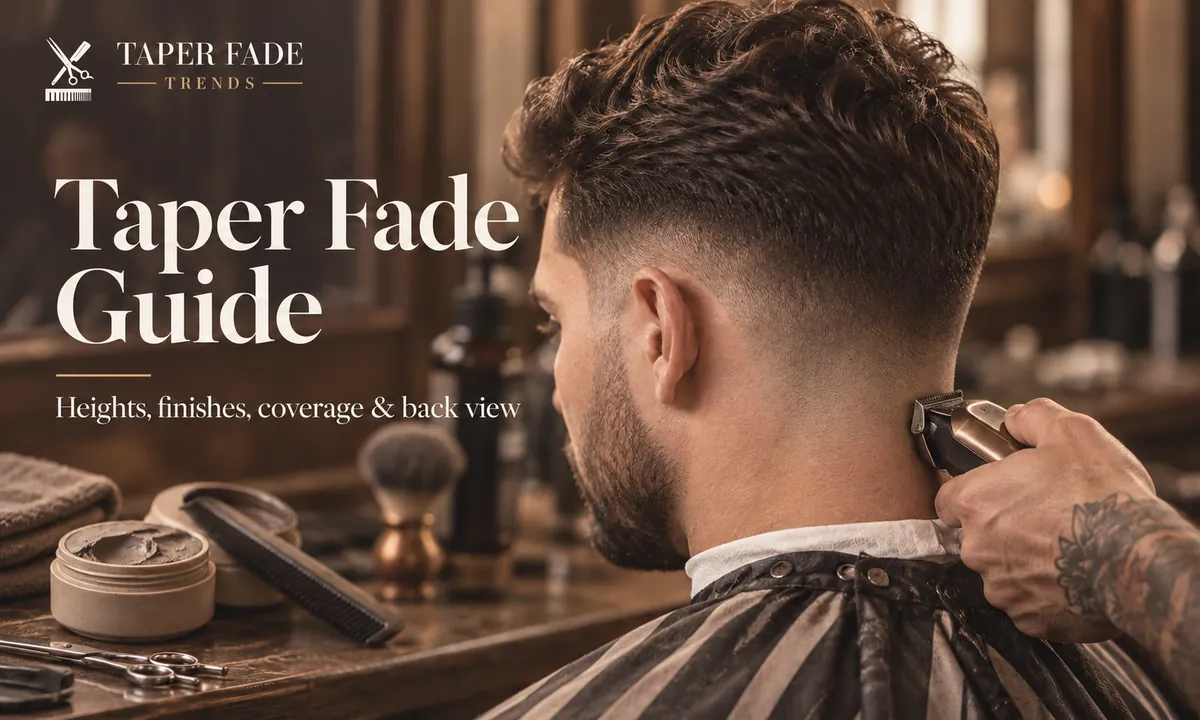
Taper fade: a visual guide to heights, finishes and top styles
Where a taper fade sits from the front, side and back, how low, mid and high differ, and how to ask for side coverage and a finish with or without skin.
How to ask for a taper fade: a five-part barber brief
How to ask for a taper fade: say where it may reach, how short the base goes, how much side weight stays and what to do on top, then check the plan first.
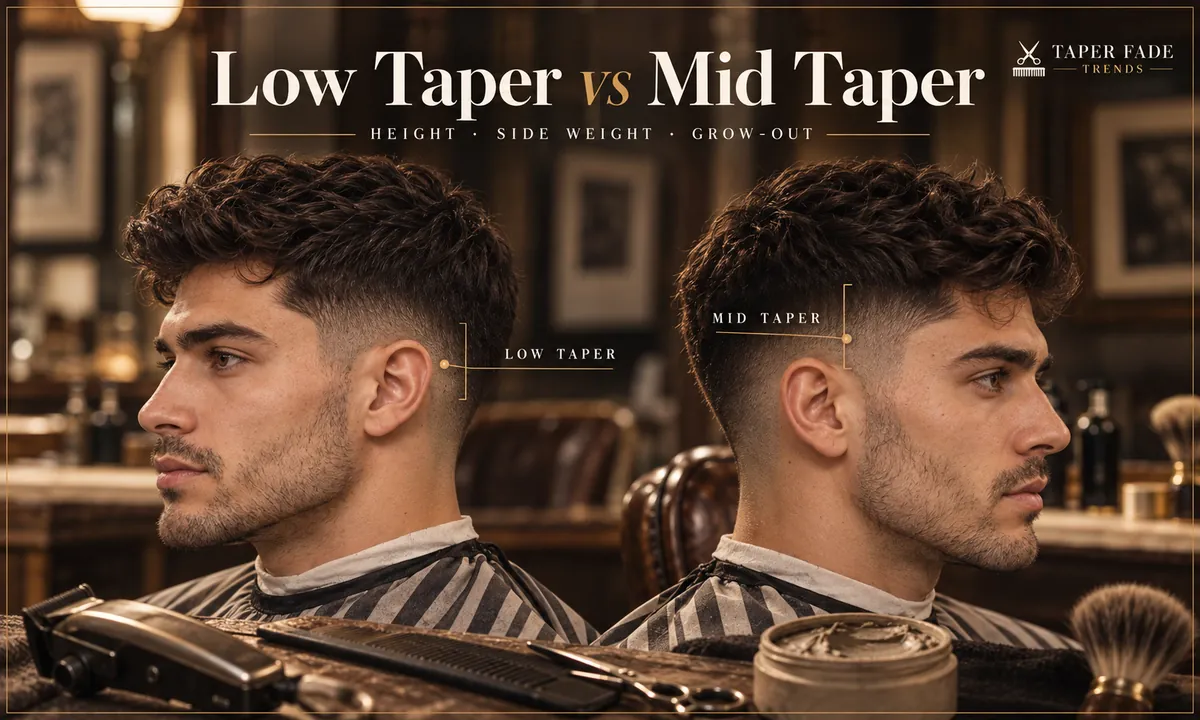
Low taper vs mid taper: what changes when only the height moves
Low taper vs mid taper compared on height, side weight, shortest finish and grow-out, why switching mid to low takes time, and what to tell your barber.
Mid taper fade Black male guide: what stays and what to ask for
Mid taper fade Black male guide: keep more side weight than a full mid fade, set finish and hairline, protect waves, coils or locs, and brief your barber.
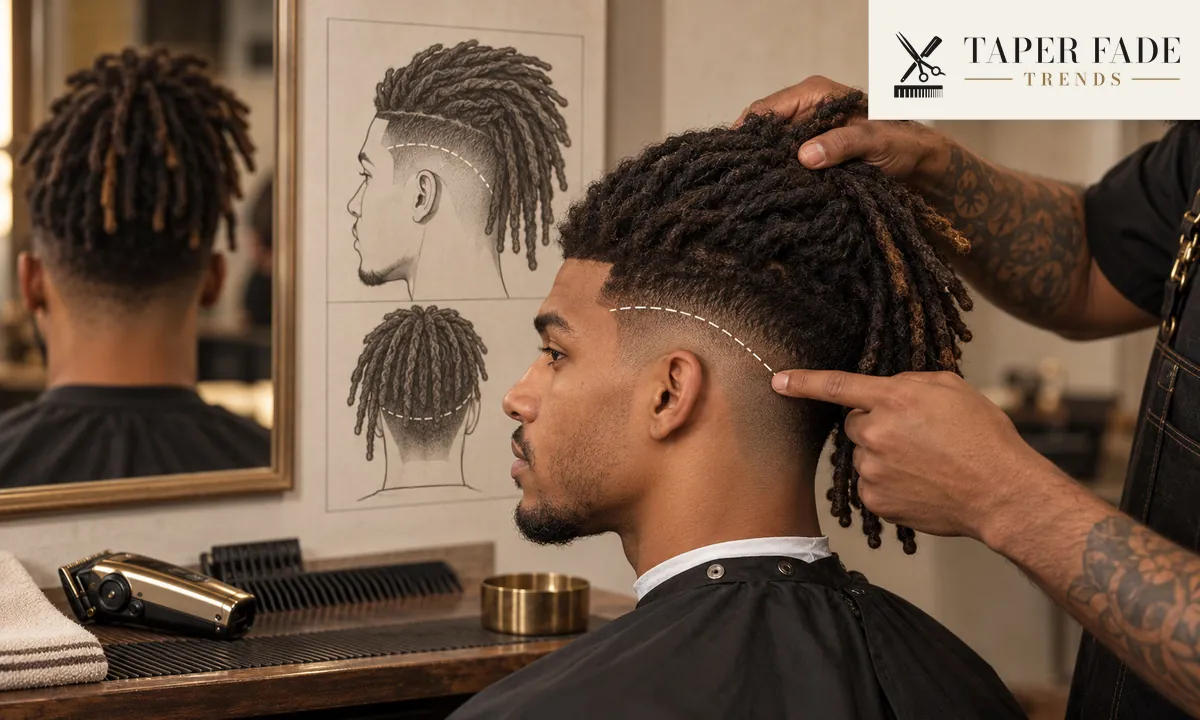
Mid taper with dreads: where the clippers stop and your locs begin
A mid taper with dreads shortens only the loose hair at the temples and nape. See where the clippers stop, what to tell your barber and when to go lower.
Mid taper fade waves: preserve 360-wave connections
Mid taper fade waves: where the blend cuts 360-wave connections, low vs mid height, what to tell your barber, and how to keep the taper and the waves.
Mid taper fade curly hair: choose dry length, side width and finish
Mid taper fade curly hair guide: what it keeps vs a full mid fade, how to judge dry length and side width, and the four specs to give your barber.
More in mid taper fades
Mid taper fades: all 15- Mid taper fade: what it is and what to ask your barber12 min
- Mid taper blowout: keep volume without flattening the sides11 min
- Mid taper fade curly hair: choose dry length, side width and finish9 min
- Mid taper fade straight hair: fine, flat and outward-growing sides11 min
- Mid taper fade Black male guide: what stays and what to ask for13 min
- Mid taper fade wavy hair: work with the natural bend12 min
- Mid taper fade buzz cut: top length, coverage and finish8 min
- Mid taper fade with beard: how the sideburn blend works13 min
- Mid taper fade middle part: set the part, then the taper12 min
- Mid taper with dreads: where the clippers stop and your locs begin8 min
- Mid taper fade Afro: choose a rounded or squared topYou are here
- Mid taper fade waves: preserve 360-wave connections11 min
- Low taper vs mid taper: what changes when only the height moves10 min
- Mid taper vs mid fade: how much side hair comes off10 min
- How to choose taper height using side weight12 min